
Gandhi: The Secret of Silence
Experience has taught me that silence is a part of the spiritual discipline of a votary of truth. Proneness to exaggerate, to suppress or modify the truth, wittingly or unwittingly, is a natural weakness of man, and silence is necessary in order to surmount it.
“It has often occurred to me that a seeker after truth has to be silent. I know the wonderful efficacy of silence. I visited a Trappist monastery in South Africa. A beautiful place it was. Most of the inmates of that place were under a vow of silence. I inquired of the Father the motive of it and he said the motive is apparent: 'We are frail human beings. We do not know very often what we say. If we want to listen to the still small voice that is always speaking within us, it will not be heard if we continually speak.' I understood that precious lesson. I know the secret of silence.”
“Experience has taught me that silence is a part of the spiritual discipline of a votary of truth. Proneness to exaggerate, to suppress or modify the truth, wittingly or unwittingly, is a natural weakness of man, and silence is necessary in order to surmount it. A man of few words will rarely be thoughtless in his speech; he will measure every word.”
“When one comes to think of it one cannot help feeling that nearly half the misery of the world would disappear if we, fretting mortals, knew the virtue of silence. Before modern civilization came upon us, at least six to eight hours of silence out of twenty-four were vouchsafed to us. Modern civilization has taught us to convert night into day and golden silence into brazen din and noise. What a great thing it would be if we in our busy lives could retire into ourselves each day for at least a couple of hours and prepare our minds to listen in to the Voice of the Great Silence. The Divine Radio is always singing if we could only make ourselves ready to listen to it, but it is impossible to listen without silence. St. Theresa has used a charming image to sum up the sweet result of silence: ‘You will at once feel your senses gather themselves together; they seem like bees which return to the hive and there shut themselves up to work without effort or care on your part. God thus rewards the soul; and gives to it such a domination over the senses that a sign is enough when it desires to recollect itself, for them to obey and so gather themselves together. At the first call of the will they come back more and more quickly. At last, after many exercises of this kind, God disposes them to a state of absolute repose and of perfect contemplation.’”
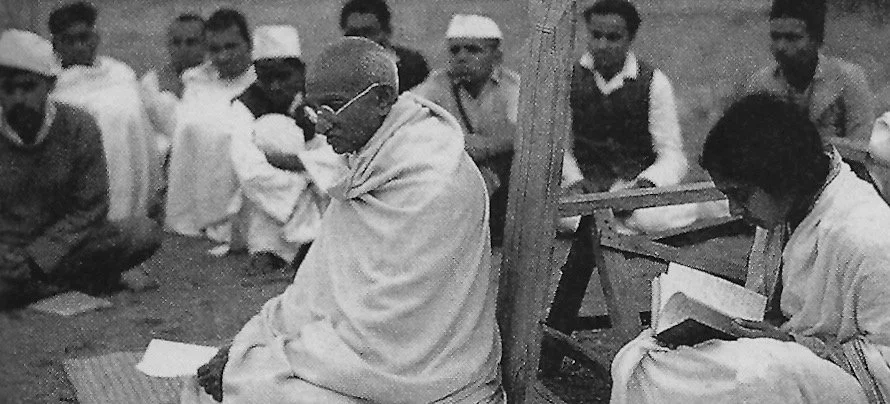
Gandhi and the Sermon on the Mount
Journalist and author, Vincent Sheean wrote the following description of Gandhi, saying that Gandhiji “was so penetrated with the truth and beauty he felt in the verses of the Sermon that through years of effort he actually became something like a summation of the Beatitudes, the meek, the merciful, the pure in heart, the peacemaker. His reverence for Jesus and the Sermon on the Mount illumined his long struggle and gave him strength for it.”
Mahatma Gandhi regarded the Sermon on the Mount and its assertion of the law of love as eternal wisdom. We know the Sermon on the Mount as a collection of sayings and moral teachings of Jesus, found in the Gospel of Matthew, in the New Testament of the Bible. It takes place relatively early in the Ministry of Jesus after he had been baptized by John the Baptist, and after he had finished a period of fasting and meditation in the desert. Jesus had been "all about Galilee" preaching and "great crowds followed him.” Seeing the multitudes, Jesus goes up unto the mountain and after he sat down his disciples came to him, and he began to teach them.
Charles Freer Andrews a close friend of Mahatma Gandhi, wrote the following: “Very early in my life, while engaged in the study of the Sermon on the Mount, the discovery came to me which every learner makes sooner or later, that Christ’s words in these chapters are not a series of beautiful proverbs, loosely strung together, but an amazingly perfect description of character at its highest point. Christ sets before us, in each moral issue that he raises, the standard. He speaks to us, not from theory but from practice. His example is all the while before us; and when He tells us that nothing less than perfection is to be our goal, we remember with awe that He has not only set that standard, but also attained it… ‘Be ye perfect,’ he bids us with good cheer, ‘even as your father which is in heaven is perfect.’ And ‘Seek ye first the Kingdom of God and his righteousness, and all these things shall be added unto you.’ Christ was born in a village and spent His youth and early manhood as an artisan. He lived His own life in close touch with the fields and the hills. He was constantly engaged in friendly intercourse with the country folk, who loved homely stories and rhyming proverbs. To these rather than the learned He spoke first His universal message, and in this plain and direct way.”
What are the Beatitudes but the teaching and realization of humility, compassion and love:
Blessed are the poor in spirit, for theirs is the Kingdom of Heaven.
Blessed are those who mourn, for they shall be comforted.
Blessed are the meek, for they shall inherit the Earth.
Blessed are those who hunger and thirst for righteousness, for they shall be filled.
Blessed are the merciful, for they shall be shown mercy.
Blessed are the pure in heart, for they shall see God.
Blessed are the peacemakers, for they shall be called children of God.
Blessed are those who are persecuted because of righteousness, for theirs is the Kingdom of Heaven.
Journalist and author, Vincent Sheean wrote the following description of Gandhi, saying that Gandhiji “was so penetrated with the truth and beauty he felt in the verses of the Sermon that through years of effort he actually became something like a summation of the Beatitudes, the meek, the merciful, the pure in heart, the peacemaker. His reverence for Jesus and the Sermon on the Mount illumined his long struggle and gave him strength for it.”
In the Sermon on the Mount Jesus not only brings forth the beatitudes but He also presents us with the Lord’s prayer. Prayer had a very important place in Gandhi’s ashrams. In fact, each day commenced with congregational worship from 4:15 a.m. to 4:45 a.m. and the day closed with evening prayer from 7 to 7:30 p.m. He experimented with the timing of the morning prayer but finally settled upon the earlier time (with a wake up call at 4 a.m. to give everyone in the ashram time to wash and arrive for prayer which was held under the canopy of the sky. He said in all countries of the world, devotees of God and tillers of soil rise early!
Gandhiji felt that without prayer there is no inward peace. He said that “If insistence on truth constitutes the root of the ashram, then prayer is the principal feeder of that root.” This brings us back to his appreciation for the Sermon on the Mount and the Lord’s Prayer when Gandhiji said: “There is really only one prayer that we may offer. ‘Thy will be done.’ After all, what do we pray for? Is it not simply that God should be ever victorious in our own hearts?”
We often hear the beautiful words in Arabic… In-Shallah. God-willing. Think of the significance of these words. In our daily life, how often do we think, speak and work with the thought of God and higher Truths. It is a source of resignation to the will of God, “In-Shallah”… But it is also our challenge to learn what is the will of God in light of Eternal Truth of all. Thinking of the will of God… is not merely leaving things to chance. There is an important element of responsibility placed on us to realize, to understand and to know the very Truth of our life. After all, it is Truth that shall set us free. Even Jesus was careful to discriminate between the real and the unreal, Truth and the untruth, to sort out what was God’s will and what was not. This requires us to lift our consciousness to a higher state, to realize the perfection of soul.
Gandhi said, “The Sermon on the Mount went straight to my heart. I compared it with the Gita. The verses, 'But I say unto you, that ye resist not evil: but whosoever shall smite thee on thy right cheek, turn to him the other also. And if any man take away thy coat let him have thy cloak too,' delighted me beyond measure and put me in the mind of Shamal Bhatt's 'For a bowl of water, give a goodly meal’.” Shamal Bhatt was a medieval Gujarati narrative poet and Gandhi related his poem to the message in the Sermon on the Mount. Bhatt's expression is one of returning tenfold goodness to whatever is done to us.
Gandhiji said: "A Gujarati didactic stanza...gripped my mind and heart. Its precept: return good for evil—became my guiding principle. It became such a passion with me that I began numerous experiments in it.” And Gandhiji quoted the wonderful lines of this stanza in his autobiography:
For a bowl of water give a goodly meal;
For a kindly greeting bow thou down with zeal;
For a simple penny pay thou back with gold;
If thy life be rescued, life do not withhold.
Thus the words and actions of the wise regard;
Every little service tenfold thy reward.
But the truly noble know all men as one,
And return with gladness good for evil done.
Closely resembling the teachings of Jesus in the Sermon on the Mount, this poem resurfaced in the mind of Gandhiji from his youth and he renewed his dedication to its message by carrying it out in the activities of his life. He said: “My young mind tried to unify the teaching of the Gita, The Light of Asia and the Sermon on the Mount. That renunciation was the highest form of religion appealed to me greatly. This reading whetted my appetite for studying the lives of other religious teachers.”
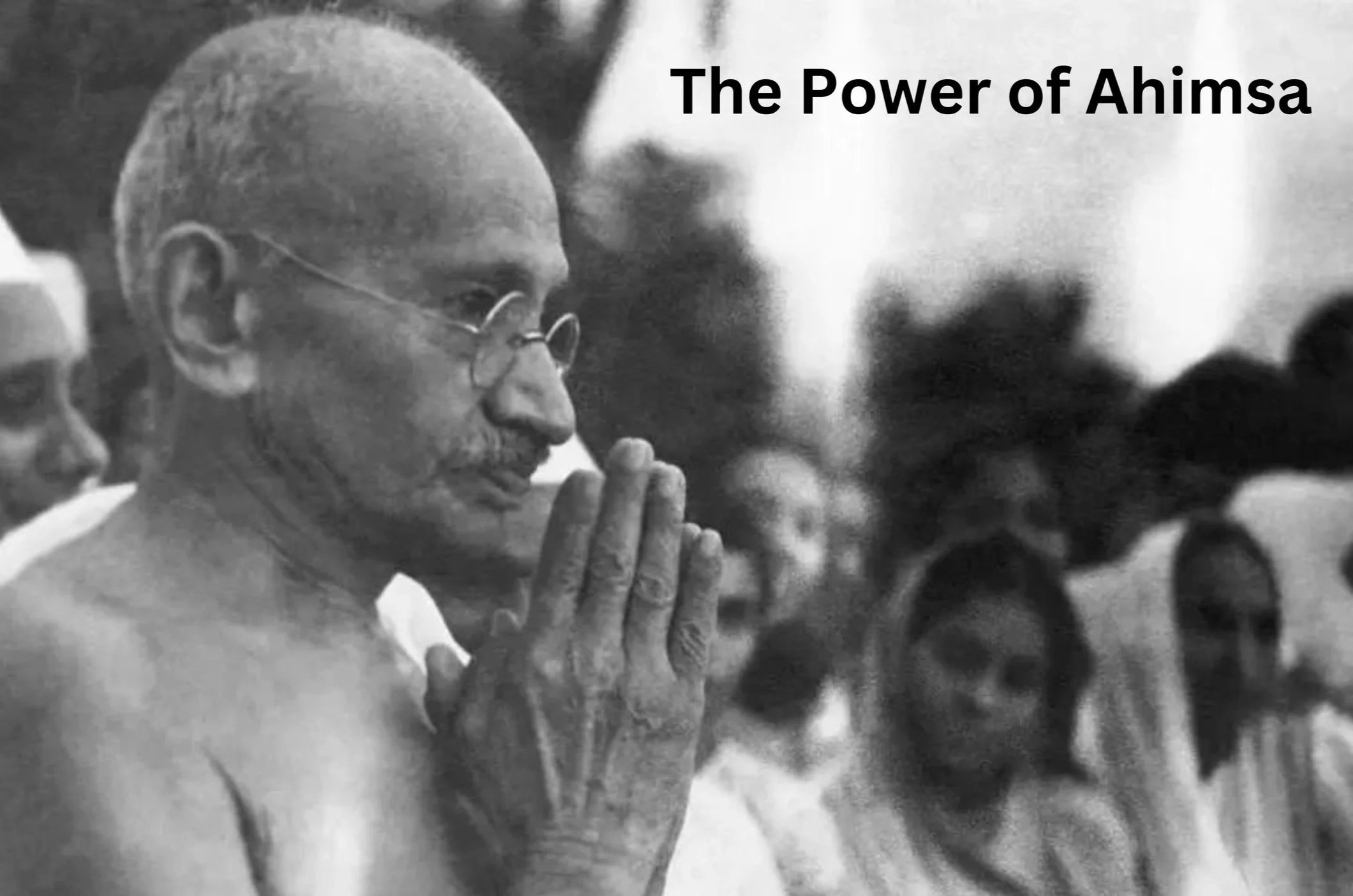
The Power of Ahimsa
Ahimsa, in its subtle power, depends on a cosmic principle — that of the oneness of life. Ahimsa, in its positive form, means the largest love, the greatest charity. When ahimsa becomes all-embracing it transforms everything it touches. There is no limit to its power. Gandhiji understood that power. He made a conscious and constant effort to apply the power of ahimsa in his daily life. Ahimsa is living so as to realize the oneness of life.
For Mahatma Gandhi, the pursuit of Truth, dedication to the law of love, practice of selfless service, and aspiration for self-liberation, pave the way to unify the human experience. He wanted to awaken minds and unite hearts to a higher ideal—an ideal that unites Truth, love and service into living practice.
All the religions of the world, while they may differ in other respects, unitedly proclaim that nothing lives in this world but Truth.
Consider Gandhiji’s ashram prayer meetings. Through these prayer meetings, an ideal of devotion was practiced on a daily basis. The prayers, hymns, slokas and bhajans offered inspiration to nourish the mind, heart and soul each and every day. The time given to the thought of that Reality which pervades the whole universe, built a foundation of respect and reverence within each and every participant, and perhaps in hearts beyond.
If, therefore, we achieve that purity of the heart, when it is emptied of all but love, if we keep all the chords in proper tune, they ‘trembling pass in music out of sight.’ … Our prayer is a heart-search.
Love is the essence of life. It generates in us a continuous source of power which is indestructible, ever-productive and transforming. In our love, we awaken ourselves to the higher principles of life. Our ideal is to manifest this love in its perfection. The idea of the oneness of life—that you and I are one, that we are one with the stars and the planets. That if I harm you or another, I harm myself.
To slight a human being is to slight those divine powers and thus to harm not only that being but with him the whole world.
One cannot separate one’s love for God or Truth from an all-encompassing love of creation. They are inseparable. This is what Gandhiji tried to express. This is the law of love, of life. Love is more than feeling. It is all-consuming thought and fullness of action. It is absolute oneness.
I believe in the absolute oneness of God and therefore also of humanity. What though we have many bodies, we have but one soul. The rays of the sun are many through refraction. But they have the same source. I cannot, therefore, detach myself from the wickedest soul nor may I be denied the identity with the most virtuous.
Ahimsa, in its subtle power, depends on a cosmic principle — that of the oneness of life.
Ahimsa, in its positive form, means the largest love, the greatest charity. When ahimsa becomes all-embracing it transforms everything it touches. There is no limit to its power.
Gandhiji understood that power. He made a conscious and constant effort to apply the power of ahimsa in his daily life. Ahimsa is living so as to realize the oneness of life.
By Srimati Karuna

Gandhi's Inspiration from the Prophet Muhammad
During his prayer meetings, Gandhiji always included verses from the Qur'an Sharif. He would not hold prayer meetings without recitations from the Qur’an. He had a profound admiration for the refined character of the Prophet Muhammad, as a man of faith and action.
Begin your day with prayer, and make it so soulful that it may remain with you until the evening. Close the day with prayer, so that you may have a peaceful night free from dreams and nightmares. —Mahatma Gandhi
Evening prayer was a great center of attraction in Gandhiji’s ashram in India. The morning prayers, he explained, were too early to attract additional friends, but a gathering of Hindus, Muslims, Parsis, Sikhs, and a sprinkling of Europeans attended the evening prayers. They often requested a fifteen minute talk after prayer and before dinner. A question was asked each evening, and Gandhiji replied to it the next evening. One of the Indian participants, a Muslim youth, asked Gandhiji to give his personal testimony on prayer, not a theoretical discourse but a narration of what he had felt and experienced as a result of prayer. Gandhiji liked this question immensely, and poured out his personal testimony from a full heart. "Prayer," he said, "has been the saving of my life…prayer has not been part of my life in the sense that truth has been. Rather, it came out of sheer necessity…I could not possibly be happy without it. And the more my faith in God increased, the more irresistible became the yearning for prayer. Life seemed to be dull and vacant without it.”
The missionary, Charles Freer Andrews, a close friend of Gandhiji, wrote that there was no one at Sabarmati Ashram to whom Gandhiji went more surely for quiet counsel and help in time of prayer than to the Imam, who accompanied him from South Africa. And during his prayer meetings, Gandhiji always included verses from the Qur'an Sharif. In fact, he would not hold prayer meetings without recitations from the Qur’an.
Gandhiji had a profound admiration for the refined character of the Prophet Muhammad as a man of faith and action. He studied the history and rise of Islam and was impressed by the strong faith of the very first followers of the Prophet and the simplicity with which they lived. Their devotion to the poor and their intense belief thoroughly inspired him.
Gandhiji said: "I wanted to know the best of the life of one who holds today undisputed sway over the hearts of millions...I became more than ever convinced it was the rigid simplicity, the utter self-effacement of the Prophet, the scrupulous regard for pledges, his intense devotion to his friends and followers, his intrepidity, his selflessness, his absolute trust in God and his own mission. These surmounted every obstacle. Muhammad was a great Prophet. He was brave and feared no one but God. He was never found to say one thing and do another. He acted as he felt. The Prophet was a faqir. He could have commanded wealth if he had so desired. I shed tears when I read of the privations, he, his family and companions suffered voluntarily. How can a truth-seeker like me help but respect one whose mind was constantly fixed on God, who ever walked in God's fear and who had boundless compassion for humanity.” Gandhiji also explained “I have read Sir Abdullah Suhrawardy's collection of the sayings of the Prophet with much interest. They are among the treasures not only of Muslims, but of all humanity.”
In addition to his interest in the life example of Prophet Muhammad, Gandhiji also studied the Qur'an regularly. He spent a considerable time studying the Qur'an during his intermittent sojourns while imprisoned by the British. He thought there was no difference between the Qur'an and the Upanishads on the issue of the necessity for total self-surrender to God.
In Gandhi's mind, dharma meant firmness in upholding truth. This was similar to his understanding of the Qur'anic imperative in Surah Fatiha to remain on the straight path, and not be led astray. He continuously included Surah Fatiha from the Holy Qur'an as part of his daily prayer service.
In the name of God, the Most Compassionate, Most Merciful.
All praise is for God - Lord of all worlds –
the Most Compassionate, Most Merciful,
You alone we worship and You alone we ask for help…
Guide us along the straight path –
the Path of those You have blessed…
Peace on Earth, Goodwill to All
"Peace requires one first to be brave enough to love another, and to trust another. That requires faith in oneself.”

In the words of Mahatma Gandhi:
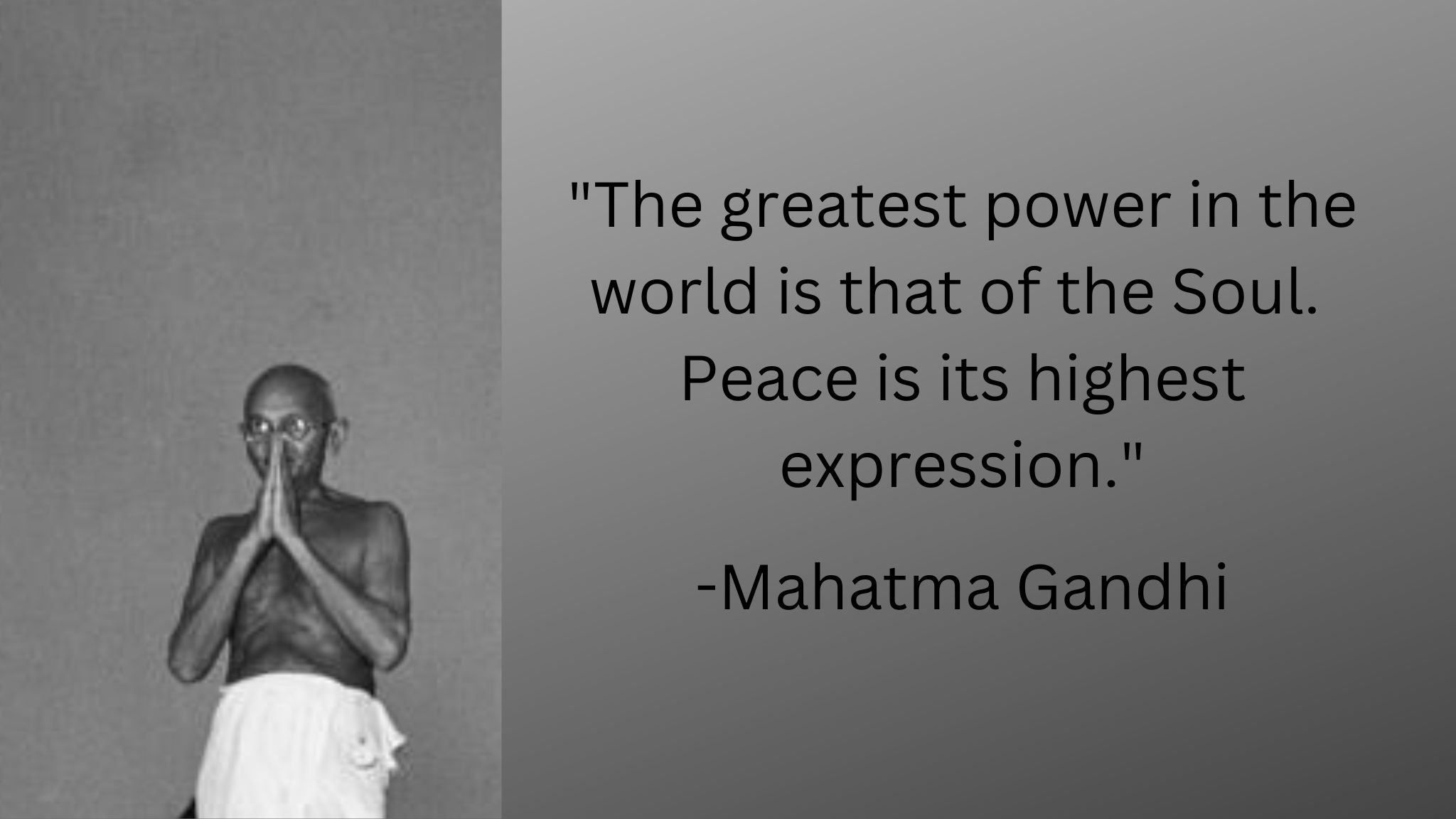
"The greatest power in the world is that of the Soul. Peace is its highest expression. To attain peace, first we must acquire greater mastery over ourselves. We secure then an atmosphere of perfect peace, calm and goodwill that protects and fortifies ourselves and blesses others around us.”
(Discourses on the Gita)
"Peace requires one first to be brave enough to love another, and to trust another. That requires faith in oneself. One has not the strength to be peaceful if he is fighting the internal duel of selfish desires. Good can never result from evil desires or actions; hence, the Gita's central teaching of the oneness of the means and ends. The practice of peace is thus a test of the sincerity of our hearts; it requires solid and silent self-sacrifice, honesty and the capacity for diligent work, but must be realized first in its source within.”
(Discourses on the Gita)
“True humility means most strenuous and constant endeavor, entirely directed towards the service of humanity. God is continuously in action without resting for a single moment. If we should serve him or become one with him, our activity must be as unwearied as his. There may be momentary rest in store for the drop which is separated from the ocean, but not for the drop in the ocean, which knows no rest. The same is the case with ourselves. As soon as we become one with the ocean in the shape of God, there is no more rest for us, nor indeed do we need rest any longer. Our very sleep is action. For we sleep with the thought of God in our hearts. This restlessness constitutes true rest. This never-ceasing agitation holds the key to peace ineffable. This supreme state of total surrender is difficult to describe, but not beyond the bounds of human experience. It has been attained by many dedicated souls, and may be attained by ourselves as well.”
(The Way to God)
“Without good thoughts there is no peace, and without peace there is no happiness. Where a stable-minded man sees things clear as daylight, the unstable man distracted by the turmoil of the world is as good as blind. On the other hand, what is pure in the eyes of the worldly wise looks unclean and repels the stable-minded man. Rivers continuously flow into the sea, but the sea remains unmoved; in the same way all sense objects come to the yogi, but he always remains calm like the sea. One who abandons all desires, is free from pride and selfishness and behaves as one apart, finds peace. This is the condition of a perfect devotee of God, and he who is established therein, even at the final hour, finds moksha… self-liberation.”
(Discourses on the Gita)
“He who would practice yoga, i.e., evenness of temper (samatvam), cannot but perform action. The man who has achieved such evenness of temper will be serene, because his mere thoughts are charged with the strength of action. A yogi is one who is not attached to the objects of sense or to action and whose mind has ceased to roam restlessly. He is a yogi who is a man of knowledge as well as experience, who is unwavering and master of his senses and to whom gold, stone and earth seem all alike. He regards with an equal eye friend and foe, sinner and saint. The yogi is stable-minded at all times, and is without effort free from all desires. He is like an unflickering lamp burning in a windless place. He is not tossed to and fro by dramatic events on the world-stage or by his own brain waves. Such mental poise can be achieved by slow but steady effort. The mind is fickle and restless, but it should be gradually stabilized, for one can have peace of mind only when he is firm of understanding. In order thus to stabilize the mind, he should constantly fix it on the Soul.“
(Discourses on the Gita)