
Truth Alone Conquers
Truth alone conquers, falsehood never does. The path to God is built on the foundation of truth. By following that path the sages of renunciation reach the transcendental state of the absolute Truth.
The effulgent, pure and perfect Self is ever present within this body. In purity of heart, the cognitive consciousness, is gained the direct vision of the Self, the absolute God. Love of truth, discrimination, right knowledge, serenity, self-discipline and intuition are the prerequisites to the attainment of realization of the supreme Self.
Truth alone conquers, falsehood never does. The path to God is built on the foundation of truth. By following that path the sages of renunciation reach the transcendental state of the absolute Truth.
Not by the sight of the eyes, nor by the words of speech, nor by the power of any other sense faculty can the universality of the supreme Self be perceived. When the heart is made pure by the Yoga of meditation the initiate realizes the formless Brahman in the immensity of the
effulgent pure-consciousness.
Mundaka Upanishad
Light on Kriya Yoga
Translation by Swami Premananda

Dear to Me
One who is completely free from ill will and is friendly and compassionate towards all, who has overcome attachment and egotism, who is self-composed in pain and pleasure, and forgiving…is thus devoted to me is dear to me…Those who follow this immortal path of devotion exactly as herein propounded by me, with faith and regarding me as the supreme goal; such devotees indeed are exceedingly dear to me.
One who is completely free from ill will and is friendly and compassionate towards all, who has overcome attachment and egotism, who is self-composed in pain and pleasure, and forgiving, (13) Who is ever content, meditative, serene, resolute in spiritual effort, and whose mind and intellect are dedicated to me; he who is thus devoted to me is dear to me. (14) He by whom the world is not afflicted and who is not afflicted by the world, who is not carried away by emotion, and who is free from envy, fear and anxiety; he is dear to me. (15) He who is not ruled by sensory desires, who is pure, wise and competent, unattached, undisturbed, free from egoistic motive; he who is thus devoted to me is dear to me. (16) He who is neither overbearing in the joy of achievement nor negatively depressed in failure, who is neither abased by misfortune nor greedy of gain, who has renounced the concept of relative good and evil and is full of devotion; he is dear to me. (17) He who is equal to friend and foe, serene in fame and insult, heat and cold, pleasure and pain, and free from attachment, (18) Self-composed in praise and blame, wise in speech, content amidst all circumstances, unattached to this abode of life, and calm of mind; such a devout heart is dear to me. (19) But those who follow this immortal path of devotion exactly as herein propounded by me, with faith and regarding me as the supreme goal; such devotees indeed are exceedingly dear to me. (20)
Srimad-Bhagavad-Gita: The Revelation of the Supreme Self
Chapter 12:13-20
Translation by Swami Premananda

When a Gift is Offered
When a gift is offered with the thought that it is righteous to perform acts of charity, without expecting anything in return, at the right time and place and to a worthy person, that gift is regarded as the source of self-liberation and peace.
Whosoever with devotion offers me a leaf, a flower, a fruit, or water, I accept it from him as the devout gift of a pure heart. O son of Kunti, whatever thou doest, whatever thou eatest, whatever thou offerest as oblation, whatever thou givest as gift, and whatever soul’s power thou puttest forth, do it as an offering unto me.
When a gift is offered with the thought that it is righteous to perform acts of charity, without expecting anything in return, at the right time and place and to a worthy person, that gift is regarded as the source of self-liberation and peace.
That gift which is made with the hope of receiving in return, or desiring personal reward, or with reluctance, is known as the source of pride and sorrow. The gift that is given at the wrong place or time, to unworthy persons, or ungraciously and with contempt, is the cause of self-degradation and misery.
AUM-TAT-SAT, this has been declared to be the triple name of Brahman, by which in the beginning were created and sanctified the Brahmanas, the Vedas and the sacrifice. Therefore, with the utterance of AUM, the worshippers of Brahman always commence their acts of sacrifice, charity and austerity, as enjoined by the laws of the holy scriptures. The seekers of liberation, uttering TAT, without desiring any phenomenal reward, perform various acts of sacrifice, austerity and charity. The word SAT is used to signify reality and goodness. O son of Pritha, the word SAT is also used to indicate and extol an auspicious act.
Srimad-Bhagavad-Gita: The Revelation of the Supreme Self
9:26-27, 17: 20-22, 23-26
Translation by Swami Premananda

Initiation into Subjective Meditation is Like a Bridge
“Initiation into subjective meditation is like a bridge to those who are earnest and determined to transcend all inner finiteness. Realization of the imperishable Brahman, the absolute Self, is the goal of self-liberation.”
“The perfection of the Self is revealed in the divinity of the Self. He whose mind remains constantly identified with the senses, who is restless of body, who is lacking in subjective serenity, and whose consciousness is engrossed with relative concepts and finite thought impressions, even with much learning, cannot attain the realization of the Self.
“Beyond the reach of the phenomenal power, where mind is sanctified in the wisdom of Pure-Consciousness; beyond the domain of ego, where the individualized self-consciousness is illumined by the effulgence of the Absolute; beyond the grasp of death, where immortality abides in Bliss; there is the transcendental Self. Who can ever express in words the nature and the reality of the Self?
“Hidden within this body there are two states of consciousness; one is the state of supreme Brahman, and the other is that of self-acquired concepts. Men of Self-realization, who have attained their identity with the absolute Self at Sahasraram, call these two the states of ‘light and shade’. And those whose practice of triune subjective meditation, Sahaja Sadhana, comprising Maha-Mudra, Kriya and Jyoti-Mudra, is polarized within the Five-Pranic Effulgence between Muladhar and Prajna-Ajna, are also cognizant of this truth.
“Initiation into subjective meditation is like a bridge to those who are earnest and determined to transcend all inner finiteness. Realization of the imperishable Brahman, the absolute Self, is the goal of self-liberation.”
Katha Upanishad
Translation by Swami Premananda
From Eight Upanishads

Universal Love
One who is completely free from ill will and is friendly and compassionate towards all, who has overcome attachment and egotism, who is self-composed in pain and pleasure, and forgiving, who is ever content, meditative, serene, resolute in spiritual effort, and whose mind and intellect are dedicated to me; he who is thus devoted to me is dear to me.
Selection from the 12th Chapter of the Bhagavad Gita
Translated by Swami Premananda
One who is completely free from ill will and is friendly and compassionate towards all, who has overcome attachment and egotism, who is self-composed in pain and pleasure, and forgiving, who is ever content, meditative, serene, resolute in spiritual effort, and whose mind and intellect are dedicated to me; he who is thus devoted to me is dear to me.
He by whom the world is not afflicted and who is not afflicted by the world, who is not carried away by emotion, and who is free from envy, fear and anxiety; he is dear to me.
He who is not ruled by sensory desires, who is pure, wise and competent, unattached, undisturbed, free from egoistic motive; he who is thus devoted to me is dear to me.
He who is neither overbearing in the joy of achievement nor negatively depressed in failure, who is neither abased by misfortune nor greedy of gain, who has renounced the concept of relative good and evil and is full of devotion; he is dear to me.
He who is equal to friend and foe, serene in fame and insult, heat and cold, pleasure and pain, and free from attachment, self-composed in praise and blame, wise in speech, content amidst all circumstances, unattached to this abode of life, and calm of mind; such a devout heart is dear to me.
But those who follow this immortal path of devotion exactly as herein propounded by me, with faith and regarding me as the supreme goal; such devotees indeed are exceedingly dear to me.
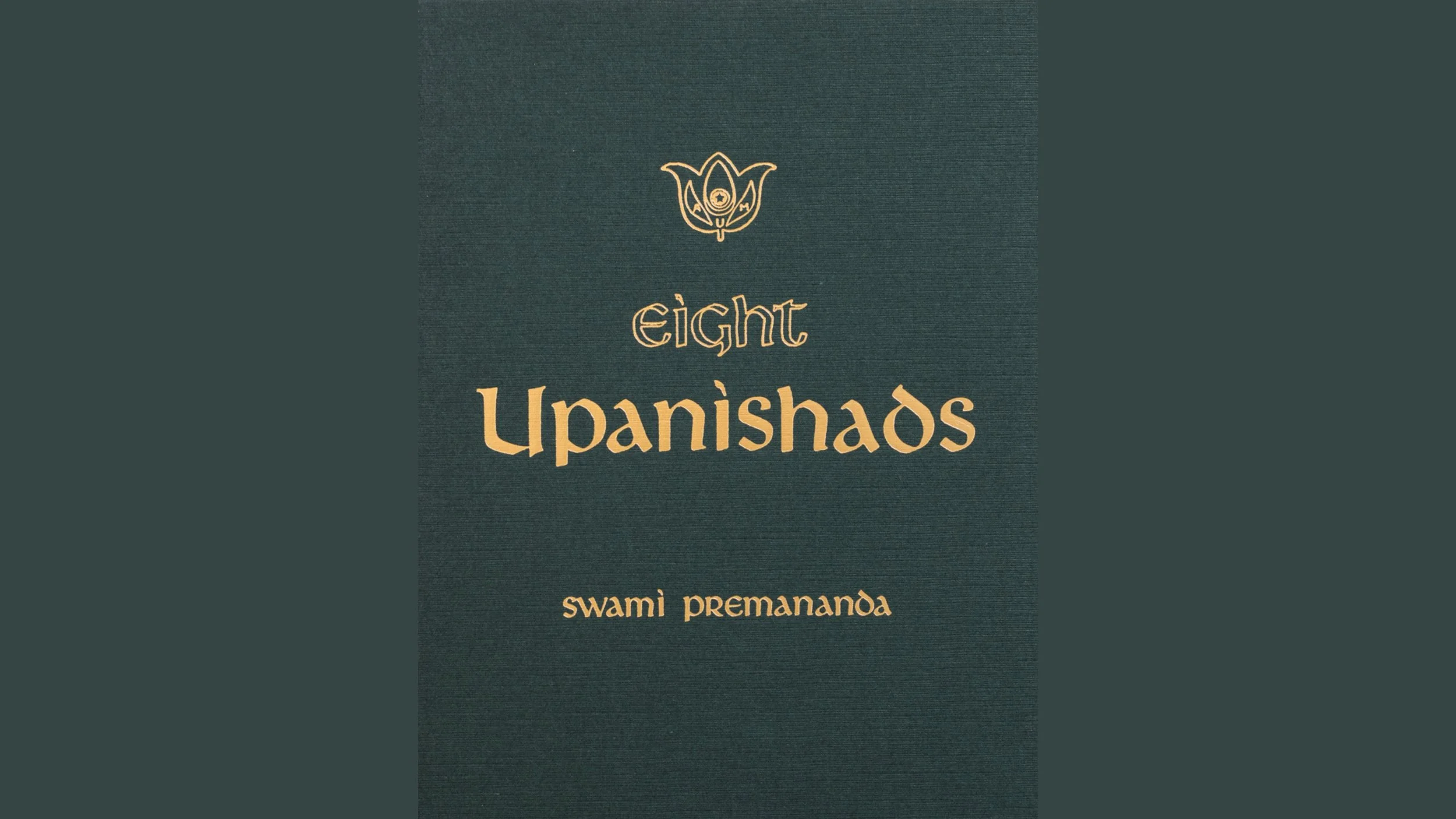
Ideal of the Spiritual Life
The spiritual life has only one ideal, the realization of the Supreme Spirit, Brahman, God. The theoretical and intellectual knowledge of God is not enough; in fact it is of secondary importance in our spiritual endeavor. What is of supreme importance in our spiritual aspiration is that each of us must attain the realization of God within his own effulgent cosmic pure consciousness, for thus alone we reach Kaivalyam, we become the absolute One.
The Upanishads are quite clear and emphatic regarding the truth of spiritual life. The spiritual life has only one ideal, the realization of the Supreme Spirit, Brahman, God. The theoretical and intellectual knowledge of God is not enough; in fact it is of secondary importance in our spiritual endeavor. What is of supreme importance in our spiritual aspiration is that each of us must attain the realization of God within his own effulgent cosmic pure consciousness, for thus alone we reach Kaivalyam, we become the absolute One.
Foreword to Kaivalya Upanishad by Swami Premananda
Then the true devotee of self-realization, in whom all personal and objective desires have ceased to exist, approached the great Master with veneration and said: Venerable Sir, teach me the knowledge of Brahman, the one and the absolute God and also the way to attain to the realization of that transcendental Spirit whom the wise constantly seek after, who is hidden in all and by the light of whom one, in due time, gains complete freedom from all subjective finiteness and limitations and becomes one with the supreme Self.
The venerable Master said to him: Seek to realize Brahman by unconditional and abiding faith, supreme devotion, profound meditation and by the practice of the spiritual yoga, the subjective communion of mind with self and self with Self-Consciousness.
The self-disciplined and enlightened devotees who have rightly recognized that scriptural learning is not sufficient to receive spiritual illumination and who have purified their minds and hearts, thoughts and emotions by the practice of subjective renunciation of sensory desires and ego, they, without being distracted by the limitations of the concept of time, meditating on the attributes of God and thereby becoming one with the eternal Brahman, attain to self-liberation.
By perceiving the self in all beings and all beings in the self the devotee attains to the realization of Brahman.
Kaivalya Upanishad (translation by Swami Premananda)
Included in Eight Upanishads by Swami Premananda

Children of Immortality
The source of man’s divine qualities is the infinite perfection of God. But man cuts himself off, though not completely, from this cosmic spiritual reservoir by his own thought of self-separateness and consequently of self-limitation. “Man thinking himself separated from Brahman, revolves on the wheel of birth and death.”
Within this ever changing body resides the eternal Brahman, God, Consciousness-Existence-Bliss Absolute. Realization of the indwelling nearness of, in truth, the inseparable oneness with Brahman awakens man to the conscious cognition of the illimitable power of his wisdom, will and love. He gains the illumination that he is above all conditions of duality, and secures that transcendental self-assurance of moral and spiritual strength which inspires and enables him to live by righteousness and truth amidst all the adversities and perplexities of life.
The source of man’s divine qualities is the infinite perfection of God. But man cuts himself off, though not completely, from this cosmic spiritual reservoir by his own thought of self-separateness and consequently of self-limitation.
“Man thinking himself separated from Brahman, revolves on the wheel of birth and death.”
Man, in his soul, is omnipotent. By divine benediction he possesses the power to liberate himself from the thralldom of bondage by realizing his identity with God.
“In the realization of Brahman is the severance of all bondage of self-limitation.”
The Rishi Svetasvatara, a sage of self-realization and the author of this (Svetasvatara) Upanishad, reveals the wisdom and the way to divine identity and self-liberation:
“Ye sons of immortality, listen!”
—Swami Premananda, Introduction to his translation of the Svetasvatara Upanishad in Eight Upanishads
Meditate on the Light of AUM
“By meditating on AUM, the Word, within the effulgence of each of the seven lotuses, the mystic centers of spiritual revelation, is gained the inner illumination of the self which consumes the causes of all finiteness and self-limitation.”— Kaivalya Upanishad “The Self is symbolized by the word AUM. AUM is composed of three mystic sound vibrations. These also signify the first three states of consciousness in the self." — Mandukya Upanishad


Finding Freedom from the Gunas
All aspects of creation are the various modulations of Sattva, Rajas and Tamas—the law of harmony, the self-manifesting power, and the evolving potency—but in reality these are the objective manifestations of myself. I am not limited by them, though they exist in me... Rise above the pairs of opposites, be thou firmly established on truth, be not attached to material gain and possession, be established on the Self, and thus thou shalt find freedom in and from the relative world of the Gunas.

Power of Cosmic Prana
Like the spokes on the hub of a chariot wheel, all beings are established on Prana. Life, Prana, is born of Atman, the absolute Self. Prana sustains and determines the functions of various currents of life-force within the body.
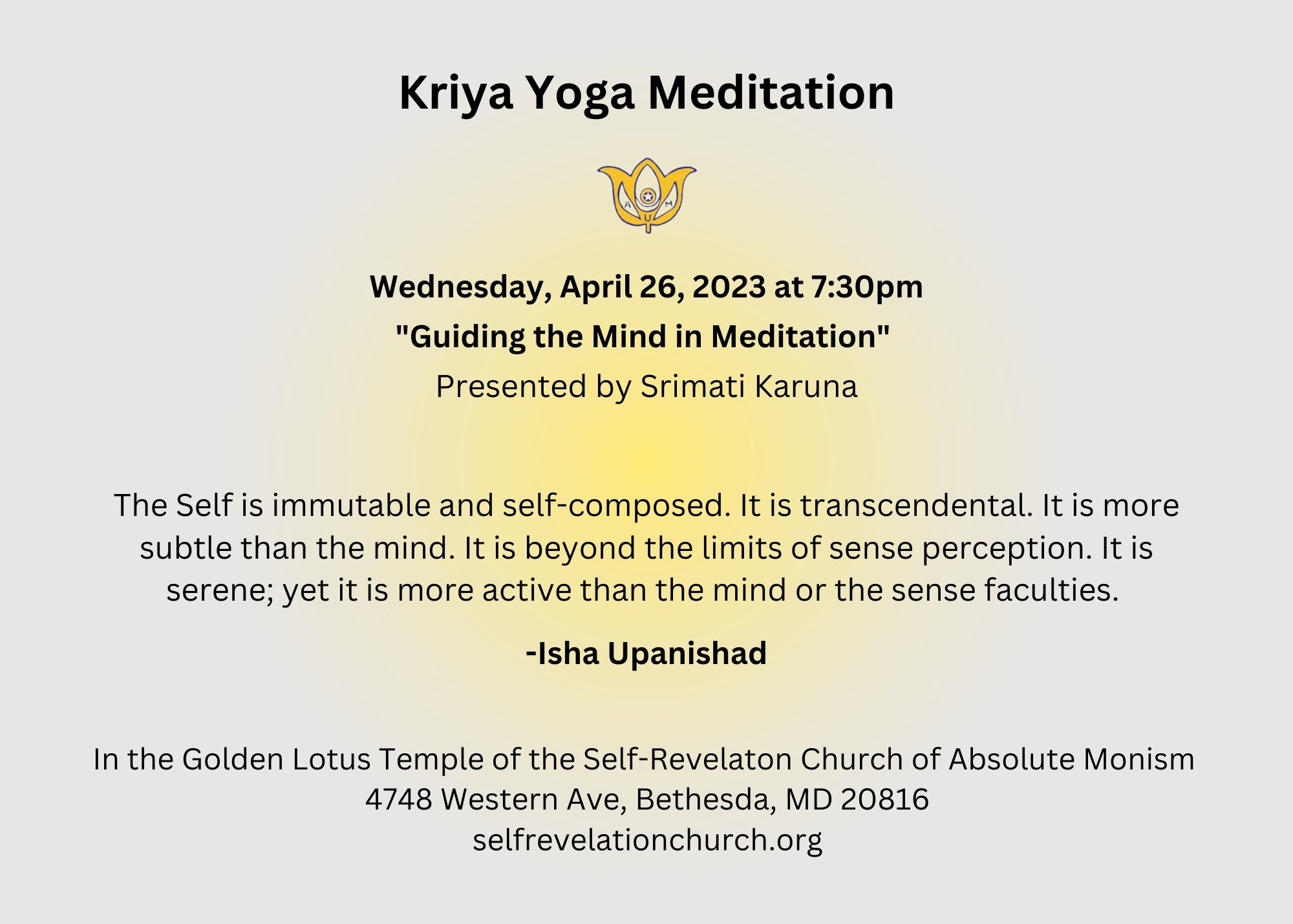
Guiding the Mind in Meditation
The Self is immutable and self-composed. It is transcendental. It is more subtle than the mind. It is beyond the limits of sense perception. It is serene; yet it is more active than the mind or the sense faculties.


Heart-Centered
The state of pure-consciousness, transcends all other states of spiritual enlightenment; it is enshrined within the effulgence of the heart lotus, Anahata. Those who aspire with patience and perseverance to reach that blessed state become completely immersed in it. Meditate on the lotus of the heart with calm serenity and subjective purity.

Self-Subjectivity
The self is endowed with the power to guide itself to the realization of absolute perfection. And the self, having fulfilled its divine duty by revealing cosmic illumination at Sahasraram, merges in the limitless, luminous dynamic stillness.
Kriya Yoga Meditation Series 2023 - April l2 at 7:30pm in the Golden Lotus Temple
In this first of our series we will explore the roots of self-subjectivity through Sahaja Sadhana and self-effort on the sacred path of yoga.
“The self is endowed with the power to guide itself to the realization of absolute perfection. And the self, having fulfilled its divine duty by revealing cosmic illumination at Sahasraram, merges in the limitless, luminous dynamic stillness. Verily, with self-mergence in the infinity of effulgent pure-consciousness is realized the absolute Self in conscious bliss.
“Regarding this a Rishi, a sage of self-realization, said: ‘Through meditation I realized all the steps of self-unfoldment. Numberless accumulated finite concepts of long past imprisoned my consciousness in self-limitation. But with devotion and determination, I finally regained my freedom in the perfection of the Self.’”
From Aitareya Upanishad
Translated by Swami Premananda
Included in Eight Upanishads

Five Ways of Meditation
Meditation is a very broad term in the field of philosophy and religion. It includes all righteous efforts of mind, heart and soul that lead to enlightenment, revelation and realization. Enlightenment is the result of the right comprehension of truth. Revelation is the result of the inner unfoldment of truth. Realization is the perfection of becoming one with truth.
Meditation is a very broad term in the field of philosophy and religion. It includes all righteous efforts of mind, heart and soul that lead to enlightenment, revelation and realization. Enlightenment is the result of the right comprehension of truth. Revelation is the result of the inner unfoldment of truth. Realization is the perfection of becoming one with truth. Mind enquires and comprehends. Heart feels and unfolds. Soul recognizes and realizes. Meditation begins with the mind, it is inspired by the heart and perfected in the soul.
Meditation may be practiced in the following five ways:
1. Contemplation on a spiritual form or symbol. A spiritual form is the personified image of impersonal truths. A symbol is the visible manifestation of absolute ideals. The knowledge that an image or a symbol is but a finite representation of infinite truths and ideals must be recognized in this method of meditation.
2. Contemplation upon the spiritual qualities which are associated with a sacred form or symbol. It is the concentration of mind exclusively upon the sublime qualities of a symbol. In this meditation, mind and thought are lifted completely beyond form and finiteness.
3. Contemplation upon the divine attributes of one's own heart. Within the heart of each of us are enshrined all the attributes of divinity and perfection. Meditation upon each and all of these attributes fills the heart with inspiration, joy and blissfulness.
4. Contemplation upon one's own inner self as a spiritual being. By deep introspection we recognize within us a self-conscious self. It is totally independent of body and mind. It is completely free from all finite thoughts and impressions. It is a distinct individual entity. It is our spiritual self, our soul. Contemplation upon the spiritual self is meditation on the soul. The light of God illumines and liberates the individualized self-consciousness.
5. Contemplation upon the cosmic-consciousness. This is the unification of individual self-consciousness with infinite Self-consciousness. It is that inner profound meditation wherein the self, rejecting and transcending all subjective finiteness, becomes absorbed in meditation upon the absolute Self.
RAJA Yoga: The Yoga of God-Realization by Swami Premananda
(Translation and commentary on the first chapter of Patanjali’s Yoga Sutras)

Isha: Philosophy of God-Consciousness
Whatever exists in the phenomenal universe should be perceived in the light of the consciousness of the supreme Self, Isha, God, Consciousness-Existence-Bliss Absolute
Whatever exists in the phenomenal universe should be perceived in the light of the consciousness of the supreme Self, Isha, God, Consciousness-Existence-Bliss Absolute. Know that all are impermeated by the divine Reality, God. Thus, renounce matter consciousness. By such renunciation realize the supreme Self. Do not follow the way of the worldly minded.
Man should desire to live the full measure of his life in this world; but he must do so by the performance of his duties, always with the ideal of self-perfection. Thus, his mind will not become a slave to sensory impressions. There is no path other than this to attain self-liberation.
That (Brahman, the Self) is One. The Self is immutable and self-composed. It is transcendental. It is more subtle than the mind. It is beyond the limits of sense perception. It is serene; yet It is more active than the mind or the sense faculties. Because of Its presence, Prana, the life-force, awakens and sustains the functioning powers of the body.
It creates; yet It is transcendental. It is far; yet It is the nearest of all. It resides within all; yet Its presence surrounds and extends beyond all beings.
The wise man perceives all as the manifestation of the One Self, his true Self, and he witnesses the One Self in every being. Because of this realization he hates no one.
(Isha Upanishad, v 1-2, 4-6)
Translated by Swami Premananda, Eight Upanishads

The Devout Gift
Whosoever with devotion offers me a leaf, a flower, a fruit, or water, I accept it from him as the devout gift of a pure heart.
From
The Srimad-Bhagavad-Gita: The Revelation of the Supreme Self
Translated by Swami Premananda
Whosoever with devotion offers me a leaf, a flower, a fruit, or water, I accept it from him as the devout gift of a pure heart.
O son of Kunti, whatever thou doest, whatever thou eatest, whatever thou offerest as oblation, whatever thou givest as gift, and whatever soul’s power thou puttest forth, do it as an offering unto me.
When a gift is offered with the thought that it is righteous to perform acts of charity, without expecting anything in return, at the right time and place and to a worthy person, that gift is regarded as the source of self-liberation and peace.
That gift which is made with the hope of receiving in return, or desiring personal reward, or with reluctance, is known as the source of pride and sorrow.
The gift that is given at the wrong place or time, to unworthy persons, or ungraciously and with contempt, is the cause of self-degradation and misery.
From Ch 9:26-27 and Ch 17:20-22