
The Philosophy of Love
Love is eternally within us. We feel its presence; we know it exists in us; we realize its power; yet we are unable to express it in words. Who has ever succeeded in giving the fullest expression of love in words?
Love is eternally within us. We feel its presence; we know it exists in us; we realize its power; yet we are unable to express it in words. Who has ever succeeded in giving the fullest expression of love in words? None. Love is transmitted from heart to heart, from soul to soul. In love we become silent. In the fullness of love, we are speechless. In love, our whole being vibrates in the rhythm of joy. Love needs no words to express itself. The moment we attempt to express love in words, it loses its charm, its magnetism is gone. Truly did the poet realize:
“When words are spoken, Love’s accent is soon forgot.”
Do not inquire about love, find it, live in it, and be immersed in the sweetness of joy. Love cannot be understood by intellect. Love dies when we try to analyze it. Love is a quality of soul, it is realized in soul alone.
By Swami Premananda, The Magnetic Power of Love (Bhakti Yoga)

My Journey
The time that my journey takes is long and the way of it long. I came out on the chariot of the first gleam of light, and pursued my voyage through the wildernesses of worlds leaving my track on many a star and planet.

The time that my journey takes is long and the way of it long.
I came out on the chariot of the first gleam of light, and pursued my voyage through the wildernesses of worlds leaving my track on many a star and planet.
It is the most distant course that comes nearest to thyself, and that training is the most intricate which leads to the utter simplicity of a tune.
The traveller has to knock at every alien door to come to his own, and one has to wander through all the outer worlds to reach the innermost shrine at the end.
My eyes strayed far and wide before I shut them and said “Here art thou!”
The question and the cry “Oh, where?” melt into tears of a thousand streams and deluge the world with the flood of the assurance “I am!”
By Rabindranath Tagore, Gitanjali

Isha: Philosophy of God-Consciousness
Whatever exists in the phenomenal universe should be perceived in the light of the consciousness of the supreme Self, Isha, God, Consciousness-Existence-Bliss Absolute
Whatever exists in the phenomenal universe should be perceived in the light of the consciousness of the supreme Self, Isha, God, Consciousness-Existence-Bliss Absolute. Know that all are impermeated by the divine Reality, God. Thus, renounce matter consciousness. By such renunciation realize the supreme Self. Do not follow the way of the worldly minded.
Man should desire to live the full measure of his life in this world; but he must do so by the performance of his duties, always with the ideal of self-perfection. Thus, his mind will not become a slave to sensory impressions. There is no path other than this to attain self-liberation.
That (Brahman, the Self) is One. The Self is immutable and self-composed. It is transcendental. It is more subtle than the mind. It is beyond the limits of sense perception. It is serene; yet It is more active than the mind or the sense faculties. Because of Its presence, Prana, the life-force, awakens and sustains the functioning powers of the body.
It creates; yet It is transcendental. It is far; yet It is the nearest of all. It resides within all; yet Its presence surrounds and extends beyond all beings.
The wise man perceives all as the manifestation of the One Self, his true Self, and he witnesses the One Self in every being. Because of this realization he hates no one.
(Isha Upanishad, v 1-2, 4-6)
Translated by Swami Premananda, Eight Upanishads

Peace of Self-Subjectivity
Every person craves self-composure and strength of calmness, yet few people are willing to devote even a few minutes of their day to find themselves in silence and solitude. Yet we can free ourselves from the habits of worldliness and get into the peace of self-subjectivity in many beautiful, meditative ways…
By Swami Kamalananda, The Mystic Cross
Do you know what happens to the mind that is unprepared, untrained, ignorant of its divine powers of pure self-reflection? It becomes afraid. Afraid to be alone. Afraid to be silent. Afraid to be calm. It is the greatest tragedy of life, because every person desires peace of mind. Every person craves self-composure and strength of calmness, yet few people are willing to devote even a few minutes of their day to find themselves in silence and solitude.
Yet we can free ourselves from the habits of worldliness and get into the peace of self-subjectivity in many beautiful, meditative ways: For instance, some people enjoy absorbing themselves in the thought of being part of the all-pervasive beauty and peace of God. They walk alone, “losing themselves” in the company of God in nature, communing with the vastness of the heavens above them or answering the hypnotic invitation whispered from a woodland stream at their feet. Who would’t be blessed by the subjective adoration? A love of the “inner life” includes finding in the quietness and loveliness of the world surrounding us a self-revealing subjective calm. This comprehensive mood of inspiration is a prerequisite for meditation. The habits of quietness, reverie and reverence for nature are themselves important components of meditation.
Meditation is the only way to self-enlightenment and peace, but unless one truly understands his subjective life he will encounter greater difficulties when he attempts meditating. Promised the bliss and spiritual attainments of meditation the novice initially elects it with enthusiasm. But what happens if he is subjectively unprepared is sadly predictable: He either becomes bored with meditation or restless. The reason? So long has his consciousness been dominated by and engrossed in the outer, sensory world that his uncultivated inner realm seems empty to him. Or worse, left unattended it has become cluttered. It is just as if one has been outside all day and returned home to find everything inside his home in disarray. How discouraging! Entering our subjective abode that has been neglected and unattended day after day from morning ’til night, our mind would surely turn inward and feel, “I want out of this!” The novice, having initially chosen meditation with enthusiasm now rejects it summarily. His unexplored power of introspection is weak—too burdened by worldliness, and also too weak to withstand the demands of the world…
To progress in meditation the mind draws revelations of light and truth from the current of the cosmic. It must have knowledge and love of its subject, the ability to focus and the strength of self-subjectivity to prepare it for illumination, fortified by sincere dedication and serenity.

Thread of Desire
When our desires are many, they overwhelm us. We don’t know which one to fulfill, when, or how. Yet, out of this maze of infinite desires, we find the soul’s one true desire: the perfection of absolute oneness.
By Srimati Karuna
When our desires are many, they overwhelm us. We don’t know which one to fulfill, when, or how. Yet, out of this maze of infinite desires, we find the soul’s one true desire: the perfection of absolute oneness.
A yearning develops within us to experience our true self. With this desire, we genuinely long for meditation. At this point, meditation is much more than a habit or a discipline. When we seek the life of meditation with an all-consuming desire, it is like longing for a breath of air while immersed deep in the water. All we desire is that breath.
This single desire becomes like the thread that passes through the eye of a needle. Everything we do becomes stitched with that thread. It transforms every aspect of our life with a single current of thought. In this current of thought, feeling, inspiration, vibration—we are completely absorbed—body, mind, heart and soul. It is a sublime surrender into the depth of our being.
——————————
“Since the beginning of creation, every soul has been endowed with the desire to regain its original state of absolute perfection. This desire inspires the spiritual aspirant to manifest his divinity in its fullest glory.
“Self-illumination is the ideal of meditation. Therefore, do thou practice Kriya with the sole desire for spiritual perfection so that thy physical, mental and spiritual nature may be directed to the realization of the highest good.
“Make thy meditation incessant. Desire not phenomenal powers. Be not misguided nor do thou falter in meditation. The Absolute is within. Keeping thy mind firmly directed to thy highest Self, continue in thy meditation. Let no discouragement overcome thee in thy joy and determination. Meditation always leads to self-realization.”
—Srimad-Bhagavad-Gita: The Revelation of the Self by Swami Premananda
Cosmic Vibration
“When the mind is absorbed by the cosmic vibration, AUM, then the power of understanding becomes pure, the mind remains established on the Self at the spiritual eye, and finally the Self is revealed.”
“The illuminating, joyous vibration of the ascending current of Pranic force resembles the tone quality of the hum of the bumblebee at Muladhar, coccygeal; that of the melodious note from a violin at Sadhisthan, sacral; that of the sweet call of a flute at Manipur, lumbar; that of the deep and vibrant roar of a conch at Anahata, dorsal; that of the reverberation of rolling thunder at Visuddha, cervical; and that of a universal symphony of exalting blissfulness at Ajna, the spiritual eye. Besides these there are also felt in this body temple the power of calmness of mind and poise of the senses, clear conscience and love of truth, intuition and enlightened perception, as well as the power of purified consciousness and self-realization. The illuminating power and joyousness of these vibrations are beyond the conception of mind. This cosmic vibration, resounding throughout the entire being and consciousness, spiritualizes the faculties of the senses, transforms the will of the sense-attached mind, and liberates the self from sense-identification.” (1:15-19)
“When the mind is absorbed by the cosmic vibration, AUM, then the power of understanding becomes pure, the mind remains established on the Self at the spiritual eye, and finally the Self is revealed.” (2:53)
“The practice of Kriya spiritualizes the perceptive and cognitive faculties by raising the sensitivity of the entire nervous system to a highly perfected rate of subtle vibration; and in this state the self is realized in the body and finally the absolute Self is revealed as the transcendental, illimitable consciousness.” (8:3)
—Swami Premananda, A Spiritual Interpretation of the Srimad-Bhagavad-Gita: The Revelation of the Supreme Self
Peace on Earth, Goodwill to All
"Peace requires one first to be brave enough to love another, and to trust another. That requires faith in oneself.”

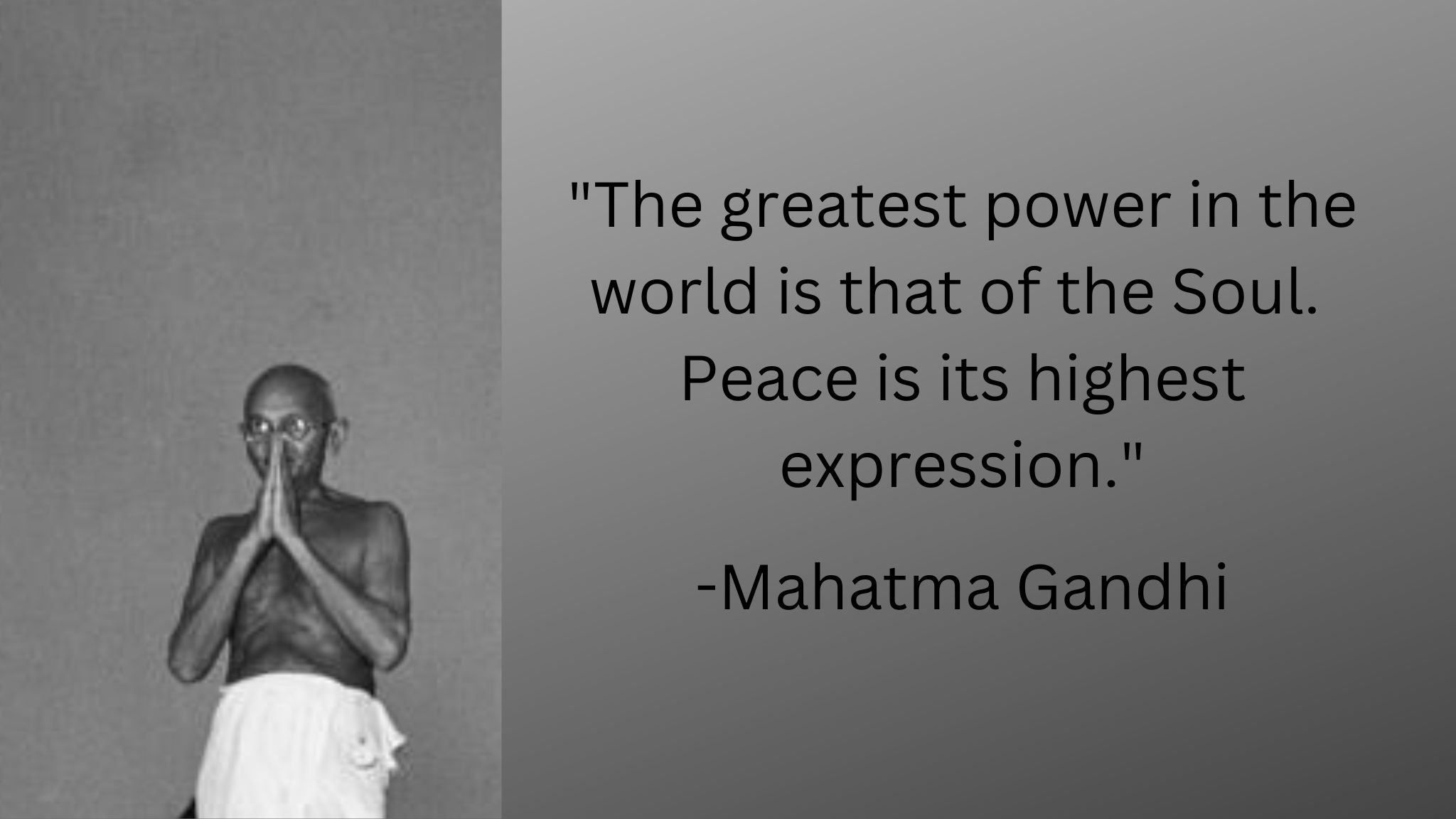
In the words of Mahatma Gandhi:
"The greatest power in the world is that of the Soul. Peace is its highest expression. To attain peace, first we must acquire greater mastery over ourselves. We secure then an atmosphere of perfect peace, calm and goodwill that protects and fortifies ourselves and blesses others around us.”
(Discourses on the Gita)
"Peace requires one first to be brave enough to love another, and to trust another. That requires faith in oneself. One has not the strength to be peaceful if he is fighting the internal duel of selfish desires. Good can never result from evil desires or actions; hence, the Gita's central teaching of the oneness of the means and ends. The practice of peace is thus a test of the sincerity of our hearts; it requires solid and silent self-sacrifice, honesty and the capacity for diligent work, but must be realized first in its source within.”
(Discourses on the Gita)
“True humility means most strenuous and constant endeavor, entirely directed towards the service of humanity. God is continuously in action without resting for a single moment. If we should serve him or become one with him, our activity must be as unwearied as his. There may be momentary rest in store for the drop which is separated from the ocean, but not for the drop in the ocean, which knows no rest. The same is the case with ourselves. As soon as we become one with the ocean in the shape of God, there is no more rest for us, nor indeed do we need rest any longer. Our very sleep is action. For we sleep with the thought of God in our hearts. This restlessness constitutes true rest. This never-ceasing agitation holds the key to peace ineffable. This supreme state of total surrender is difficult to describe, but not beyond the bounds of human experience. It has been attained by many dedicated souls, and may be attained by ourselves as well.”
(The Way to God)
“Without good thoughts there is no peace, and without peace there is no happiness. Where a stable-minded man sees things clear as daylight, the unstable man distracted by the turmoil of the world is as good as blind. On the other hand, what is pure in the eyes of the worldly wise looks unclean and repels the stable-minded man. Rivers continuously flow into the sea, but the sea remains unmoved; in the same way all sense objects come to the yogi, but he always remains calm like the sea. One who abandons all desires, is free from pride and selfishness and behaves as one apart, finds peace. This is the condition of a perfect devotee of God, and he who is established therein, even at the final hour, finds moksha… self-liberation.”
(Discourses on the Gita)
“He who would practice yoga, i.e., evenness of temper (samatvam), cannot but perform action. The man who has achieved such evenness of temper will be serene, because his mere thoughts are charged with the strength of action. A yogi is one who is not attached to the objects of sense or to action and whose mind has ceased to roam restlessly. He is a yogi who is a man of knowledge as well as experience, who is unwavering and master of his senses and to whom gold, stone and earth seem all alike. He regards with an equal eye friend and foe, sinner and saint. The yogi is stable-minded at all times, and is without effort free from all desires. He is like an unflickering lamp burning in a windless place. He is not tossed to and fro by dramatic events on the world-stage or by his own brain waves. Such mental poise can be achieved by slow but steady effort. The mind is fickle and restless, but it should be gradually stabilized, for one can have peace of mind only when he is firm of understanding. In order thus to stabilize the mind, he should constantly fix it on the Soul.“
(Discourses on the Gita)

Divine Messengers
The Angels, Gracious Light of Soul, bending near the earth in me touched the golden heart strings of my heart and the worlds in silent obeisance lay to hear their voices: "Peace and Joy! Peace and Joy unto All!”

“The Angels, Gracious Light of Soul,
bending near the earth
in me
touched the golden heart strings
of my heart
and the worlds
in silent obeisance lay
to hear their voices:
"Peace and Joy!
Peace and Joy
unto All!"
Upon this midnight clear
I listen to their
Word
resounding,
still.”
By Swami Kamalananda
“Praise be to Allah, who created the heavens and the earth,
who made the angels, messengers with wings…”
From the Qur’an, Fatir 35:1
“Praise him, all his angels; praise him, all his heavenly hosts.
Praise him, sun and moon; praise him, all you shining stars.
Praise him, you highest heavens, and you waters above the skies.
Let them praise the name of the Lord, for at his command they were created.”
From Psalms 148:2-5
“Let your life come amongst them like a flame of light, my child, unflickering and pure, and delight them into silence. Let them see your face, my child, and thus know the meaning of all things. Let them love you and love each other. Come and take your seat in the bosom of the limitless, my child. At sunrise open and raise your heart like a blossoming flower, and at sunset bend your head and in silence complete the worship of the day.”
From “The Child Angel” by Rabindranath Tagore

The Yuletide Tree
O, if we could meet other humans beings with as much love and respect as we do our beloved Yuletide Tree! If we could recognize how they too came to live and grow on earth, striving for growth, for light and companionship of their surroundings as we do.
From
The Forest of Forever
By Srimati Kamala
Perhaps you were walking in woodland familiar to you. A place that brings you thoughts of the beauty, majesty and beneficence of a forest. Did the little tree invite you with a special charm? “Perfect,” You thought. “I receive this offering as Perfect. It has fulfilled its forest existence with quiet humility and grace.”
Perhaps the little tree was planted and cultivated by a farmer to end up in a home like yours, or perhaps it sprang up in the forest from the seeds of previous generations, surrounded with other voluntary upstarts, all drawing to light and sharing the vitality and breath of creation.
You chose it for its symmetry or something intangible about it that suited the space you would soon offer it, and you no doubt discovered that it had some peculiarities: Some branches splayed out; one side was a bit uneven; there were gaps that needed to be filled. It had to grow in a unique way to be vigorous and to receive light.
Once “home,” within the evenness of walls and windows, its form became more pronounced. Did you attempt to remove or alter its expression then, so it conformed to public appraisal? Remember, whatever its own expression while in the forest, it spoke intimately to your heart. So you allowed that vision to survive as you chose it.
You worked to share its vital verdure anew, stringing it with strands of brightly colored lights, garlands and metallic bulbs, hand-painted decorations, carved and mirrored collections specially sorted and saved from over the years.
Sitting there in front of your yuletide tree in silent admiration you were filled with its timeless message of Gladness and Hope.
O, if we could meet other humans beings with
as much love and respect as we do
our beloved Yuletide Tree!
If we could recognize how they too came to
live and grow on earth,
striving for growth, for light and companionship
of their surroundings as we do.
Like this little tree, humans are born into
conditions they cannot change and
must adapt in order to survive and flourish.
Like this little tree’s branches some people have traits
and virtues that seem disproportionate or
overbearing.
It is for us to encourage them, to visualize
their rightfulness and fruition, giving them
adornments from our own treasures of
divine qualities.
You brought this little tree from God's garden onto the hearth of your heart. It shared its truth and beauty with you as an offering, and you received it with love and joy.

The Devout Gift
Whosoever with devotion offers me a leaf, a flower, a fruit, or water, I accept it from him as the devout gift of a pure heart.
From
The Srimad-Bhagavad-Gita: The Revelation of the Supreme Self
Translated by Swami Premananda
Whosoever with devotion offers me a leaf, a flower, a fruit, or water, I accept it from him as the devout gift of a pure heart.
O son of Kunti, whatever thou doest, whatever thou eatest, whatever thou offerest as oblation, whatever thou givest as gift, and whatever soul’s power thou puttest forth, do it as an offering unto me.
When a gift is offered with the thought that it is righteous to perform acts of charity, without expecting anything in return, at the right time and place and to a worthy person, that gift is regarded as the source of self-liberation and peace.
That gift which is made with the hope of receiving in return, or desiring personal reward, or with reluctance, is known as the source of pride and sorrow.
The gift that is given at the wrong place or time, to unworthy persons, or ungraciously and with contempt, is the cause of self-degradation and misery.
From Ch 9:26-27 and Ch 17:20-22
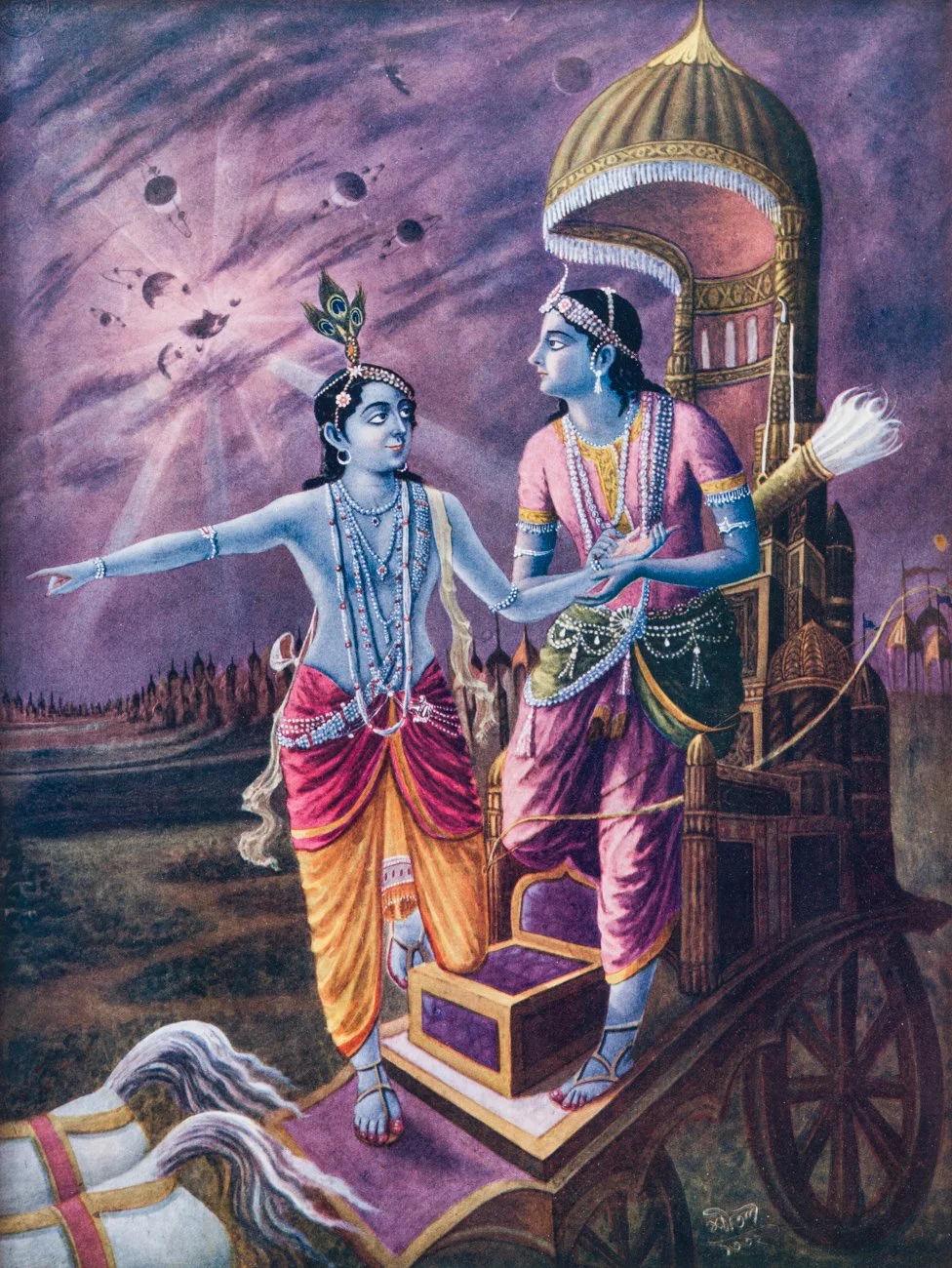
Guidance
Who, or what leads us? How are we led? What is the goal of guidance? The ideal of guru is profound and universal, not delimited by human association nor confined to any one religious tradition. It is inherent in the unfoldment of cosmic life as well as human spirituality.

An excerpt from
Frontiers of the Spirit
By Swami Kamalananda
Lead us from the unreal to the real,
From darkness to light,
From death to immortality.
--Vedic Invocation
There is a saying, “There are thousands of gurus, but it is difficult to find one true disciple.” in other words, we find more who wish to tell and proclaim rather than to study, understand, learn and follow spiritual wisdom in their life. There may be many to pontificate, but few who truly and sincerely, wisely and humbly practice.
Who, or what leads us? How are we led? What is the goal of guidance? From the invocation above, the ideal and law of guidance, cosmic and human, are revealed.
From the most wayward to the most enlightened, all need and heed some authority for guidance in life. In our spiritual life the recognition of this need is revealed in the supplication of prayer, and the law of guidance is further demonstrated through the ideal of Guru.
The ideal of Guru is profound and universal, not delimited by human association nor confined to any one religious tradition. It is inherent in the unfoldment of cosmic life as well as human spirituality. The authority of “Guru” is based on reverence for the goal of self-perfection, and it comes from an understanding of the means to attain that goal.
All life is guided by consciousness. Consciousness is responsible for all our happiness or unhappiness, peace or sorrow in life. Right now we are our consciousness. Our consciousness reveals the authority over our daily experience. Therefore, it is wise to evaluate the course of our own consciousness to see what authority we are obeying most of the time. What is our perspective, vision, awareness, ideal that guides our learning and growth? As Jesus wisely said, “Where your treasure is, there your heart will be also.” Our “treasure” or predominant identification of consciousness determines our happiness.
The quality of our life improves when we live more in the understanding, hence authority, of our pure consciousness. Our pure consciousness is the light of soul. It is ever one with the pure light of the universe. Remember, it is relatively easy to serve the growth and maintenance of our physical being, but do we make the effort to serve and to obey what governs our physical being? Good people today are rightly concerned about the purity of our food for the proper health of the body. Then how much more concern and care should be given to the cultivation of mental purity for the mind’s balance and strength? Just as our muscles require practice and training to maintain balance and harmony of the nervous system, so our mental faculties need practice and constant effort to receive pure consciousness, the power and peace of soul.
For the full publication: “Frontiers of the Spirit”

Two Little Birds in the Self-Same Tree
There are both of these birds in man himself, the objective one with its business of life, the subjective one with its disinterested joy of vision.
“Two little birds, linked by mutual friendly bonds, reside in the self-same tree; one of them is engrossed in the enjoyment of sweet fruit, while the other merely looks on with perfect serenity.”
“Dwelling within this body are the supreme Self, the individual self, and the potencies of thought, volition and feeling. The individual self, by means of the potencies of thought, volition and feeling, creates and lives in a little world of its own desires and pleasures. But finally the indwelling supreme Self, by its inherent power of illumination, renounces all bondage of limitations and regains freedom.”
“Even so, becoming identified with the body, man has fallen into the delusion of imperfection, self-condemnation and weakness, and in consequence has become engulfed in sorrow. But when, by the power of his subjective meditation and illumination he realizes the glory of his own divine Self, he transcends sorrow and lives by the power of inner contentment.”
—Svetasvatara Upanishad
translated by Swami Premananda in Eight Upanishads
“In the Upanishad it is said in a parable that there are two birds sitting on the same bough, one of which feeds and the other looks on. This is an image of the mutual relationship of the infinite being and the finite self. The delight of the bird which looks on is great, for it is a pure and free delight. There are both of these birds in man himself, the objective one with its business of life, the subjective one with its disinterested joy of vision.”
—Rabindranath Tagore

Painted by the Master Artist
Every object reveals God’s beauty and perfection. Do not close your eyes but open them in the singleness of spiritual vision that everything about you may reveal the reality of the Supreme Spirit.
By Swami Premananda
From “Seven Mystic Holydays”
Keep your mind serenely and continuously on God both within and without. Witness the glories and beauty of God all about. The world is a living manifestation of divinity. Every object reveals God’s beauty and perfection. Do not close your eyes but open them in the singleness of spiritual vision that everything about you may reveal the reality of the Supreme Spirit.
The stars have a message for us. In the fall season they seem so bright and clear. God has placed them in the heavens to reveal to us the transcendental nature of soul. Although we live in this world, our soul cannot be confined to earthly limitations. The sun, too, has a message of spiritual awakening. Have you ever witnessed a sunrise? City-dwellers rarely see that glorious spectacle and that is one of the tragedies of modern living. As the sun lifts above the horizon it seems that the consciousness also is lifted and we are reminded of our spiritual unfoldment.
The rivers, too, carry a godly message. They have their origin in the mountains. They flow over rough places, through fields and valleys, finally to reach the vast ocean. So our life originates in God. It travels through many lowlands of toil and effort but it always comes, at last, to the ocean of divinity. Life moves ever onwards to the infinity of God.
This constant perception of God wherever you look, saturates the consciousness with spiritual harmony and identifies mind with all that is noble and sublime. Behind all the objects of nature is the message of God. Find spiritual companionship with this glorious manifestation all about us. The seasons reveal to us the garment of God, painted by the hand of the master artist.

Hamsa
When others around him sank into gloom and despair, Gandhiji held on to an unfailing optimism. A text often on his lips to reawaken others' lost inspiration was from Tulsidas' Ramayana: "All things - with or without life - the Lord has created with their good and bad points. The wise like the discerning swan separate the good milk and reject the adulterating water."
By Srimati Karuna
Hamsa is the Sacred Swan. Many poetic images are derived from the flight of the swan to an abode at Manasarovar Lake in the Himalayas. In the Hamsa Jataka, the swan symbolizes wisdom and loyalty. And the Goddess, Sarasawati, rides the sacred swan that can separate milk from water, a symbol of discernment and detachment. It represents discernment because the sacred swan, if offered a mixture of milk and water, is said to be able to separate milk from the water and drink the milk alone. The swan thus symbolizes the ability to discern the eternal from the ephemeral.
Mahatma Gandhi often repeated the words from Tulsidas’ Ramayana: ”All things - with or without life - the Lord has created with their good and bad points. The wise like the discerning swan separate the good milk and reject the adulterating water.” Beyond the relative knowledge of the mind is the pure consciousness of soul which enlightens our reason, instinct and intuition.
The hamsa also symbolizes detachment because though swans need water for their survival, they can always fly away without a drop of water burdening their wings. The flight of the swan relates to moksha, freedom or liberation. This release from Samsara is represented by its freedom to travel between heaven and earth. This hamsa, a migratory bird, symbolizes the transcendent and is thus identified with the Supreme Spirit or Brahman.
In Sanskrit, Soham or Sohum means “I am That." It is identification with the Ultimate Reality. The mantra is also inverted from so 'ham (saḥ + aham) to ham + sa (“That I am.”) The combination of so ‘haṃ and haṃsa has also been interpreted as "I myself am the Swan.” HAMSA is also HONGSWA.
“The flame of pure-consciousness is eternally ignited within this body. By the meditation of Hong-Swa, all delusion having been dispelled, the Self is revealed in its effulgent glory. In the realization of oneness with Brahman, the Self, man transcends death. There is no path other than this to the attainment of immortality and bliss…The Supreme Self is Hong Swa, which leads to the realization of SOHONG in wisdom and bliss.” (Svetasvatara Upanishad, Ch 6:16 and 3:18)
“O Thou self-manifested cause and substance of creation, O Thou indwelling Self of all, Thou source of illumination, guide me beyond Thy rays of creation, transport me beyond Thy objective form that, by Thy grace, I may behold Thy glorious Self: That absolute Self abiding in the transcendental effulgence, verily, I am That.” (Isha Upanishad, v16)
Patanjali’s Yoga Sutras also refer to viveka or discernment. It is that mental state which is capable of discerning what is true from what is false, what is permanent from what is fleeting, and what brings suffering from what does not. Viveka is considered as the first requirement in the spiritual journey. Vivekachudamani is a text, attributed to Adi Shankaracharya. It means the “crest-jewel of discrimination” and it discusses the viveka, discrimination or discernment, between the Real (unchanging, eternal) and the unreal (changing, temporal) and reflects on the oneness of Atman and Brahman. The next requirement in this journey of Self-Realization is vairagya or detachment. It is a natural extension of viveka. Hence, we come to recognize in the symbol of the HAMSA, realization derived from viveka and vairagya, discernment and detachment.
The swan can tell us the good from the bad
Floating on a pond near a lily pad
As graceful and beautiful as silk
Separating water mixed with milk
The swan will tell us of its role
To reflect freedom of the soul
At home on water and on land
At ease in all ways, small and grand
Of spirit or matter, body or mind
Arise, every one! Awake, every kind!

Ashvattha
While we live on earth we must learn to see trees (as all living beings) in another way: As coming from above, from beyond creation. From an unseen source beyond heaven itself and extending downwards into the realm of Creation and, finally, to Earth—bringing the unmanifest Soul into all our surroundings.
By Swami Kamalananda
From “The Forest of Forever”
We know
of course that
“Only God can make a tree,”
the miracle and colorful fount of vitality,
the living symbol of the cooperative
and holistic existence
of life on earth!
Now turn that symbol upside down.
Yes, UPSIDE DOWN,
And you will have a symbol of unmatched,
unique
and yet characteristically sublime
meaning from India's spiritual heritage:
“Ashvattha”
“What, visualize a tree upside down?” you ask.
Precisely.
Now that gets our attention!
That will remain an unforgettable image.
Forever.
Why would one imagine a tree with its roots
above the branches,
and the branches extending below them?
“Why on earth?” indeed:
Because while we live on earth
we must learn to see trees
(as all living beings)
in another way:
As coming from above,
from beyond creation.
From an unseen source
beyond
heaven itself
and extending
downwards
into the realm of
Creation and, finally, to Earth—
bringing the unmanifest Soul
into
all our surroundings.
“With its roots, the original source,
established above in the Supreme Self,
and its branches spreading below as creation,
stands the everlasting Ashvattha,
the symbolic tree of the ever changing world.
The hymns of the Vedas form its leaves.
He who knows this is truly enlightened
in the wisdom of the Vedas.”
—Srimad-Bhagavad-Gita, Ch. 15, V.1
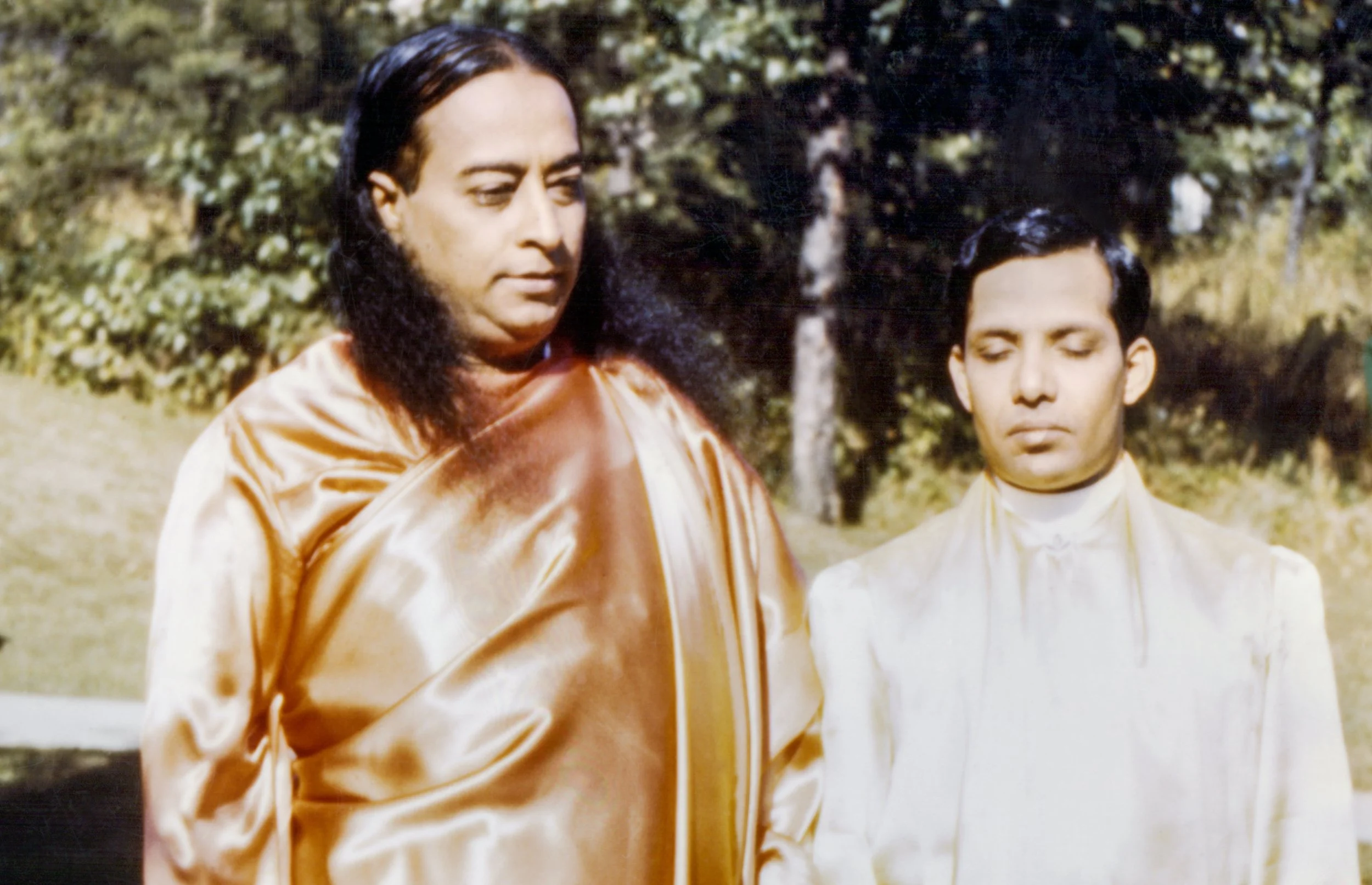
Guru-Disciple
In the purest light of God-consciousness there is no relationship nor any bond as sacred as that between guru and disciple. Purely spiritual and divinely ordained by the cosmic law of self-unfoldment, that mutual bond of soul continues to guide and inspire the path of self-illumination which leads to absolute oneness in the perfection of God.


By Swami Kamalananda
Excerpt from “The Mystic Cross” Magazine Dedication Issue
In the purest light of God-consciousness there is no relationship nor any bond as sacred as that between guru and disciple. Purely spiritual and divinely ordained by the cosmic law of self-unfoldment, that mutual bond of soul continues to guide and inspire the path of self-illumination which leads to absolute oneness in the perfection of God.
There are many self-proclaimed gurus. There are more who profess unending and deep devotion as true disciples. Vanities and emotions come and go. Life is the ultimate and only revealer of the truth. To live according to the light of God and soul is to fulfill the vow of perfect disciple and perfect guru. That requires the most energy, a tremendous intelligence, cultivated self-discipline, subtle thinking and, above all, great love.
Since his coming to the United States in 1928—in a life of ministry that extended over half a century—Swami Premananda arduously and devotedly worked to carry the light of the spiritual heritage of his guru and of the great souls that preceded him in the tradition of the Swami Order. He never wavered in his self-remembrance and adherence of his guru-disciple vow. That today we should enjoy the inspiration of idealism shared through the Self-Revelation Church and Gandhi Memorial Foundation is testimony to the wisdom and service of Swamiji and the noble souls who understood, embraced and served the life and goal of self-realization that he so purely established in our nation's capital over decades.
The many translations and illuminations of Vedic scriptures in the light of absolute monism; almost 20 years of weekly radio broadcasts; the receiving of the 33rd degree and jewel of the 33rd degree of Scottish Rite Freemasonry; and the chartering of the Swami Order in America are but a few of the unique achievements of far-reaching and enduring consequence that Swamiji offered from his dedication to further our spiritual heritage in America.
I am stating unequivocally that no swami has made such a profound and enduring contribution to American life. Beyond Washington, on the summit of the Stony Man Mount, beneath the crystal skies of Skyland in the most beautiful Shenandoah National Park, Swamiji dedicated a permanent mystic shrine of the Swami Order of India where devotees of all faiths—even atheists—will come henceforth to worship the One Absolute in the cathedral of Nature. Years later (in 1952), in the beautiful northwest section of Washington called Friendship Heights, the Golden Lotus Temple opened its sacred doors for all seekers of truth and light. It was an unprecedented and unique event in Masonic and religious history that a Grandmaster of the Light laid the foundation stone in a temple of which a swami is the minister.
May the light of God and gurus continue to illumine the path of our life.
The Festival of Light
The Light of Light has arrived and is in touch with the souls of all souls. Each soul is a shining light; bring your luminous lamp of joy and happiness, and lend your ecstasy to the rapturous delight of all hearts.
From Prayers of Soul, by Swami Premananda
Come join the festival of light.
The Light of Light has arrived and is in touch with the souls of all souls. Each soul is a shining light; bring your luminous lamp of joy and happiness, and lend your ecstasy to the rapturous delight of all hearts. The stars in the sky above have come with their bright lights to fill the firmament with the celestial lights of the gods of heavens and earth. The sweet jasmines have infused the evening breeze with the exotic fragrance of the intoxicating perfume. The whole world is uplifted with the spirit of love, and man and nature are in the indulgence of divine ecstasy. The bliss of God has spread its blossoms of happiness upon the hearts of the lovers of love.
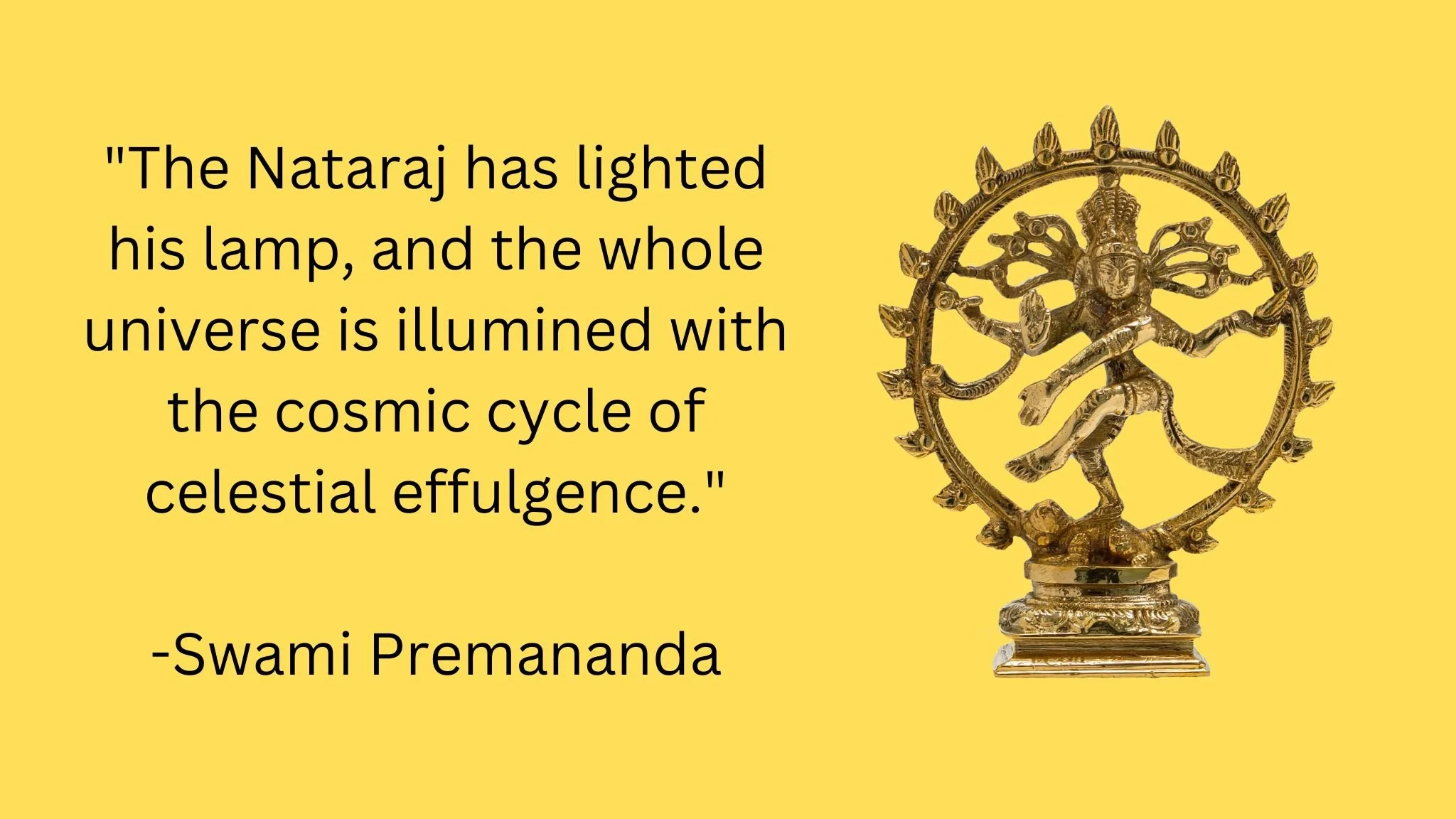
The Nataraj has lighted his lamp, and the whole universe is illumined with the cosmic cycle of celestial effulgence. The Divine Dancer has ushered the yoga of joy for all souls to become one in the rhythm of ecstasy. Light reveals beauty, beauty brings joy, and joy lifts the soul into the paradise of purity and peace. Sublimity of happiness is the ascension of soul. Joy is the jewel of the human heart, and peace is the ornament of the human soul. Bliss is the blue diamond on the forehead of the icon of divine consciousness. Soul in peace is in the bliss of God. Soul dances with joy and the freedom of self-effulgent self-illumination.
The darkness of sorrow and sadness, pain and suffering has vanished from the sphere of human consciousness, and the spirit of man is awakened in the lustrous splendor of beauty and purity and holiness. Darkness is dawn in ascension like the fragrant incense rising in adoration of the Devata, the Deity of Light. Dance is the invitation of love from soul to soul to become one in the hall of happiness. Love unfolds the flower of soul to blossom forth with the petals of hidden happiness. The light of God glows in the hearts of lovers in the embrace of purity of soul. The light of God shines in the soul of man.
Invitation to dance is an offering of love and the chalice of love. Dance is a sacred sacrament of love. The breeze offers an invitation to dance to the butterfly with shimmering wings. The dew drop opens its pure heart welcoming the light of the dawn.
Creation is the dance of the Creator in the cosmic rhythm of love. Love is heavenly and divine. Love is God. Come and dance with love in the light of holiness. Come let your soul dance with love and consort with the ballet of the lighted candles. Let the pure hearts melt in joy in the festival of love.
The Light of Light has touched the souls with his lamp of love. Come—join the festival of the dance of light.
Light is God.
Gandhi and the Ashram Ideal
Awareness of life as spiritual through identification and practice is no less a priority for the householder or student than it is for the “renunciate” or “sannyasin.” If we believe it to be so, then we condition spirituality by the personality or condition of the body, thus contradicting the oneness of life.
FOUR “ASHRAMAS” or “abodes of identification with an ideal”
There is no time or condition of our life when faith in God and self-dedication to following the will of God as spiritual ideal should not or cannot come first. Life is spiritual in purpose at every moment and throughout every condition. Resignation is recognizing the first motive and final attainment of life as spiritual.
Awareness of life as spiritual through identification and practice is no less a priority for the householder or student than it is for the “renunciate” or “sannyasin.” If we believe it to be so, then we condition spirituality by the personality or condition of the body, thus contradicting the oneness of life.
From ancient times the “ideal life” of self-dedication was described by our Vedic ancestors, as such, that at every stage of self-unfoldment the Self could be experienced. The life of self-dedicated progressive Self-remembrance according to one’s individual tendency of self-expression was called sadhana. Broadly speaking, life was viewed symbolically as comprised of four progressive and spiritual stages, a descriptive guide for self-dedication. The four stages are called “ashramas” or “abodes of identification with an ideal.” They correspond to the normal patterns of human growth and expression between birth and death. The stage are not mutually exclusive, but each illustrates the understanding, work, love and wisdom of the soul through a human condition.
The first stage, called Brahmacharya is not a mere student phase, nor does it refer only to a monk or celibate as has been the popular misunderstanding. The word conveys the ideal: Life guided by and dedicated to Brahman, God. In the ideal life this stage would come first, naturally, during one’s early years, as a necessity for establishing the understanding of the spiritual ideal and value of life from the first experiences in learning. When experience broadens the mind, and when new problem confronts us, should not the ideal of our spiritual life be remembered first, in order to help us to evaluate our disposition and action?
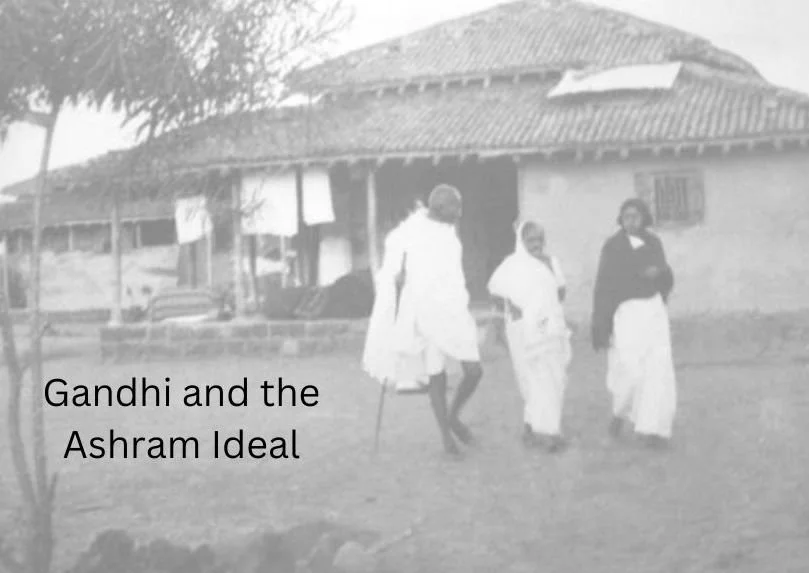
Mahatma Gandhi included the ideal of brahmacharya as one of the vows or ideals of life for those of all ages – married or unmarried – who lived in his ashram communities. He rightly intended it to be an ideal to be followed throughout life and not to be taken in a narrow sense. He interpreted brahmacharya as self-mastery or self-control, consistent with Truth. Instead of mere control of the body this includes channeling of the mind to resist every low thought.
“I have always felt that much harm has been done by the narrow definition of brahmacharya. If we practice self-control in all directions, the attempt will be scientific and possible of success…Let us remember the root meaning of brahmacharya. Charya means course of conduct: brahmacharya, conduct adapted to the search of Brahma, i.e., Truth. We must entirely forget the incomplete definition.” —From: Yeravda Mandir, Ashram Observances by M.K. Gandhi
The second ashrama is called Garhastya. As an ideal it is not confined to those who are married and have children nor to those with family responsibilities. It refers to that aspect of self-manifestation wherein one realizes his well-being as mutual (shared) responsibility and then seeks to fulfill it through selfless action. “Griya” from “ghar,” means “home,” not in the limited sense of domicile, but in the larger connotation of community or society. “-Hastya” refers to the hand, lending the idea of performance of duty or action. The natural desire as well as purpose of the soul is to give and to share for the benefit of broader life. Objective service is an expression of understanding and reverence for our ideal. Life is incomplete without it. The body is the instrument of self-expression.
“Reverence for Life…does not allow the scholar to live for his science alone, even if he is very useful to the community in so doing. It does not permit the artist to exist only for his art, even if he gives inspiration to many by its means. It refuses to let the business man imagine that he fulfills all legitimate demands in the course of his business activities. It demands from all that they should sacrifice a portion of their own lives for others. When we are truly filled with the idea of reverence for life, all our attitudes, thinking, actions change. We must go deep into ourselves to find this inspiration.” —Albert Schweitzer
In the traditional Hindu marriage ceremony, the bride and groom walk together seven circles around the altar, a symbolic affirmation of the ideal of garhastya: They make God the center of their life while journeying together as co-partners on the path of self-unfoldment to the perfection of God. Their seven spiritual aspirations may be seen as the dedications of every soul to render creative service in divine union with the will of God.
To establish a spiritual abode or environment wherein divinity may find refuge and flourish.
To aid one’s companion in life in the harmonious development of physical, mental, emotional and spiritual well-being.
To offer the best of oneself in creative, useful and purposeful work to enrich life on earth with harmony, peace and wisdom.
To seek, perceive and follow the path of self-perfection (dharma).
To honor divine trust of spiritual kinship by serving the soul and becoming a spiritual companion to all souls on earth.
To realize oneness of soul through the universe of Life.
To become one with God in the realization of the Self.
Vanaprashta is the third ashrama. It refers to the service of soul through wisdom of experience and the need in life for the introspective guidance of the mind. There comes a time in objective service or expression in life when we are not as physically strong or able to help actively in provision for welfare for ourselves and others. This outer stage mirrors an inner need. At this stage ideally one should offer the wisdom of experience, understanding and inspiration in continued service to one’s fellow companions, while at the same time seeking deepening subjective knowledge. Objective detachment is symbolized in the third stage of life when the strength of the senses diminishes and the powers of mind and heart predominate. The ideal of God is not realized by the neglect of duty or idleness. Age does not necessarily bring wisdom by the waning of our physical strengths. Wisdom is dependent upon the renunciation of ego—that is, the departure from sense-identified self-consciousness and the entering into the haven of the spirit. Renunciation is a requisite practice of every stage of our spiritual life. “Vana,” or “forest,” refers in a religious sense to a campus or community of enlightened souls. “Prastha” is “departure” or “farewell.” (Mahaprasthan is death, or the final farewell.) Vanaprastha therefore designates the stage of life wherein one renounces or departs from “the worldly” (sense-dominated) experience and identifies with the community and guidance of soul.
The ideal of Sannyas is the fourth ashrama of life. To be a sannyasin is not to wear a robe and go preaching or to retreat from the difficulties or burdens of life. Sannyas is an ideal of heart. It is the life of subjective freedom, embracing all in the consciousness of the Self with love and wisdom. When one lives in the consciousness of God one becomes a sannyasi, having totally renounced selfish desires. The greatest spiritual power of the sannyasi is a pure heart.
“All imperfections are automatically dropped when love adorns the heart. Devotion has three stages: Meditation in the consciousness of love; subjective perception or feeling of love; and realization of oneness in love. By unconditional love man attains to the state of God-hood.” —Sri Chaitannya
Excerpt from “Frontiers of the Spirit” by Srimati Kamala
THE ASHRAM OBSERVANCES
The ashram vows, to Mahatma Gandhi, were more than arbitrary rules or mental decisions pertaining to matters of ephemeral importance (which may be alterable by moods of fancy or which may even be imposed without.) A vow one takes upon the altar of one’s conscience in the name of all that one holds to be sacred and true. “God is the very image of the vow,” said Gandhi.
“A vow is a spiritual commitment of self-dedication of body, mind, heart and soul consistent with Truth which is cosmically beneficent. Based on what is constituent to our being, a vow is self-fulfilling—itself a power of progressive realization.”
To vow means to do steadfastly and at any sacrifice what one really ought to do according to purity of heart and the nature of Truth. “A vow is the marriage of ideal and practice, of duty and will.”
The perpetual striving to fulfill basic vows in one’s life constitutes the means of religion. The means then perfect the art of living consistent with the purity of human nature.
During his incarceration in 1930 in the Yeravda Central Prison (Poona), Mahatma Gandhi wrote weekly letters to the community of workers at Satyagraha Ashram on the banks of the Sabarmati River in Ahmedabad, India. The letters contained descriptions and examinations of the principal ashram observances. The “ashram life” had been cultivated under Gandhiji’s supervision and example for already more than one decade, and its influence had far exceeded its geographical confines—proof of its practical and universal applicability.
Copies of his letters were printed for wider circulation, therefore, and translations were rendered into various Indian languages. In 1932 (from prison) Gandhi himself put pen to the final English translation of Mahadev Desai, his secretary, which was later published as “From Yeravda Mandir: Ashram Observances.” Over the years Gandhiji wrote, said and demonstrated much more, elaborating upon and analyzing these basic principles of conduct which he himself considered to be the heart of any philosophical conduct consistent with Truth.
The following are Mahatma Gandhi’s own words, faithful to their original context, but gathered from different times and texts and chosen for their timeless and universal importance. Thus, they are equally practicable for our as well as his generation, and for generations to come.
Truth
The word SATYA (Truth) is derived from Sat, which means “Being.” Nothing is or exists in reality except Truth. That is why SAT or Truth is perhaps the most important name of God. Where there is Truth, there also is knowledge which is true. Where there is no truth, there can be no true knowledge. That is why the word CHIT, or “knowledge,” is associated with the name of God. And where there is true knowledge, there is always bliss (Ananda). There sorrow has no place. And even as Truth is eternal, so is the bliss derived from it. Hence, we know God as Sat-Chit-Ananda—one who combines in Himself Truth, Knowledge and Bliss.
For me, truth is the sovereign principle, which includes numerous other principles. This truth is not only truthfulness in word, but truthfulness in thought also, and not only the relative truth of our conception, but the Absolute Truth, the Eternal Principle, that is God. I worship God that is Truth or Truth which is God.”
Ahimsa, or Love
In its positive form, Ahimsa means the largest love, the greatest charity. If I am a follower of Ahimsa, I must love my enemy. I must apply the same rules to the wrongdoer who is my enemy or a stranger to me as I would to my wrong-doing father or son. This active Ahimsa necessarily includes truth and fearlessness.
Ahimsa is not the crude thing it has been made to appear. Not to hurt any living thing is no doubt a part of Ahimsa. But it is its least expression. The principle of Ahimsa is hurt by every evil thought, by undue haste, by lying, by hatred, by wishing ill to anybody. It is also violated by our holding on to what the world needs.
Brahmacharya or Self-Mastery
Brahmacharya is a mental condition. The outward behavior of man is at once the sign and proof of the inner state.
Let us remember the root meaning of Brahmacharya. “Charya” means course of conduct; “Brahma-charya” conduct adapted to the search of Brahma, i.e., Truth. From this etymological meaning arises the special meaning, viz. control of all the senses. Thus, an impure thought is a breach of Brahmacharya; so is anger…And since thought is the root of all speech and action, the quality of the latter corresponds to that of the former. Hence, perfectly controlled thought is itself power of the highest potency and can become self-acting. That seems to me to be the meaning of the silent prayer of the heart.
Control of the Palate
Most of us, instead of keeping the organs of sense under control, become their slaves. We must not be thinking of food all the twenty-four hours of the day. The only thing needful is perpetual vigilance, which will help us to find out very soon when we eat for self-indulgence and when in order only to sustain the body. This being discovered, we must resolutely set our faces against mere indulgence.
Non-Stealing
The profound truth upon which this observance is based is that God never creates more than what is strictly needed for the moment. Therefore, whoever appropriates more than the minimum that is really necessary for him is guilty of theft.
It is theft to take something from another even with his permission if we have no real need of it. We should not receive any single thing that we do not need…We are not always aware of our real needs, and most of us improperly multiply our wants, and thus unconsciously make thieves of ourselves. If we devote some thought to the subject, we shall find that we can get rid of quite a number of our wants…Most of the distressing poverty in this world has arisen out of breaches of the principle of non-stealing.
Non-Possession
Non-stealing and non-possession are mental states only. No human being can keep these observances to perfection. The body too is a possession, and as long as it is there it calls for other possessions in its train.
These difficulties appear to have given rise to the current conception of sannyasa “(renunciation of the world”) which is not acceptable… Such sannyasa may be necessary for some rare spirit who has the power of conferring benefits upon the world by only thinking good thoughts in a cave. But the world would be ruined if everyone became a cave-dweller. Ordinary men and women can only cultivate mental detachment. Whoever lives in the world and lives in it only for serving it is a [true renunciate].
Physical Labor
It is a gross superstition to imagine that knowledge is acquired only through books. Even for real intellectual development one should engage in some useful bodily activity (having) fully acquired the skill of correlating the three R’s with body labour …(and)…the idea of saving others. The Ashram ideal is to live to serve. In such an institution there is no room for idleness or shirking of duty, and everything should be done with right goodwill.
Fearlessness
Fear has no place in our hearts, when we have shaken off attachment for wealth, for family and for the body. “Enjoy the things of the earth by renouncing them” is a noble precept. Wealth, family and body will be there, just the same; we have only to change our attitude towards them. All these are not ours, but God’s. Nothing whatever in this world is ours. Even we ourselves are His. Why then should we entertain any fears? The Upanishad therefore directs us ‘to give up attachment for things, while we enjoy them.”
Swadeshi
A man’s first duty is to his neighbor. This does not imply hatred for the foreigner or partiality for the fellow countryman.
Our capacity for service has obvious limits. We can serve even our neighbor with some difficulty. If every one of us duly performed his duty to his neighbor, no one in the world who needed assistance would be left unattended. Therefore, one who serves his neighbor serves all the world. As a matter of fact, there is in Swadeshi no room for distinction between one’s own and other people…One to whom the whole world is as his family should have the power of serving the universe without moving from his place. He can exercise this power only through service rendered to his neighbor.
Religious Tolerance
The principle faiths of the world constitute a revelation of Truth. One must therefore entertain the same respect for religious faiths of others as one accords to one’s own. Where such tolerance becomes law of life, conflict between different faiths becomes impossible, and so does all effort to convert other people to one’s own faith. Religions are different roads converging to the same point. What does it matter that we take different roads so long as we reach the same goal? In reality there are as many religions as there are individuals.
Excerpt from “Mahatma Gandhi: An American Profile” by Srimati Kamala
The Revelation of The Supreme Self
The awakened mind enquired: Reveal unto me, O power of introspection, the various states of consciousness passing through which the self comes to realize its absolute perfection, as its qualities aspire to overcome the accumulated impressions born of mind through its identification with the senses.
Spiritual interpretation of the first chapter
of the Srimad-Bhagavad-Gita according to Kriya Yoga
By Swami Premananda
The awakened mind enquired:
Reveal unto me, O power of introspection, the various states of consciousness passing through which the self comes to realize its absolute perfection, as its qualities aspire to overcome the accumulated impressions born of mind through its identification with the senses. (1)
Introspection observed:
Aroused by the rising influence of the divine qualities of the self, the objective will of the sense-identified mind, aided by its power of discrimination, becomes engaged in subjective self-analysis; (2)
And with intelligent cognition it at once becomes aware and feels the impact of the tremendous power of the newly awakened divine qualities revealed in the effulgence of illumined consciousness. (3)
Among these qualities the following may be distinguished: complete forgetfulness of the objective and sensory world, and indomitable subjective strength, as well as others of equal power, faith, spiritualized consciousness, intuition, noninjury, memory, revelation, self-discipline, sense-control, subjectivity, moral well-being, inner contentment, and enlightened perception; each of which is a liberating power of the self to guide the senses. (4-6)
In the light of clear intelligence, which is the best of the qualities of the newly awakened self, there also appear within the consciousness the dominant negative concepts, acquired through the faculties of the senses engrossed in physical propensities: (7)
False knowledge, sense-identified self-consciousness, attachment, ignorance which is the root cause of all sorrow, hatred, fear, clinging to sensory life, and the self-limiting consequences of the sum total of these; (8)
And many more powerful, cunning and deluding concepts in deceptive garb gain their firm footing in the consciousness and seek to veil the vision of the self. (9)
Limitless in number are the negative concepts under the dominance of the ego, the sense-identified self-consciousness; but few appear to be the divine qualities manifested by the power of the self. (10)
Moreover, it is only the existence of ego that keeps the self-limiting negative concepts intrenched in the consciousness of the awakened self, and at this initial stage of subjective analysis the inherent weakness of the sense-attached mind is exposed before the rising power of the self. (11)
But to strengthen the faltering will of the sense-attached mind, the ego, the first and most powerful cause of all objectivity, reaches out for the cosmic Prana embedded at Kundalini, the coccygeal center, and in consequence thereof the ascending Pranic force emits a roaring vibration, exhilarating all the sense organs. (12)
Responding thereto, the entire organic system, comprising the faculties of touch and sensation, taste and assimilation, attraction and expansion, reception and protection, perception and expression, creates a prolonged, reverberating, rhythmic, intense and penetrating sensation throughout the entire body, a feeling dynamic and decidedly psychosensory in character. (13)
Thereafter, however, illumined and inspired by the divine qualities of the indwelling supreme Self, the enlightened self becomes firmly established at Ajna, the spiritual eye, and witnesses a white star within a dark blue center surrounded by a brilliant but soothing effulgence. While at this state there is awakened a cosmic vibration of all-engulfing immensity wherein the self is merged in blissful self-consciousness. (14)
The illuminating, joyous vibration of the ascending current of Pranic force resembles the tone quality of the hum of the bumblebee at Muladhar, coccygeal; that of the melodious note from a violin at Sadhisthan, sacral; that of the sweet call of a flute at Manipur, lumbar; that of the deep and vibrant roar of a conch at Anahata, dorsal; that of the reverberation of rolling thunder at Visuddha, cervical; and that of an universal symphony of exalting blissfulness at Ajna, the spiritual eye. (15,16)
Besides these there are also felt in this body temple the power of calmness of mind and poise of the senses, clear conscience and love of truth, intuition and enlightened perception, as well as the power of purified consciousness and self-realization. The illuminating power and joyousness of these vibrations are beyond the conception of mind. (17,18)
This cosmic vibration, resounding throughout the entire being and consciousness, spiritualizes the faculties of the senses, transforms the will of the sense-attached mind, and liberates the self from sense-identification. (19)
Thus subjectively prepared, with perception interiorized and spine erect, the spiritual aspirant is about to commence subjective meditation; but he is at once confronted by the acquired finite impressions of long past, rising out of subconsciousness in accumulated number. Though seeking the guidance of the supreme Self, yet, in mistaken self-sufficiency, he looks up to his own intellect for counsel of truth. (20)
Consequently, the self directs its consciousness to recognize its own divine qualities as well as to discover the acquired concepts born of sensory existence in order that it may gain, at the very outset, a proper perspective of the entire field of subjective struggle, but particularly that it may be able to discern the negative qualities of the sense-attached mind. (21-23)
Whereupon the pure-consciousness, the highest of all cognitive and perceptive faculties, guides the self to that state of cognition at which it can clearly perceive the true nature of ego, the egoistic intelligence, and other sensory powers, thereby revealing unto the self its sense-identified nature of self-limitation. (24,25)
At this state the self observes the innumerable procreative, accumulated concepts of finitude acquired from sense-identified existence, while at the same time the revealing qualities of the self begin to shed their illumination within the consciousness. (26)
But the spiritual aspirant, influenced by the subconscious effect of sense-identified existence, again succumbs to his sensory habits, and once more delusion overpowers his consciousness. (27)
Inevitably, thoughts of personal attachment sway his reason as he ventures into discrimination:
My soul longs for transcendental revelation, but within my consciousness are gathered all my cherished concepts of long past, as my divine qualities aspire to overcome my relative impressions and concepts of the phenomenal world. I feel powerless. I am disturbed. Nervousness rocks my whole body. I am full of fear. My moral courage fails me, and even my circulation has gone awry. (28,29)
I know full well that within me is hidden the eternal source of strength and power, yet I have lost my physical poise and my serenity of mind is gone. My judgment misleads me and I am negative through and through. (30)
I am perfectly aware of my divine destiny of spiritual perfection, nevertheless, I do not see any moral or spiritual justification for destroying the subjective concepts and impressions which I have acquired through self-effort in the phenomenal world. If these are to be destroyed to gain spiritual illumination, I desire neither self-control nor enlightenment, nor even peace. (31)
Life is intelligent self-manifestation, then of what constructive value are self-control, serenity and peace, or even existence itself, if these are to be gained by destroying intellect, ego, mind, cognitive and perceptive faculties, self-consciousness, judgment, discrimination, understanding, sympathy and affection, and many other acquired qualities such as these, through the cultivation of which enjoyment and pleasure are derived? (32-34)
Enlightenment is not self-annihilation, therefore, although these relative concepts and impressions do limit my consciousness, I cannot destroy them, not even to gain the threefold attainment of mastery over the senses, calmness of mind, and the illumination of the Self, and most surely not to obtain the pleasures of the senses and sensory existence. (35)
The supreme goal of self-illumination is the realization of bliss in the perfection of consciousness; then what higher ideal could be attained by destroying the will, intellect and feeling, born of mind? Surely it is unrighteous to mortify the senses and to destroy the sense-faculties. Therefore I should not annihilate any of the cognitive and perceptive faculties. Besides, how are pleasure and happiness to be enjoyed if these are destroyed? (36,37)
Though the negative and self-limiting qualities, born of sense-identified existence, may seek to overcome the divinity of the self, or may create an inner conflict with the virtues of the self, even that could not justify the annihilation of the senses, will, intellect, feeling, and the rest, because that would inevitably result in self-destruction. (38,39)
Furthermore, when the harmonious functioning of the psychophysical system is disturbed by the absence of any of its organic powers, the whole system gradually loses its proper balance, just as the violation of any of the fundamental principles of righteousness disrupts the entire spiritual life. (40)
When the light of the self is veiled by mental objectivity and sensory attachment, higher and subtler faculties lose their power of inspiration and guidance. (41)
When inharmony disrupts the co-relationship of the physical, mental and spiritual nature, life degenerates into a state of confusion, sorrow and suffering. (42)
Mental discord disturbs the nervous system and creates subjective perturbation and thereby undermines the powers of body and mind. (43)
Indeed, when the proper functioning of the senses and the mind becomes disorganized, life itself is doomed to chaotic existence and insufferable sorrow. (44)
What ignorance! that I am determined to destroy my physical and mental powers in order to gain spiritual illumination and peace. (45)
If that constitutes the way which leads to self-perfection, it is better not to pursue that course; rather let the forces of the sensory propensities destroy all the spiritual qualities and aspirations. (46)
Such thoughts, arising in the midst of the inner conflict between the desires of the senses and the aspiration of the soul, cause the spiritual aspirant to lose control over his body and mind, and to forsake the inspiration and spiritual guidance of his soul. (47)
The full publication is available through the Self-Revelation Church HERE.

Gandhi and Advaita
On the occasion of Gandhi Jayanti, the observance of the birth anniversary of Mahatma Gandhi, we reflect upon the enduring inspiration of his idealism.
By Srimati Karuna
On the occasion of Gandhi Jayanti, the observance of the birth anniversary of Mahatma Gandhi, we reflect upon the enduring inspiration of his idealism. This idealism is rooted in his faith in Universal Truth. He said, “I believe in Advaita, in the essential unity of man and for that matter, of all that lives.” His life revolved around his belief “in the oneness of God and, therefore, in the oneness of humanity.” His was a belief in the absolute oneness of all.
Gandhi emphasized that “Truth alone is eternal, everything else is momentary.” And the Vedas record the powerful and significant Advaitist revelation: “Ekam Sat” — “Truth is One.” It is the monistic philosophy that there is one reality which pervades all. Gandhi’s commitment to Truth and Love (Satya and Ahimsa) is rooted in this ideal.
Absolute Monism or Advaita Vedanta is considered a philosophy or spiritual pathway rather than a religion. It cannot be contained nor limited to any one scripture. It is found in all scriptures of self-enlightenment, all revelations of Truth. The word Advaita means non-dual. Veda is the knowledge of wisdom.
The philosophy of Advaita Vedanta is expressed in the subjective teachings of the Upanishads but has also been given moral application through the compassionate example of the Buddha. It found rejuvenation through the intellectual approach of Shankaracharya and Mahatma Gandhi brought new life to Advaita philosophy through his selfless service.
The ideal of Advaita is to realize that one’s true Self is of identical nature with the God of the universe. It is the realization of the relationship of all beings to the one Reality… complete identification with that Reality or Truth. Gandhi believed and often articulated that “God is Truth.” He even turned it around and said: “Truth is God.” For Gandhi, Truth, Love, and God were interchangeable terms.
Advaita is the philosophy of the soul’s realization of perfection. Gandhi’s effort toward Swaraj (“Swa” means Self and “Raj” means Rule — Self-Rule) was not merely aimed at political and economic self-rule for India, but for a universal Swaraj of the individual self. Individual Swaraj or Self-Rule guides the individual toward a mastery of the Self that frees one from all limitation, from the bondage of negativity, fear, and attachment. Gandhi said, “The greatest power in the world is that of the Soul. To attain peace we must first attain greater mastery over ourselves.” His goal was to attain moksha: self-liberation through self-realization. He was a universalist ever seeking the Truth that all human life aspires to reach: True knowledge of the Self. He said, “The purpose of life is undoubtedly to know oneself. We cannot do it unless we learn to identify ourselves with all that lives.”
Mahatma Gandhi utilized the ashram life as a sort of spiritual laboratory. It was the environment he created in which to test and experiment with the ideal of Truth. Just as Henry David Thoreau went to Walden Pond to experiment with the simple life, a life enriched by a natural heritage, Gandhiji, too, explored the domain of the Soul through prayer and service in the ashram setting. His deep conviction in terms of his experiments with Truth reveal that he was constantly engaging the reality and applicability of Truth within the ever changing conditions of life. Through a combination of faith and experience, Gandhi pursued Truth above all else.
We, too, can create an environment in which to search deeply and personally the understanding and application of the philosophy of Advaita. We do this through our own study, service and meditation. We do this as we observe our own spiritual growth, as we become more attuned to the oneness of life.
Although Gandhiji undertook very practical objectives in terms of breaking down societal barriers and advancing constructive programs, he always had at the heart of his life’s ambition, the goal of self-realization. He attempted to live his ideal, Truth. He was committed to his statement that “Truth to be real must incarnate in human life.” Gandhiji lived and worked to reawaken the human heart and mind to a higher ideal — the ideal that unites Truth and Love into a living practice.