Meditate on the Light of AUM
“By meditating on AUM, the Word, within the effulgence of each of the seven lotuses, the mystic centers of spiritual revelation, is gained the inner illumination of the self which consumes the causes of all finiteness and self-limitation.”— Kaivalya Upanishad “The Self is symbolized by the word AUM. AUM is composed of three mystic sound vibrations. These also signify the first three states of consciousness in the self." — Mandukya Upanishad

Hong Swa & Pranayam: The Breath of Life
“Rise above the consciousness of separation and realize thyself in all and all in thee.” -Adi Shankarachariya “The flame of pure-consciousness is eternally ignited within this body. By the meditation of Hong-Swa, all delusion having been dispelled, the Self is revealed in its effulgent glory. The supreme Self is Hong Swa, which leads to the realization of Sohong in wisdom and bliss.” -Svetasvatara Upanishad


Finding Freedom from the Gunas
All aspects of creation are the various modulations of Sattva, Rajas and Tamas—the law of harmony, the self-manifesting power, and the evolving potency—but in reality these are the objective manifestations of myself. I am not limited by them, though they exist in me... Rise above the pairs of opposites, be thou firmly established on truth, be not attached to material gain and possession, be established on the Self, and thus thou shalt find freedom in and from the relative world of the Gunas.

Power of Cosmic Prana
Like the spokes on the hub of a chariot wheel, all beings are established on Prana. Life, Prana, is born of Atman, the absolute Self. Prana sustains and determines the functions of various currents of life-force within the body.
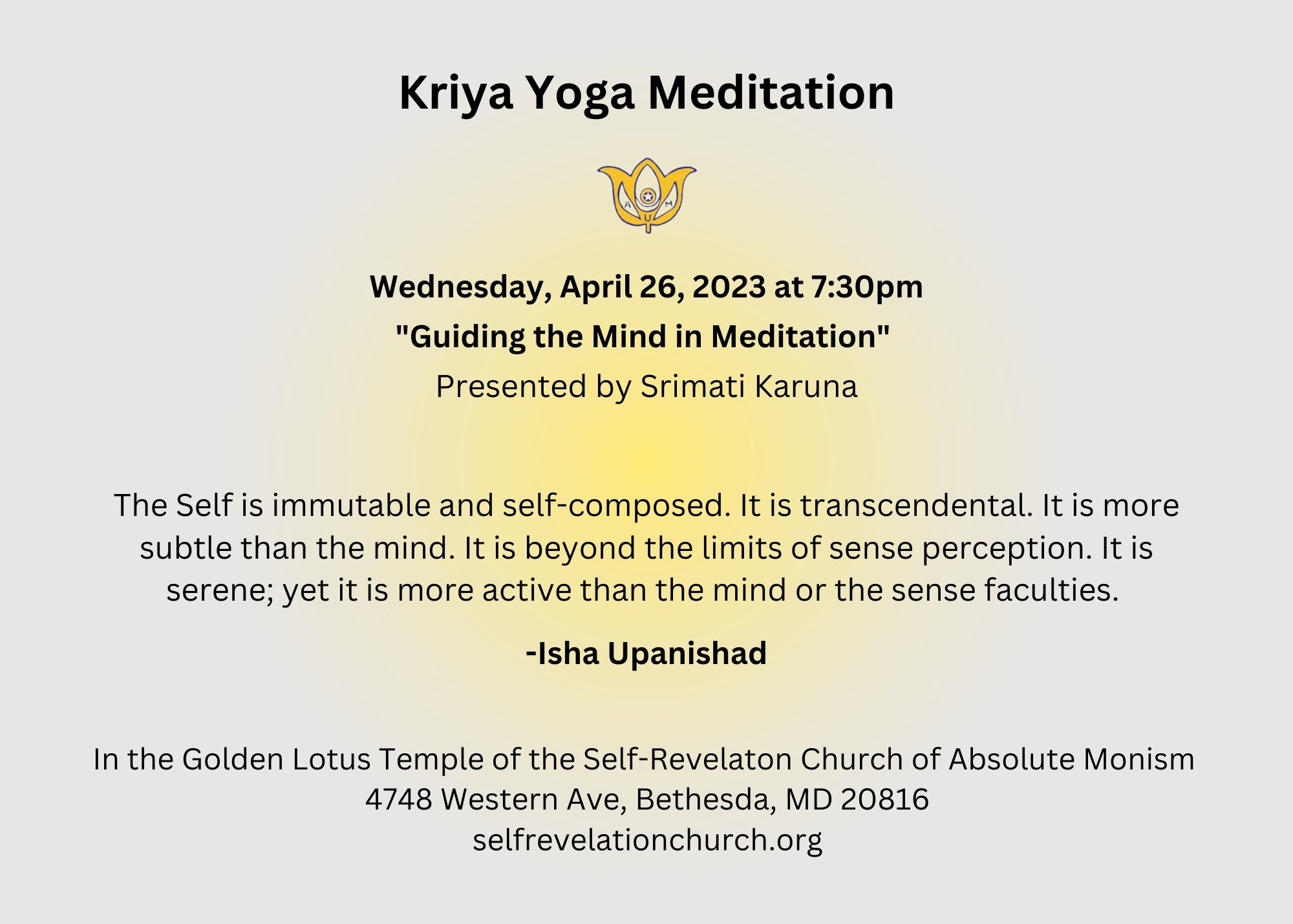
Guiding the Mind in Meditation
The Self is immutable and self-composed. It is transcendental. It is more subtle than the mind. It is beyond the limits of sense perception. It is serene; yet it is more active than the mind or the sense faculties.


Heart-Centered
The state of pure-consciousness, transcends all other states of spiritual enlightenment; it is enshrined within the effulgence of the heart lotus, Anahata. Those who aspire with patience and perseverance to reach that blessed state become completely immersed in it. Meditate on the lotus of the heart with calm serenity and subjective purity.

Self-Subjectivity
The self is endowed with the power to guide itself to the realization of absolute perfection. And the self, having fulfilled its divine duty by revealing cosmic illumination at Sahasraram, merges in the limitless, luminous dynamic stillness.
Kriya Yoga Meditation Series 2023 - April l2 at 7:30pm in the Golden Lotus Temple
In this first of our series we will explore the roots of self-subjectivity through Sahaja Sadhana and self-effort on the sacred path of yoga.
“The self is endowed with the power to guide itself to the realization of absolute perfection. And the self, having fulfilled its divine duty by revealing cosmic illumination at Sahasraram, merges in the limitless, luminous dynamic stillness. Verily, with self-mergence in the infinity of effulgent pure-consciousness is realized the absolute Self in conscious bliss.
“Regarding this a Rishi, a sage of self-realization, said: ‘Through meditation I realized all the steps of self-unfoldment. Numberless accumulated finite concepts of long past imprisoned my consciousness in self-limitation. But with devotion and determination, I finally regained my freedom in the perfection of the Self.’”
From Aitareya Upanishad
Translated by Swami Premananda
Included in Eight Upanishads

One God, Variously Called by Thy Devotees
Awaken us to the realization that this manifested universe Is but an infinitesimal part of thy stupendous whole. Let us realize that thou art the Brahman of the Hindus, Jehovah of the Jews, Christ of the Christians, Allah of the Muslims: One God, variously called by thy devotees.
Lead us from the unreal to the real,
From darkness to light,
From death to immortality.
Bless us that we may realize thee within us,
And thy presence in each and every object and being of the universe:
That we may realize thou art sleeping in minerals,
Dreaming in plants, awake in animals, conscious in human souls;
That we may love all as part of our own soul in the cosmic Soul.
Awaken us to the realization that this manifested universe
Is but an infinitesimal part of thy stupendous whole.
Let us realize that thou art the Brahman of the Hindus,
Jehovah of the Jews, Christ of the Christians, Allah of the Muslims:
One God, variously called by thy devotees.
Thou art Consciousness-Existence-Bliss Absolute.
We are one with thee. We are immortal, blissful, perfect.
From Prayers of Self-Realization
By Swami Premananda
Based on a Vedic Prayer

The Authority of the Mind
By what power does the mind color our vision and govern our personality? Is the mind an entity which, once set in motion, proceeds of its own will to be the final authority to our consciousness?
In our daily encounters with people, some seem mentally resilient, receptive, confident and cheerful. Others resist new associations and ways, or feel burdened by the world. Some remain serene amidst difficulties and face them with constructive attitudes; others are fearful of the unexpected, bored, cynical or bitter. By what power does the mind color our vision and govern our personality? Is the mind an entity which, once set in motion, proceeds of its own will to be the final authority to our consciousness?
The mind builds its own patterns of certainty, expectancy, security of its own interests. Self-interest, attachment, makes the mind petty. Shallowness brings deterioration or weakness. Carried away into worldliness or not giving thought to enduring and universal or uplifting things of beauty and truth brings decay or restlessness to the mind and body. If we lead a life inattentive to the cultivation of the mind, towards the end of our days on earth we wonder why the mind is negative or unhappy, yet we will be unable to arrest the process. The mind needs nourishment by the pure food of noble thoughts. Right thinking is necessary for right living. Right thinking is right awareness and right evaluation which come only with the light of the Self.
In our desire to solve the mysteries of the universe we cannot and should not stop the quest of the mind. By its nature, the intellect seeks to know, to explore. That “knowledge is the key,” is universally acclaimed, but what will be unlocked by the mind is disputable. As the key, knowledge itself is (as implied) a mere instrument; it is not the end. Philosophically, it secures our introduction to the realm of Truth, but it is not Truth. Truth can be realized, but is beyond the limits of knowledge. Knowledge, with its words and mind-forms and analytic comprehension, cannot comprehend reality. That reality empowers the mind to know, yet is all-knowing and self-existent. It does not require form or time or association to see.
Put in another way, by the mind’s authority we cannot fully comprehend life. The authority of the intellect is complete only when enlightened by intuition, soul’s direct apprehension of Truth. The ordinary intellect works analytically, piecing together the elements of the large puzzle of experience—comparing, measuring, predicting, analyzing—but reality remains veiled from linear programs of thought. The mind cannot see the nature of the whole because the reality is more than the sum of time, space and relation.
Swami Kamalananda
Frontiers of the Spirit
Gandhi's Inspiration from the Prophet Muhammad
During his prayer meetings, Gandhiji always included verses from the Qur'an Sharif. He would not hold prayer meetings without recitations from the Qur’an. He had a profound admiration for the refined character of the Prophet Muhammad, as a man of faith and action.
Begin your day with prayer, and make it so soulful that it may remain with you until the evening. Close the day with prayer, so that you may have a peaceful night free from dreams and nightmares. —Mahatma Gandhi
Evening prayer was a great center of attraction in Gandhiji’s ashram in India. The morning prayers, he explained, were too early to attract additional friends, but a gathering of Hindus, Muslims, Parsis, Sikhs, and a sprinkling of Europeans attended the evening prayers. They often requested a fifteen minute talk after prayer and before dinner. A question was asked each evening, and Gandhiji replied to it the next evening. One of the Indian participants, a Muslim youth, asked Gandhiji to give his personal testimony on prayer, not a theoretical discourse but a narration of what he had felt and experienced as a result of prayer. Gandhiji liked this question immensely, and poured out his personal testimony from a full heart. "Prayer," he said, "has been the saving of my life…prayer has not been part of my life in the sense that truth has been. Rather, it came out of sheer necessity…I could not possibly be happy without it. And the more my faith in God increased, the more irresistible became the yearning for prayer. Life seemed to be dull and vacant without it.”
The missionary, Charles Freer Andrews, a close friend of Gandhiji, wrote that there was no one at Sabarmati Ashram to whom Gandhiji went more surely for quiet counsel and help in time of prayer than to the Imam, who accompanied him from South Africa. And during his prayer meetings, Gandhiji always included verses from the Qur'an Sharif. In fact, he would not hold prayer meetings without recitations from the Qur’an.
Gandhiji had a profound admiration for the refined character of the Prophet Muhammad as a man of faith and action. He studied the history and rise of Islam and was impressed by the strong faith of the very first followers of the Prophet and the simplicity with which they lived. Their devotion to the poor and their intense belief thoroughly inspired him.
Gandhiji said: "I wanted to know the best of the life of one who holds today undisputed sway over the hearts of millions...I became more than ever convinced it was the rigid simplicity, the utter self-effacement of the Prophet, the scrupulous regard for pledges, his intense devotion to his friends and followers, his intrepidity, his selflessness, his absolute trust in God and his own mission. These surmounted every obstacle. Muhammad was a great Prophet. He was brave and feared no one but God. He was never found to say one thing and do another. He acted as he felt. The Prophet was a faqir. He could have commanded wealth if he had so desired. I shed tears when I read of the privations, he, his family and companions suffered voluntarily. How can a truth-seeker like me help but respect one whose mind was constantly fixed on God, who ever walked in God's fear and who had boundless compassion for humanity.” Gandhiji also explained “I have read Sir Abdullah Suhrawardy's collection of the sayings of the Prophet with much interest. They are among the treasures not only of Muslims, but of all humanity.”
In addition to his interest in the life example of Prophet Muhammad, Gandhiji also studied the Qur'an regularly. He spent a considerable time studying the Qur'an during his intermittent sojourns while imprisoned by the British. He thought there was no difference between the Qur'an and the Upanishads on the issue of the necessity for total self-surrender to God.
In Gandhi's mind, dharma meant firmness in upholding truth. This was similar to his understanding of the Qur'anic imperative in Surah Fatiha to remain on the straight path, and not be led astray. He continuously included Surah Fatiha from the Holy Qur'an as part of his daily prayer service.
In the name of God, the Most Compassionate, Most Merciful.
All praise is for God - Lord of all worlds –
the Most Compassionate, Most Merciful,
You alone we worship and You alone we ask for help…
Guide us along the straight path –
the Path of those You have blessed…
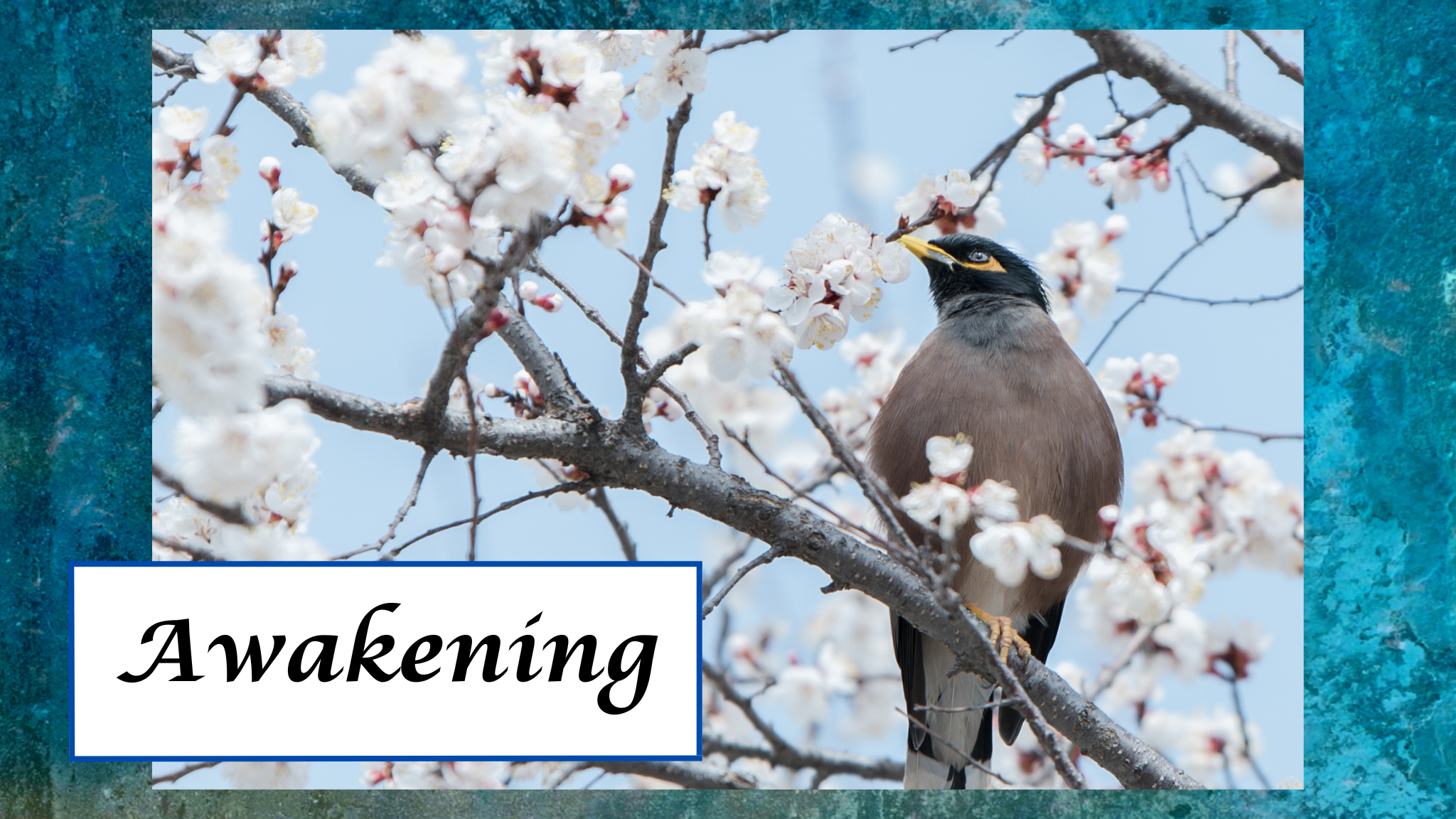
Awakening
I was alone on the lonely mountain when I heard thy voice in the song of a spring bird. I opened my eyes and beheld thy form. I looked within and found thee in my heart. The light of the new dawn has touched my soul and I am awakened with the vision of thy all-pervading universality and thy transcendental infinity.
I was alone on the lonely mountain when I heard thy voice in the song of a spring bird. I opened my eyes and beheld thy form. I looked within and found thee in my heart. The light of the new dawn has touched my soul and I am awakened with the vision of thy all-pervading universality and thy transcendental infinity.
When I came out to greet the dawn thy light touched my soul and filled my heart with the peace of thy bliss. Thy life animates the seed to grow into the beauty of a plant. Thy divinity inspires my soul to unfold the glory and grace of thy perfection. Thou dost reveal thy splendor through thy created universe. I look at the grandeur and beauty of nature and a feeling of adoration overfills my heart. I bow before the grandeur of thy form. I lose myself in thy formless being. It must be that my soul has touched thy glory. Then, O all-pervading God, unveil thy mystery which is hidden within me that I may realize thy perfection in my soul and manifest thy divine attributes in my life and self-expression.
The dawn heralds thy coming to my heart and the twilight opens the door of thy immortality to my soul. I gather the morning flowers in my hands and I feel thee everywhere. Would my garden of flowers be beautiful without thy light? Then touch my heart with thy divinity that all the virtues of love and grace may blossom forth in their fullest glory in my being.
Why do the flowers not bloom in the winter? Is it because the spring then would be devoid of beauty and loveliness? The beauty of spring draws thee closer to my heart. With devotion and purity let me receive thee nearer to my soul.
The flowers and the foliage are my fellow devotees. I worship thee in the companionship of these souls of thy creation in the temple of thy cosmic nature. Only the thought of thee inspires beauty in my heart; then the exquisitely sweet pansy must be in ever-adoring contemplation of thy perfection.
Nature has put on the robe of beauty and I behold thy permeating grace and glory in all and everywhere. As the little lake plays with the stars above so let my senses catch the beauty of thy manifested glory.
Some mystic hand must have painted the butterfly, else how could such exquisite colors have decorated its wavering wings? The bluejay gathers the azure from the sky above. The cardinal borrows its beauty from the setting sun. The violet draws its sweetness from the kindly earth, but my soul imbibes the glory of God from everywhere. Then let me in humility receive the grace of thy wisdom, power and love to inspire my heart.
Like the song of the morning bird let thy wisdom and love awaken me from the slumber of spiritual forgetfulness.
“Awakening” by Swami Premananda
From The Inner Path to God

Kriya Yoga
In this Kriya Yoga Meditation series we will examine the life and practice of Kriya. Each evening we will explore the abode of PEACE within us by our own personal effort and unfoldment. AUM-SHANTHI


Five Ways of Meditation
Meditation is a very broad term in the field of philosophy and religion. It includes all righteous efforts of mind, heart and soul that lead to enlightenment, revelation and realization. Enlightenment is the result of the right comprehension of truth. Revelation is the result of the inner unfoldment of truth. Realization is the perfection of becoming one with truth.
Meditation is a very broad term in the field of philosophy and religion. It includes all righteous efforts of mind, heart and soul that lead to enlightenment, revelation and realization. Enlightenment is the result of the right comprehension of truth. Revelation is the result of the inner unfoldment of truth. Realization is the perfection of becoming one with truth. Mind enquires and comprehends. Heart feels and unfolds. Soul recognizes and realizes. Meditation begins with the mind, it is inspired by the heart and perfected in the soul.
Meditation may be practiced in the following five ways:
1. Contemplation on a spiritual form or symbol. A spiritual form is the personified image of impersonal truths. A symbol is the visible manifestation of absolute ideals. The knowledge that an image or a symbol is but a finite representation of infinite truths and ideals must be recognized in this method of meditation.
2. Contemplation upon the spiritual qualities which are associated with a sacred form or symbol. It is the concentration of mind exclusively upon the sublime qualities of a symbol. In this meditation, mind and thought are lifted completely beyond form and finiteness.
3. Contemplation upon the divine attributes of one's own heart. Within the heart of each of us are enshrined all the attributes of divinity and perfection. Meditation upon each and all of these attributes fills the heart with inspiration, joy and blissfulness.
4. Contemplation upon one's own inner self as a spiritual being. By deep introspection we recognize within us a self-conscious self. It is totally independent of body and mind. It is completely free from all finite thoughts and impressions. It is a distinct individual entity. It is our spiritual self, our soul. Contemplation upon the spiritual self is meditation on the soul. The light of God illumines and liberates the individualized self-consciousness.
5. Contemplation upon the cosmic-consciousness. This is the unification of individual self-consciousness with infinite Self-consciousness. It is that inner profound meditation wherein the self, rejecting and transcending all subjective finiteness, becomes absorbed in meditation upon the absolute Self.
RAJA Yoga: The Yoga of God-Realization by Swami Premananda
(Translation and commentary on the first chapter of Patanjali’s Yoga Sutras)
Three Ways of Living
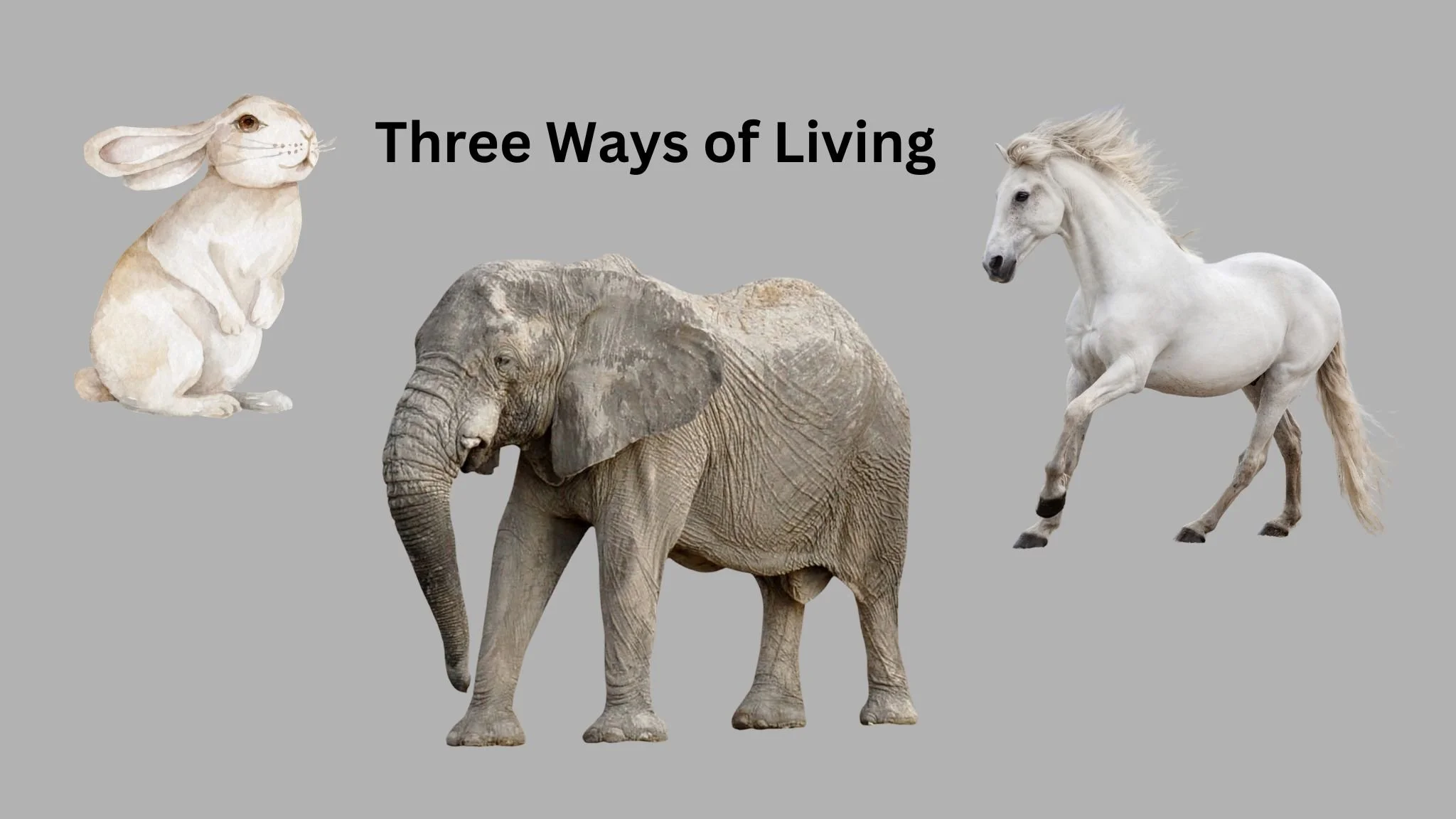
Buddha’s many stories are teachings, rich with illustrations from animal and human life, helping us to discover and perceive as he did that the Eternal lives with us here on earth in companionable ways. In one Nirvana Sutra (teaching on self-realization) he brought to mind three ways of living by describing how three animals - a hare, a horse, and an elephant - cross a river.
The power that Buddha attained in meditation gave him a penetrating vision into “everyday life.” A vision that was neither denial of nor escape from the world’s dual nature, but wise understanding of the freedom possible while living here.
Buddha’s many stories are teachings, rich with illustrations from animal and human life, helping us to discover and perceive as he did that the Eternal lives with us here on earth in companionable ways. In one Nirvana Sutra (teaching on self-realization) he brought to mind three ways of living by describing how three animals - a hare, a horse, and an elephant - cross a river. We can picture the animals and imagine how they each proceed. They bring to mind similarities in our own behaviors, linking us to other earthly beings with greater appreciation and compassion… and helping us to cross the “sea of samsara,” the ebb and flow in the currents of ever changing worlds.
In Buddha’s story, the hare must cross the river by skirting the flotsam, and hopping over the surface or else he will drown. Poor thing, he must be an escape artist in order to survive, nervously moving from here to there. There is nothing at all secure in his way of going.
The horse seemingly has an advantage over the hare. He can understand the current and stride deeper into the river, perhaps even crossing it safely because he can swim. He will have to struggle all the way, though, pushing and probing, while immersed in the currents, but he’s definitely better off than the hare!
The elephant is the only one of the three who moves forward steadily whatever the current, as his footing will always be solid and secure. Stride by stride, even if completely immersed in the flow of the waters, he is fearless, and will surely reach the other side.
In the story, the hare represents the most shallow way of human living, or one who lives as on the surface of life only; who is ever restless, afraid, and unable to bear any other responsible concern but his own physical survival, while traversing the ever-threatening river. He is helpless and continually changeable in his course, switching from one hope to another, ultimately ruled by external forces.
The human’s plight as typified by the horse, is only better than the hare’s by half. He will perhaps, “just get by” if he can swim, but the dual currents of life and death, joy and sorrow, fortune and misfortune, success and failure provide no stability to his course of crossing. Although he will be able to bear some weight of cares and responsibilities, the cycles of his crossing will be endless.
The elephant, the most noble of beasts in ths story, represents an enlightened soul, a bodhisattva who proceeds through whatever he encounters without trying to avoid difficulties, or desiring to escape them. He becomes ever stronger by his steady practice, and he penetrates into the depths of life‘s currents to cross the river without fear or suffering.
One who knows only the physical forms of earth, bound by their shapes, and colors, and words knows very little. His life remains shallow. But if he can go deeper, perceiving within them, the eternal thread of the ethereal web, he will find that all life is bound together in an essential unity.
By Srimati Kamala
The Forest of Forever
"Tapas" as Spiritual Discipline
The meaning of discipline in yoga is self-mastery. The Sanskrit term used by Patanjali expresses the goal: “Tapas” is “that which generates heat or energy.” Discipline in yoga philosophy as explained by Patanjali is the practice of directing or channeling energies towards a spiritual goal and thereby realizing greater light or energy.
The meaning of discipline in yoga is self-mastery. The Sanskrit term used by Patanjali expresses the goal: “Tapas” is “that which generates heat or energy.” Discipline in yoga philosophy as explained by Patanjali is the practice of directing or channeling energies towards a spiritual goal and thereby realizing greater light or energy. Discipline is not grim or negative, it is joyous and positive because it generates greater light and energy.
Tapas, according to Patanjali, is continuous and progressive practice of the balanced behaviors of yama and niyama. Yama is abstention in thought, word and deed from harming others, from falsehood, theft, incontinence and greed. It has an immediate constructive effect. All creatures feel better in the presence of one whose conduct is honest and peaceful. Thereby, greater peace and harmony are attracted to one who practices yama.
Niyama is the balancing discipline to yama, consisting of the cultivation of purity, contentment, study and devotion to God. Together, yama and niyama establish moral character until conflicting or distracting tendencies resolve harmoniously into a powerful character.
From “Frontiers of the Spirit” by Swami Kamalananda

The Philosophy of Love
Love is eternally within us. We feel its presence; we know it exists in us; we realize its power; yet we are unable to express it in words. Who has ever succeeded in giving the fullest expression of love in words?
Love is eternally within us. We feel its presence; we know it exists in us; we realize its power; yet we are unable to express it in words. Who has ever succeeded in giving the fullest expression of love in words? None. Love is transmitted from heart to heart, from soul to soul. In love we become silent. In the fullness of love, we are speechless. In love, our whole being vibrates in the rhythm of joy. Love needs no words to express itself. The moment we attempt to express love in words, it loses its charm, its magnetism is gone. Truly did the poet realize:
“When words are spoken, Love’s accent is soon forgot.”
Do not inquire about love, find it, live in it, and be immersed in the sweetness of joy. Love cannot be understood by intellect. Love dies when we try to analyze it. Love is a quality of soul, it is realized in soul alone.
By Swami Premananda, The Magnetic Power of Love (Bhakti Yoga)
My Journey
The time that my journey takes is long and the way of it long. I came out on the chariot of the first gleam of light, and pursued my voyage through the wildernesses of worlds leaving my track on many a star and planet.

The time that my journey takes is long and the way of it long.
I came out on the chariot of the first gleam of light, and pursued my voyage through the wildernesses of worlds leaving my track on many a star and planet.
It is the most distant course that comes nearest to thyself, and that training is the most intricate which leads to the utter simplicity of a tune.
The traveller has to knock at every alien door to come to his own, and one has to wander through all the outer worlds to reach the innermost shrine at the end.
My eyes strayed far and wide before I shut them and said “Here art thou!”
The question and the cry “Oh, where?” melt into tears of a thousand streams and deluge the world with the flood of the assurance “I am!”
By Rabindranath Tagore, Gitanjali

Isha: Philosophy of God-Consciousness
Whatever exists in the phenomenal universe should be perceived in the light of the consciousness of the supreme Self, Isha, God, Consciousness-Existence-Bliss Absolute
Whatever exists in the phenomenal universe should be perceived in the light of the consciousness of the supreme Self, Isha, God, Consciousness-Existence-Bliss Absolute. Know that all are impermeated by the divine Reality, God. Thus, renounce matter consciousness. By such renunciation realize the supreme Self. Do not follow the way of the worldly minded.
Man should desire to live the full measure of his life in this world; but he must do so by the performance of his duties, always with the ideal of self-perfection. Thus, his mind will not become a slave to sensory impressions. There is no path other than this to attain self-liberation.
That (Brahman, the Self) is One. The Self is immutable and self-composed. It is transcendental. It is more subtle than the mind. It is beyond the limits of sense perception. It is serene; yet It is more active than the mind or the sense faculties. Because of Its presence, Prana, the life-force, awakens and sustains the functioning powers of the body.
It creates; yet It is transcendental. It is far; yet It is the nearest of all. It resides within all; yet Its presence surrounds and extends beyond all beings.
The wise man perceives all as the manifestation of the One Self, his true Self, and he witnesses the One Self in every being. Because of this realization he hates no one.
(Isha Upanishad, v 1-2, 4-6)
Translated by Swami Premananda, Eight Upanishads

Peace of Self-Subjectivity
Every person craves self-composure and strength of calmness, yet few people are willing to devote even a few minutes of their day to find themselves in silence and solitude. Yet we can free ourselves from the habits of worldliness and get into the peace of self-subjectivity in many beautiful, meditative ways…
By Swami Kamalananda, The Mystic Cross
Do you know what happens to the mind that is unprepared, untrained, ignorant of its divine powers of pure self-reflection? It becomes afraid. Afraid to be alone. Afraid to be silent. Afraid to be calm. It is the greatest tragedy of life, because every person desires peace of mind. Every person craves self-composure and strength of calmness, yet few people are willing to devote even a few minutes of their day to find themselves in silence and solitude.
Yet we can free ourselves from the habits of worldliness and get into the peace of self-subjectivity in many beautiful, meditative ways: For instance, some people enjoy absorbing themselves in the thought of being part of the all-pervasive beauty and peace of God. They walk alone, “losing themselves” in the company of God in nature, communing with the vastness of the heavens above them or answering the hypnotic invitation whispered from a woodland stream at their feet. Who would’t be blessed by the subjective adoration? A love of the “inner life” includes finding in the quietness and loveliness of the world surrounding us a self-revealing subjective calm. This comprehensive mood of inspiration is a prerequisite for meditation. The habits of quietness, reverie and reverence for nature are themselves important components of meditation.
Meditation is the only way to self-enlightenment and peace, but unless one truly understands his subjective life he will encounter greater difficulties when he attempts meditating. Promised the bliss and spiritual attainments of meditation the novice initially elects it with enthusiasm. But what happens if he is subjectively unprepared is sadly predictable: He either becomes bored with meditation or restless. The reason? So long has his consciousness been dominated by and engrossed in the outer, sensory world that his uncultivated inner realm seems empty to him. Or worse, left unattended it has become cluttered. It is just as if one has been outside all day and returned home to find everything inside his home in disarray. How discouraging! Entering our subjective abode that has been neglected and unattended day after day from morning ’til night, our mind would surely turn inward and feel, “I want out of this!” The novice, having initially chosen meditation with enthusiasm now rejects it summarily. His unexplored power of introspection is weak—too burdened by worldliness, and also too weak to withstand the demands of the world…
To progress in meditation the mind draws revelations of light and truth from the current of the cosmic. It must have knowledge and love of its subject, the ability to focus and the strength of self-subjectivity to prepare it for illumination, fortified by sincere dedication and serenity.

Thread of Desire
When our desires are many, they overwhelm us. We don’t know which one to fulfill, when, or how. Yet, out of this maze of infinite desires, we find the soul’s one true desire: the perfection of absolute oneness.
By Srimati Karuna
When our desires are many, they overwhelm us. We don’t know which one to fulfill, when, or how. Yet, out of this maze of infinite desires, we find the soul’s one true desire: the perfection of absolute oneness.
A yearning develops within us to experience our true self. With this desire, we genuinely long for meditation. At this point, meditation is much more than a habit or a discipline. When we seek the life of meditation with an all-consuming desire, it is like longing for a breath of air while immersed deep in the water. All we desire is that breath.
This single desire becomes like the thread that passes through the eye of a needle. Everything we do becomes stitched with that thread. It transforms every aspect of our life with a single current of thought. In this current of thought, feeling, inspiration, vibration—we are completely absorbed—body, mind, heart and soul. It is a sublime surrender into the depth of our being.
——————————
“Since the beginning of creation, every soul has been endowed with the desire to regain its original state of absolute perfection. This desire inspires the spiritual aspirant to manifest his divinity in its fullest glory.
“Self-illumination is the ideal of meditation. Therefore, do thou practice Kriya with the sole desire for spiritual perfection so that thy physical, mental and spiritual nature may be directed to the realization of the highest good.
“Make thy meditation incessant. Desire not phenomenal powers. Be not misguided nor do thou falter in meditation. The Absolute is within. Keeping thy mind firmly directed to thy highest Self, continue in thy meditation. Let no discouragement overcome thee in thy joy and determination. Meditation always leads to self-realization.”
—Srimad-Bhagavad-Gita: The Revelation of the Self by Swami Premananda