
Bending Near the Earth
The Angels, Gracious Light of Soul, bending near the earth in me touched the golden harp strings of my heart and the worlds in silent obeisance lay to hear their voices: "Peace and Joy! Peace and Joy unto All!.”
“The Angels, Gracious Light of Soul,
bending near the earth
in me
touched the golden harp strings
of my heart
and the worlds
in silent obeisance lay
to hear their voices:
"Peace and Joy!
Peace and Joy
unto All!"
Upon this midnight clear
I listen to their
Word
resounding,
still.”
Swami Kamalananda
“Praise be to Allah, who created the heavens and the earth,
who made the angels, messengers with wings.”
Qur’an, Fatir 35:1
“Praise him, all his angels; praise him, all his heavenly hosts.
Praise him, sun and moon; praise him, all you shining stars.
Praise him, you highest heavens, and you waters above the skies.
Let them praise the name of the Lord, for at his command they were created.”
Psalms 148:2-5
“And there were shepherds living out in the fields nearby, keeping watch over their flocks at night. An angel of the Lord appeared to them, and the glory of the Lord shone around them, and they were terrified. But the angel said to them, Do not be afraid. I bring you good news that will cause great joy for all the people.”
Luke 2:8-10

Behold a Light
In our thought and meditation we are gradually revisualizing our life by the light of God. We are building our own spiritual home, a temple furnished and filled with the light of all the noble virtues of our own souls. We are making our own body a temple, a temple in which we meet God.
In our thought and meditation we are gradually revisualizing our life by the light of God. We are building our own spiritual home, a temple furnished and filled with the light of all the noble virtues of our own souls. We are making our own body a temple, a temple in which we meet God.
Meditation creates nothing new; it merely helps us to clear the way, to remove obstacles, to prepare ourselves in a pure and luminous way with pure consciousness as our goal. In revisualizing our life in the light of meditation there is nothing finite, nothing of ego, no desire, no selfishness. We seek life beyond all worlds and consciousness beyond all multiplicity of thought.
All the mystic centers within us are like inner chambers. If the doors remain closed, we pass by them unaware of what sublimity they offer. We pass by them unresponsive to their meaning.
Close your eyes. You may feel something exquisite—a promise of subjective depth, calm and serenity. Now look within, in deeper contemplation of its source. At first you may see nothing. It may seem to you that you are only peering into darkness. You may see nothing and feel nothing, and yet all that has ever been visible to you has come out of that invisible, latent potential.
Out of what is apparent darkness to the senses has come your thought, feeling, imagination and all creativity. If you keep peering into that stillness and depth, you will finally behold a light. That light is the light of all worlds, the light that illumines all mansions of consciousness. It is the light of the universe—and also the light of your own self.
In deeper meditation you will behold the source from which all the light you see now has come.
May our desire to meditate lead us into the consciousness of that divine light and energy within us.
By Swami Kamalananda
From The Mystic Cross

The Rabbit in the Moon
The figure that appears in the moon to Indians is not that of a man but a rabbit, and the story of how it got there is a lesson of charity brought through nature's own tender creature.
The figure that appears in the moon to Indians is not that of a man but a rabbit, and the story of how it got there is a lesson of charity brought through nature's own tender creature.
The story begins with three friends: a monkey, a fox and a hare, seemingly unlikely friends, to be sure. Among them the rabbit was respected as the wisest of the three, and so they lived together while sharing the sacred vow of his guidance not to kill other creatures. In fact, the hare's greatest urging was the need for compassion and self-sacrifice.
The story relates that the chief among the gods (Indra) came once to test the wisdom of the hare's charity. Approaching the three friends disguised as a beggar he said he was very hungry and pleaded with them for food. The monkey and the fox were at a loss: berries and meager fruits - their accustomed diet - would surely not be enough to satisfy the hungry beggar. As for the rabbit, who ate only grass, something unfit for human consumption, he too was at a loss.
Desperate that their guest should receive suitable hospitality, however, the rabbit came up with a plan: He would literally offer himself! He first lit a fire, then he shook himself until all the lice and fleas could escape from his fur, and then finally he jumped into the fire, intending to offer his own flesh as meat for their hungry guest.
Indra was then moved to act, for the hare’s extreme sacrifice Indra could not allow! (After all, the king of the gods is compassion and mercy personified.) So honorable was the rabbit’s charity to him that he mercifully interceded, preventing the flames from consuming our beneficent hare. Suddenly Indra revealed himself to the rabbit. Then - for all of us to learn forever more of true compassion and self-sacrifice - he dramatically painted the figure of the hare on the face of the moon.
Excerpt from The Forest of Forever
By Swami Kamalananda

Spirit of Generosity
Generosity is the expression of the soul living harmoniously, enlarging in consciousness and divine will. Life offers us at every turn the opportunity to be generous, charitable and giving.
The spontaneous spirit of generosity draws us naturally to God. Generosity is the expression of the soul living harmoniously, enlarging in consciousness and divine will. This spirit is expressed by contributing service: by meeting the world in every instance with the fullness of our hearts—through encouragement and compassion, appreciation and kindness, forgiveness and faithfulness. These are the gifts the world truly needs from us.
Life offers us at every turn the opportunity to be generous, charitable and giving. All our gifts have come from God.
Swami Kamalananda
Reflections on Still Waters

Gandhi and the American Indian
The entire religious experience of the American Indian—purification of mind and body, prayer and fasting, a strong personal relationship with God, meditation to learn from the “Great Mystery” its teaching beyond words—describes the spiritual heritage that nourished Mahatma Gandhi perfectly in one word: Yoga, the ideal of union of soul with God and the oneness of Man-God-Nature.
An Excerpt from Mahatma Gandhi: An American Profile
by Swami Kamalananda
The way of life of our first Americans has become increasingly meaningful to our society grown tired by competition and alienated by a standard of living based solely on the number of things a man possesses. We view with more appreciation the ancients’ ability to build a satisfying and colorful life without constant aid of gadgets. We look to discover their close kinship with nature and the world of the spirit, their zest for life, the value of silence and a soul at peace, and the need for a healthy life comprised of more than getting and spending.
The entire religious experience of the American Indian—purification of mind and body, prayer and fasting, a strong personal relationship with God, meditation to learn from the “Great Mystery” its teaching beyond words—describes the spiritual heritage that nourished Mahatma Gandhi perfectly in one word: Yoga, the ideal of union of soul with God and the oneness of Man-God-Nature.
The same ideal of Yoga drew the attention of Henry David Thoreau to study both the American Indian and the Indian of the East. He recognized in the American Indian a spiritual dignity and freedom attained through pursuit of the art of living studiously close to Nature and Mother Earth:
“The charm of the Indian to me is that he stands free and unconstrained in Nature, is her inhabitant and not her guest, and wears her easily and gracefully.”
Hence, to ponder the roots and kinship of Gandhi’s idealism in America, I do not start with Emerson’s philosophy of the Oversoul (Brahman) nor with Thoreau’s ideas “On Civil Disobedience.” It was our native Americans who first established the spiritual current of Mahatma Gandhi’s thought in America.
Followers of the Eternal Way
As a Hindu, Gandhi called himself a follower of the ancient ideal of Sanathan Dharma. Dharma refers to the cosmic principle or law. Sanathan designates that reality as eternal, abiding and sustaining. Believing in the essential oneness of all life in the Eternal Dharma, one aspires to center and to harmonize his life in that indwelling, supreme life-intelligence-love.
The American Indian distinguished himself by the same persistent characteristic perception of himself and of his relation to the universe around him. He centered his life in the natural world, committed to its spiritual bonds for his self-awareness, ethics, joys, and aesthetics, as well as for his religious practices. Religious rites varied among the tribes, but the purpose remained the same as that of the Hindu: a seeking for an infusion of the divine power through the medium of the natural world of universal forces.
Usha, the Dawn, lifts her gaze over the horizon and illumines the world of man with her embrace of living light. The devotee enters the river to bathe with the prayer that the holy stream of life may purify and bless him with the realization that the same divine power links life within and without.
Gandhi, too, was nourished by the daily purification of body and mind by the indwelling spirit:
“Just as this physical purification is necessary for the health of the body, even so spiritual purification is necessary for the health of the soul…Far more indispensable than food for the physical body is nourishment for the soul. One can do without food for a considerable time, but a man of the spirit cannot exist for a single second without spiritual nourishment.”
Compare that bhav (“state of consciousness”) persisting for millenniums through India’s spiritual heritage to the manner of worship described by Ohiyesa, Santee Dakota physician and author in 1911:
“In the life of the Indian there was only one inevitable duty—the duty of prayer—the daily recognition of the Unseen and Eternal. His daily devotions were more necessary to him than daily food. He wakes at daybreak, puts on his moccasins and steps down to the water’s edge. Here he throws handfuls of clear, cold water into his face, or plunges in bodily. After the bath, he stands before the advancing dawn, facing the sun as it dances upon the horizon, and offers unspoken orison. His mate may precede or follow him in his devotions, but never accompanies him. Each soul must meet the morning sun, the new sweet earth and the Great Silence alone!”
Nature
“There is an orderliness in the universe; there is an unalterable law governing everything and every being that exists or lives. It is no blind law, for no blind law can govern the conduct of living beings.” – Gandhi
Gandhi’s views of the responsibility of man to live morally and in harmony with God’s nature are basic to his philosophy of ahimsa and the teaching of the ancients in India, a reverence for the life of all beings.
To one believing in a natural order of the world, our well-being is related to the order around us. In Hinduism this harmony with the purpose of the cosmic spirit is called Rta, meaning rightness, order, and balance.
Gandhi respected the powers of nature for purification, and based his ideas about health on a conviction that disease can be prevented (or cured) if one lives naturally in harmony with nature’s forces.
The American Indian’s reverence for nature with a deep feeling for the world of the Spirit is his greatest legacy to our life. What Western culture will one day relearn from him is the synergetic relatedness of life—that is, that the experience of the whole is greater than the sum of its components, and that the “experience of the whole” comes not from accumulation of its components but from awareness of kinship in the integral whole. Native American wisdom says, “We are many selves looking at each other through the same eye with different lenses.”
Respecting Earth and her gifts, the Apache Indian deemed it man’s arrogance to leave his impression on her. How similar the reverence of the East Indian Bharatanatyam dancer, who begins every performance by touching her shoulders and then the ground, symbolically removing her vanity and then with humility bowing to touch Mother Earth in thanks for the privilege of dancing on her.
The American Indian’s aesthetics, like Gandhi’s, was marked by his perception of the world—its powers, properties, spiritual values and essences. Form, language, and imagination were powers by which relationships of the Great Spirit could be realized and conveyed, used for healing and strength.
To the Hopi, evergreens, seashells and furs symbolized their close spiritual ties with nature. Corn was of special significance: The Earth Spirit, it is believed, gave the Hopis corn when they entered this world long ago. “Maize” is mysteriously unique in its relationship with man as it is the only grain requiring his assistance in its regeneration. Because man must plant the seedgrain, its yield was much more to the Hopi than physical nourishment.
Prayer
Traveling through the countryside in India one sees here and there in the midst of a field or rice paddy or by the roadside, small stone altars. The small temples or altars are there out of respect for the Source of life and its place in the midst of man’s labors.
The American Indian, too, prepared a place for prayer in his fields. One could witness in the center of the Hopi’s cornfields prayer shrines made from a bower of evergreen branches from which fluttered prayer feathers—soft white eagle feathers carrying messages from this world to the spiritual one.
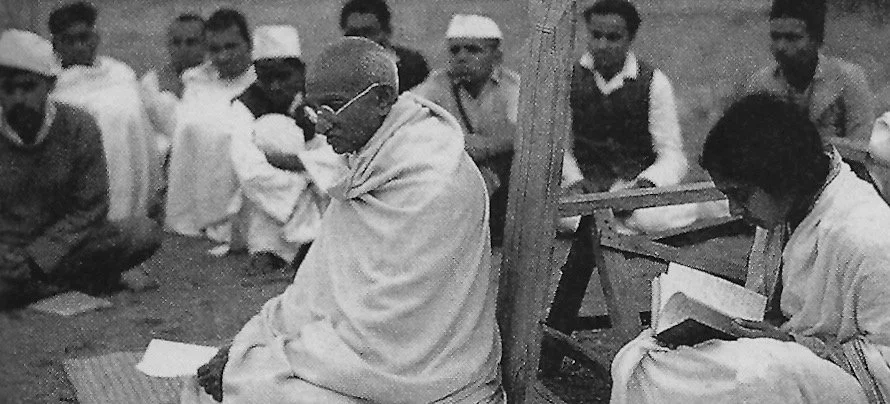
Prayer was central in the daily life of Mahatma Gandhi as well. Though he acknowledged the place of churches, mosques and temples containing images appropriate to the symbolic tendency and temperament of worship for many, he himself chose open-air prayers in the midst of the day’s work wherever he travelled, lived and worked.
For the congregational morning and evening prayers at his ashrams there were no images of any kind, only the “eternally renewed temple of worship under the vast blue canopy inviting every one of us to real worship.” Those who gathered, assembled sitting on the ground. Gandhi would speak of the healing and mothering power of the earth and of the feeling of being close to its soil which, according to Ayurvedic medicine, is strengthening, cleansing and healing.
Chief Standing Bear speaks of the Lakota, the tribal name of the western bands of Plains people now known as the Sioux, as worshippers on Earth’s lap, too:
“…the old Indian still sits upon the earth instead of propping himself up and away from its life-giving forces. For him, to sit or lie upon the ground is to be able to think more deeply and to feel more keenly; he can see more clearly into the mysteries of life and come closer in kinship to other lives about him.”
A Legacy
Philosophy took on life for Gandhi and the American Indian in a legacy that our futures must seek to emulate if we, like they, are to realize the fullness of life. A soul at peace, a balanced life, respect for leisure and shared enjoyment are all needed for a healthy life.
To Gandhi, the art of living meant pursuit of Truth, the cultivation of simplicity and high-mindedness as the secret of freedom and real happiness. The American Indian, too, found wealth not in his material possessions but in his spiritual well-being. He demonstrated to us an ability to find richness in being close to Nature.
City of Light
Serve and guard the light, never allowing doubt, distrust, or despair to creep into your life. Bring the light of goodness and godliness to your own Prag-Jyotis-Pura and keep the lamp lit to draw others to their divine light. Try to see the same light in nature—the light that draws all life together, that emanates from one source and that leads, draws and guides all life onwards.
The world's spiritual lore abounds with the symbols of hope and faith in the light of God, with the recognition that man, too, is led by the light from which the whole universe is projected, from darkness to light, and from the unreal to the Real. Light and illumination is the cosmic message of life. For man, it becomes ultimately a totally subjective experience of life, the supreme realization of God.
The hope and the life of our world is to light the lamp of godliness in our own lives. Mindful of apparent darkness which seems to envelope us we must continue to pray for the light of God to appear. The light will shine within us. All the divine qualities of soul will arise by the power of divine light and truth to radiate their beams of loveliness and draw others to illumine their own divine lamps.
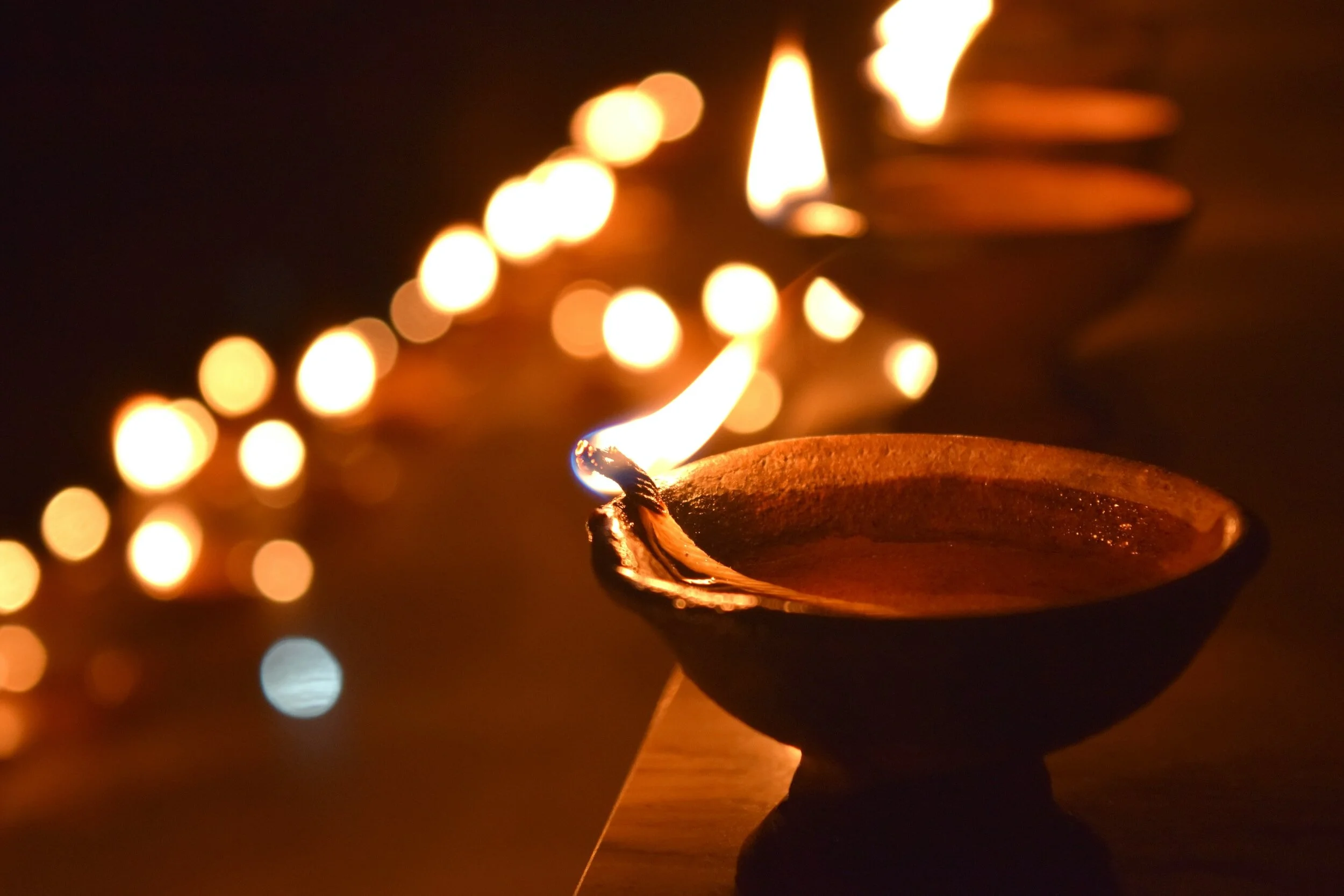
Such is the symbolic meaning of the festival of Diwali with a sublime message of the reality and power of light. (Diwali is from deep, or div—for light, from which comes our word divine.)
Diwali takes place on a dark night in October or November according to the lunar phase, marking the advent of winter. Houses everywhere are illuminated with myriads of twinkling earthenware lamps to welcome the saviour spirit of goodness, righteousness, truth and wisdom. The festival of light derives from the following message:
Narakasura, a demon king, has kept imprisoned 16,100 princesses. Naraksura is the personification of the three forces of darkness (unbridled desire, anger and greed) which lead us away from the light of perfection. He is the ego which seems to hold the divine self in its clutches.
Lord Krishna, in answer to the prayers of the princesses, proceeded to Prag-Jyotis-Pura with his lieutenant Satyabana who slayed Naraksura and freed the princesses. Thereupon, the princesses all requested to marry their saviour, Krishna.
Wherever darkness seems to hold the power of righteousness captive; wherever there develops a philosophy of life with wrong foundation; wherever the awareness of godliness wanes; whenever there is forgetfulness of the forces that make for the real happiness; whenever the forces of illlusiveness and self-destructiveness seem more alluring or formidable than divinity… our divine qualities (the princesses) seek to be saved by divine light (Krishna) as aided by the eternal power of truth (Satyabana). When He is prayerfully sought, God comes into our human life to free our soul, to draw us to oneness with Him. Prag-Joytis-Pura means the City of Light, a reference to Ajna, the chakra of subjective revelation.
The story is founded in the philosophy of creation itself: at a certain period of each cycle of creation the Eternal Dharma appears to be under a cloud. Life seems lustreless, darkened by adharma (that which is contrary to the cosmic good). The powers of light (true perception and right discrimination) of the people become subdued. The light of intelligence grows dim, dominated by the three tendencies of darkness: lust (kama), anger (krodha) and greed (lobha). When kama obscures enlightened desire, there is no chance for reasonable restraint. Unlimited indulgence prevails wantonly. When krodha darkens the higher will, compassion and forbearance give way to ruthlessness and rashness. When lobha clouds the expansive powers of light, selfishness plunders the earth.
Think of nations and civilizations of men in the times when the divine light seems forgotten. We lose our way into unrighteousness, unbridled selfishness and greed.
Then, when the struggle seems hopeless; when, as in the darkest hour before dawn deliverance seems impossible; when godliness and goodness seemed thwarted and submerged—light emerges. It is at such critical junctures that the light of divinity is reborn to guide humanity, to awaken the ignorant and to reveal the Eternal Dharma.
Our life in this world is a process of self-illumination. One must learn to meditate on the life of his soul from this point of view. Serve and guard the light, never allowing doubt, distrust, or despair to creep into your life. Bring the light of goodness and godliness to your own Prag-Jyotis-Pura and keep the lamp lit to draw others to their divine light. Try to see the same light in nature—the light that draws all life together, that emanates from one source and that leads, draws and guides all life onwards. We live in a universe of heavenly light, and a universe of heavenly light lives in us.
Swami Kamalananda
The Mystic Cross

Who Weaves the Web
He it is who weaves the web of this maya in evanescent hues of gold and silver, blue and green, and lets peep out through the folds his feet, at whose touch I forget myself.
Marbled Orb Weaver Spider
He it is, the innermost one, who awakens my being with his deep hidden touches. He it is who puts his enchantment upon these eyes and joyfully plays on the chords of my heart in varied cadence of pleasure and pain. He it is who weaves the web of this maya in evanescent hues of gold and silver, blue and green, and lets peep out through the folds his feet, at whose touch I forget myself. Days come and ages pass, and it is ever he who moves my heart in many a name, in many a guise, in many a rapture of joy and sorrow.
Rabindranath Tagore, Gitanjali

The Cosmic Vibration of Prana
Astronomers bring us to the threshold of pure Yoga philosophy with their assertion that we see only ten percent of our universe. The ninety percent that is imperceptible to our senses exists as potential to be penetrated by our minds. We must bring that light of consciousness within our minds to a similar state of vibration of cosmic light to be aware of the rest of the vast, yet unseen, universe.
Prana, drawn through the mind, is the link between consciousness and energy. A very simple illustration shows how we intelligently use this prana: I am “talking” to you. My mind is in a certain state of pranic vibration. I am trying to awaken a response, a sympathetic vibration of consciousness, within you. Whether we attune in sympathy, interest and understanding or not depends on the awakened prana in each of us. All consciousness in the same state of vibration “sees” one another. Attunement, empathy and healing employ prana in this way. This little wave of prana which is uniquely ours in the infinite ocean of prana is what we use in meditation as “pranayama.” Breathing does not produce motion or vibration of prana in the body. On the contrary, it is prana that produces breath and prana that moves the lungs.
“Pranayama” is a compound word, “-ayama” bringing the idea of “harmonization” to the word prana. The motivation and goal of pranayama is entirely spiritual, that of self-realization, although its practice involves respiration, mindful breathing and meditation. We can understand, then, that the benefits are far-reaching: the composite well-being of our body, nervous system and mind. Pranayama enhances self-discipline, equanimity, subjective coordination, concentration and purity, all essential for meditation and spiritual progress.
Beneficent and powerful wills throughout time have brought prana to states of vibration within themselves whereby they have been able to “sway the world” and draw others unto them. Suppose one understood prana completely? What power would not be his?
The mystery is no secret, and the awareness of its marvels is what one should develop more than anything in life. The more we explore it the more we find confirmation that every plane of our existence is related to every other plane. By mastering this knowledge, we can expand and enhance our life. If we neglect it, we lessen our experience of life’s greatest power, beauty and joy.
The universe of cosmic energy, or prana, exists in two tendencies: one is unmanifest, the other manifest. The unmanifest exists as the vast potential of formless being out of which the universe arises. It is self-absorbed—that is, with the power to be, but without change. The second tendency of prana is dynamic and creative: that which manifests and which we see as matter, as living organisms, and all that we behold with our minds. Astronomers bring us to the threshold of pure Yoga philosophy with their assertion that we see only ten percent of our universe. The ninety percent that is imperceptible to our senses exists as potential to be penetrated by our minds. We must bring that light of consciousness within our minds to a similar state of vibration of cosmic light to be aware of the rest of the vast, yet unseen, universe.
Swami Kamalananda
The Breath of God and Pranayam

Universal Love
One who is completely free from ill will and is friendly and compassionate towards all, who has overcome attachment and egotism, who is self-composed in pain and pleasure, and forgiving, who is ever content, meditative, serene, resolute in spiritual effort, and whose mind and intellect are dedicated to me; he who is thus devoted to me is dear to me.
Selection from the 12th Chapter of the Bhagavad Gita
Translated by Swami Premananda
One who is completely free from ill will and is friendly and compassionate towards all, who has overcome attachment and egotism, who is self-composed in pain and pleasure, and forgiving, who is ever content, meditative, serene, resolute in spiritual effort, and whose mind and intellect are dedicated to me; he who is thus devoted to me is dear to me.
He by whom the world is not afflicted and who is not afflicted by the world, who is not carried away by emotion, and who is free from envy, fear and anxiety; he is dear to me.
He who is not ruled by sensory desires, who is pure, wise and competent, unattached, undisturbed, free from egoistic motive; he who is thus devoted to me is dear to me.
He who is neither overbearing in the joy of achievement nor negatively depressed in failure, who is neither abased by misfortune nor greedy of gain, who has renounced the concept of relative good and evil and is full of devotion; he is dear to me.
He who is equal to friend and foe, serene in fame and insult, heat and cold, pleasure and pain, and free from attachment, self-composed in praise and blame, wise in speech, content amidst all circumstances, unattached to this abode of life, and calm of mind; such a devout heart is dear to me.
But those who follow this immortal path of devotion exactly as herein propounded by me, with faith and regarding me as the supreme goal; such devotees indeed are exceedingly dear to me.

The Birthright of Every Soul
The purpose of Yoga is seeking our largest, most enduring and most powerful identity. In this process we realize a potential consciousness that may seem dormant or undeveloped but is ultimately the most powerful, meaningful and sublime reality of Life.
An excerpt from: The Breath of God and Pranayam
By Swami Kamalananda
Our physical or material life is only one aspect—actually the smallest—of our experience as a human being. Our physical self endures less, extends less and expresses less than who we are to ourselves and to others.
The purpose of Yoga is seeking our largest, most enduring and most powerful identity. In this process we realize a potential consciousness that may seem dormant or undeveloped but is ultimately the most powerful, meaningful and sublime reality of Life. According to Yoga, “salvation” is the birthright of every soul!
Meditation begins with this invaluable recognition: With every breath, as we sit humbly on earth, we are dynamically connected with the entire Cosmic Life Breath and its Perfection.
We can strive to fulfill our humanness (that is Divine) or we will suffer living as less than fully human. Interestingly, Rabindranath Tagore explained our divine potential as a surplus—not as something extra that we do not need, but as a faculty greater than what our senses or our minds can provide. All of us are endowed with this faculty for self-realization. It is our birthright, our “raison d’être” that awaits our exploration. Awakening to the divine purpose of our life is itself a powerful transformation.
Gandhi and the Sermon on the Mount
Journalist and author, Vincent Sheean wrote the following description of Gandhi, saying that Gandhiji “was so penetrated with the truth and beauty he felt in the verses of the Sermon that through years of effort he actually became something like a summation of the Beatitudes, the meek, the merciful, the pure in heart, the peacemaker. His reverence for Jesus and the Sermon on the Mount illumined his long struggle and gave him strength for it.”
Mahatma Gandhi regarded the Sermon on the Mount and its assertion of the law of love as eternal wisdom. We know the Sermon on the Mount as a collection of sayings and moral teachings of Jesus, found in the Gospel of Matthew, in the New Testament of the Bible. It takes place relatively early in the Ministry of Jesus after he had been baptized by John the Baptist, and after he had finished a period of fasting and meditation in the desert. Jesus had been "all about Galilee" preaching and "great crowds followed him.” Seeing the multitudes, Jesus goes up unto the mountain and after he sat down his disciples came to him, and he began to teach them.
Charles Freer Andrews a close friend of Mahatma Gandhi, wrote the following: “Very early in my life, while engaged in the study of the Sermon on the Mount, the discovery came to me which every learner makes sooner or later, that Christ’s words in these chapters are not a series of beautiful proverbs, loosely strung together, but an amazingly perfect description of character at its highest point. Christ sets before us, in each moral issue that he raises, the standard. He speaks to us, not from theory but from practice. His example is all the while before us; and when He tells us that nothing less than perfection is to be our goal, we remember with awe that He has not only set that standard, but also attained it… ‘Be ye perfect,’ he bids us with good cheer, ‘even as your father which is in heaven is perfect.’ And ‘Seek ye first the Kingdom of God and his righteousness, and all these things shall be added unto you.’ Christ was born in a village and spent His youth and early manhood as an artisan. He lived His own life in close touch with the fields and the hills. He was constantly engaged in friendly intercourse with the country folk, who loved homely stories and rhyming proverbs. To these rather than the learned He spoke first His universal message, and in this plain and direct way.”
What are the Beatitudes but the teaching and realization of humility, compassion and love:
Blessed are the poor in spirit, for theirs is the Kingdom of Heaven.
Blessed are those who mourn, for they shall be comforted.
Blessed are the meek, for they shall inherit the Earth.
Blessed are those who hunger and thirst for righteousness, for they shall be filled.
Blessed are the merciful, for they shall be shown mercy.
Blessed are the pure in heart, for they shall see God.
Blessed are the peacemakers, for they shall be called children of God.
Blessed are those who are persecuted because of righteousness, for theirs is the Kingdom of Heaven.
Journalist and author, Vincent Sheean wrote the following description of Gandhi, saying that Gandhiji “was so penetrated with the truth and beauty he felt in the verses of the Sermon that through years of effort he actually became something like a summation of the Beatitudes, the meek, the merciful, the pure in heart, the peacemaker. His reverence for Jesus and the Sermon on the Mount illumined his long struggle and gave him strength for it.”
In the Sermon on the Mount Jesus not only brings forth the beatitudes but He also presents us with the Lord’s prayer. Prayer had a very important place in Gandhi’s ashrams. In fact, each day commenced with congregational worship from 4:15 a.m. to 4:45 a.m. and the day closed with evening prayer from 7 to 7:30 p.m. He experimented with the timing of the morning prayer but finally settled upon the earlier time (with a wake up call at 4 a.m. to give everyone in the ashram time to wash and arrive for prayer which was held under the canopy of the sky. He said in all countries of the world, devotees of God and tillers of soil rise early!
Gandhiji felt that without prayer there is no inward peace. He said that “If insistence on truth constitutes the root of the ashram, then prayer is the principal feeder of that root.” This brings us back to his appreciation for the Sermon on the Mount and the Lord’s Prayer when Gandhiji said: “There is really only one prayer that we may offer. ‘Thy will be done.’ After all, what do we pray for? Is it not simply that God should be ever victorious in our own hearts?”
We often hear the beautiful words in Arabic… In-Shallah. God-willing. Think of the significance of these words. In our daily life, how often do we think, speak and work with the thought of God and higher Truths. It is a source of resignation to the will of God, “In-Shallah”… But it is also our challenge to learn what is the will of God in light of Eternal Truth of all. Thinking of the will of God… is not merely leaving things to chance. There is an important element of responsibility placed on us to realize, to understand and to know the very Truth of our life. After all, it is Truth that shall set us free. Even Jesus was careful to discriminate between the real and the unreal, Truth and the untruth, to sort out what was God’s will and what was not. This requires us to lift our consciousness to a higher state, to realize the perfection of soul.
Gandhi said, “The Sermon on the Mount went straight to my heart. I compared it with the Gita. The verses, 'But I say unto you, that ye resist not evil: but whosoever shall smite thee on thy right cheek, turn to him the other also. And if any man take away thy coat let him have thy cloak too,' delighted me beyond measure and put me in the mind of Shamal Bhatt's 'For a bowl of water, give a goodly meal’.” Shamal Bhatt was a medieval Gujarati narrative poet and Gandhi related his poem to the message in the Sermon on the Mount. Bhatt's expression is one of returning tenfold goodness to whatever is done to us.
Gandhiji said: "A Gujarati didactic stanza...gripped my mind and heart. Its precept: return good for evil—became my guiding principle. It became such a passion with me that I began numerous experiments in it.” And Gandhiji quoted the wonderful lines of this stanza in his autobiography:
For a bowl of water give a goodly meal;
For a kindly greeting bow thou down with zeal;
For a simple penny pay thou back with gold;
If thy life be rescued, life do not withhold.
Thus the words and actions of the wise regard;
Every little service tenfold thy reward.
But the truly noble know all men as one,
And return with gladness good for evil done.
Closely resembling the teachings of Jesus in the Sermon on the Mount, this poem resurfaced in the mind of Gandhiji from his youth and he renewed his dedication to its message by carrying it out in the activities of his life. He said: “My young mind tried to unify the teaching of the Gita, The Light of Asia and the Sermon on the Mount. That renunciation was the highest form of religion appealed to me greatly. This reading whetted my appetite for studying the lives of other religious teachers.”

Light of Pure Consciousness
How do we utilize the light of consciousness, the knowing faculty of the soul? We can describe the ways that the light of pure consciousness manifests and grows in “terms of enlightenment.” First of all, the soul, as God in man, is Pure Consciousness, Suddha Chaitannya.
How do we utilize the light of consciousness, the knowing faculty of the soul? We can describe the ways that the light of pure consciousness manifests and grows in “terms of enlightenment.”
First of all, the soul, as God in man, is Pure Consciousness, Suddha Chaitannya. Our soul is from the Light which illumines the whole universe. In its power of self-awareness the soul is pure light. When we speak of consciousness, we usually refer to the buddhi, the knowing faculty of the soul, and the various ways in which the spirit manifests and grows in light.
Intelligence is that light of consciousness which is engaged in the world of name and form. It is the power of knowing which “forms” the infant from his birth, showing as his curiosity, his recognition and his assimilation of what he knows throughout life.
With the light of intelligence one builds his character: Some people’s character lacks lustre—because the quality of materiality of what their intelligences builds makes the mind itself dull (“tamasic”). With others, the light of their intelligence is more active, generating continuous movement of mental power with a sense of continual change, but with no peace or depth. (Their mind is “rajasic.”) In some, the light of their intelligence seems to gather and build a character that is harmonious and luminous, and their minds attain a clear, peaceful (“sattvic”) state.
Ignorance, spiritually speaking, is the mind in darkness. Buddha called ignorance sin, because in ignorance man behaves oblivious to the sacred life of the soul. Christ called the unawakened or ignorant “the dead,” because, unaware of the life of the soul they suffer death. Fearing mortality, the ignorant choose the vain over the real.
Wisdom: Contrary to knowledge, it is the opening of the inner eye to the light of the soul. Intelligence projects the light of the soul into the external world, seeing diversity, name and form. The light of wisdom, however sees unity. Wisdom is illumination by the light within. It permeates the spirit of things, finding the essence of harmony. It ascends to the Truth and the Beauty of God.
There are other terms that belong to the light of wisdom, such as inspiration, intuition, vision and revelation.
Inspiration is the light which arises in purity and joy from the depth of the heart. That light manifests as creations of harmony and beauty in the works of art, literature, music and science—in any work in which one concentrates with great love.
Intuition is the direct light of truth perceived by the mind independent of the processes of logic or reason. Sometimes an object or condition from the external world will trigger the flash of intuition that the mind receives as the direct guidance. All souls are potentially intuitive, but in many the faculty is dormant and undeveloped. Without confidence in the exercise of intuition, many people go against this capacity of wisdom and become closed to its wonderful light. There is a fineness and spiritual responsiveness in those souls who have developed their power of intuition.
Vision is the light-beam of wisdom which peers into the unfolding cosmic plan. Its focus is directed by the ideal of Perfection which sees limited conditions as they exist in Truth. Vision has a purely beneficent power to influence the course of unfolding life.
Revelation is the illumination of soul entirely from within. It is a light entirely unknown, lost, to the external world. For this light alone, the soul has come. To lift the veil of creation and to disclose pure light our soul has come.
From The Mystic Cross
By Swami Kamalananda

That Indwelling Power
We intuitively know that within our innermost self abides the power of Spirit, the power which is so benign and efficacious that it must have its origin in God. When we become consciously aware of the presence of that indwelling power, a new inspiration quickens our hearts and minds.
We are made in the spirit of God. This is the most sublime revelation we have attained in our advancement towards the realization of the highest goal of human existence. We are immortal spirit dwelling within this transitory body. God has created us in his spirit and he has endowed us with the very essence of his transcendental Self. He has infused into our soul all the qualities which are eternal and infinite. We instinctively feel that his divine potency is hidden within us. We intuitively know that within our innermost self abides the power of Spirit, the power which is so benign and efficacious that it must have its origin in God.
When we become consciously aware of the presence of that indwelling power, a new inspiration quickens our hearts and minds. A resplendent dawn of divine revelation awakens us to a realm of spiritual illumination wherein we gain direct perception of the immeasurable power of soul. An inner certainty stimulates our entire being with subjective vigor and strength. An indomitable courage, enlivened with sublime idealism, lifts our vision and aspiration, and we realize that the power of God is within us.
Life is creative progress. Progress is power in creative fulfillment. All true achievements are the results of the wise application of the power with which God has endowed us. In the course of civilization’s successive stages of growth, the vast constructive advancement which we have secured in our objective life is in final analysis, the fruit of the right utilization of God-given power enshrined within us. Each accomplishment that we have gained and every object that we possess in our outer life give concrete evidence of the existence of the extramundane power within us which is not only ever creative but also inexhaustible. The enormous progress that we have already made in the sensory world bears witness to the tremendous power that we carry within ourselves.
But it is in our inner life of spirituality that we attain to the full realization of the immensity and supremacy of the power which the omnipotent God has established within us. In our subjective struggle and unfoldment do we well comprehend the force and magnitude of our innate power.
From The Blessedness of the Inner Life
By Swami Premananda

Ideal of the Spiritual Life
The spiritual life has only one ideal, the realization of the Supreme Spirit, Brahman, God. The theoretical and intellectual knowledge of God is not enough; in fact it is of secondary importance in our spiritual endeavor. What is of supreme importance in our spiritual aspiration is that each of us must attain the realization of God within his own effulgent cosmic pure consciousness, for thus alone we reach Kaivalyam, we become the absolute One.
The Upanishads are quite clear and emphatic regarding the truth of spiritual life. The spiritual life has only one ideal, the realization of the Supreme Spirit, Brahman, God. The theoretical and intellectual knowledge of God is not enough; in fact it is of secondary importance in our spiritual endeavor. What is of supreme importance in our spiritual aspiration is that each of us must attain the realization of God within his own effulgent cosmic pure consciousness, for thus alone we reach Kaivalyam, we become the absolute One.
Foreword to Kaivalya Upanishad by Swami Premananda
Then the true devotee of self-realization, in whom all personal and objective desires have ceased to exist, approached the great Master with veneration and said: Venerable Sir, teach me the knowledge of Brahman, the one and the absolute God and also the way to attain to the realization of that transcendental Spirit whom the wise constantly seek after, who is hidden in all and by the light of whom one, in due time, gains complete freedom from all subjective finiteness and limitations and becomes one with the supreme Self.
The venerable Master said to him: Seek to realize Brahman by unconditional and abiding faith, supreme devotion, profound meditation and by the practice of the spiritual yoga, the subjective communion of mind with self and self with Self-Consciousness.
The self-disciplined and enlightened devotees who have rightly recognized that scriptural learning is not sufficient to receive spiritual illumination and who have purified their minds and hearts, thoughts and emotions by the practice of subjective renunciation of sensory desires and ego, they, without being distracted by the limitations of the concept of time, meditating on the attributes of God and thereby becoming one with the eternal Brahman, attain to self-liberation.
By perceiving the self in all beings and all beings in the self the devotee attains to the realization of Brahman.
Kaivalya Upanishad (translation by Swami Premananda)
Included in Eight Upanishads by Swami Premananda
Our Legacy and Our Future
In religion, in the arts, in science, as in many fields of human relations and vocations, representatives as pinnacles of achievement emerge to help us and to teach us. We continually turn to those whose examples we need and respect for their experiences to inspire and nourish our development. In their presence and with their encouragement and guidance, we find ourselves ennobled and enriched.
O Lord, grant our respected gurus spiritual strength and purity that they may be guided by Thy Light and inspired to dedicate their life to the service of humanity. —Rig Veda
In religion, in the arts, in science, as in many fields of human relations and vocations, representatives as pinnacles of achievement emerge to help us and to teach us. We continually turn to those whose examples we need and respect for their experiences to inspire and nourish our development. In their presence and with their encouragement and guidance, we find ourselves ennobled and enriched.
However great the legacy, its future depends on us, on our pure efforts. Great masters have come as examples, to awaken and to lead us on the path of self-realization. The precepts they lay down are broad principles to be developed and lived by their followers. Great teachers will come again and again. They provide the ground-work with teachings that, like spring rains, will wash over and nourish newly-awakened life. They plant seeds which, when cultivated, will bear fruit later.
It is for each person to step from legacy into a creative future. Truth asks us to be bold and creative, fresh with our own God-given energies and discoveries as the future opens within us. Quantum knowledge in physics did not end with Newton’s law. Was it left for his followers to sit and watch apples falling? No! Along came Einstein to open new thought and new areas, to loyally fulfill the known and then to build. Others have followed him into new frontiers.
The precepts of self-knowledge and self-realization are imparted to us according to a tradition known as “guru-shishya parampara,” ( i.e., personally, “from guru to disciple”). I emphasize the word “personally” to indicate the mutual kinship of responsibility, devotion and respect. Mature masters lay down broad principles, not only specific information or methods. Theirs is the groundwork for experiences by which others may delve into and grasp even greater truths and experiences. Wisdom will always bear fruit in due course when rightly followed.
Good teachers and good students know that higher proficiency in any field does not come immediately or automatically, as if accelerating by a “fast-forward” mode. Focused practice, knowledge and patience must infuse every effort. We can feel comforted with the recognition that we always exist as participants in the ocean’s vastness even as we begin to swim on its shallow shores.
Methodically we take the hand of the guru-ideal at the base of the spiritual tower. There can be no impatience or rushing to reach any higher level or vision. We must learn to enjoy our life’s attainment fully at each level. Not to worry; greater attainments will await us! From wherever we are, we learn to proceed with confidence and patience. Then only will we progress to greater understanding and proficiency.
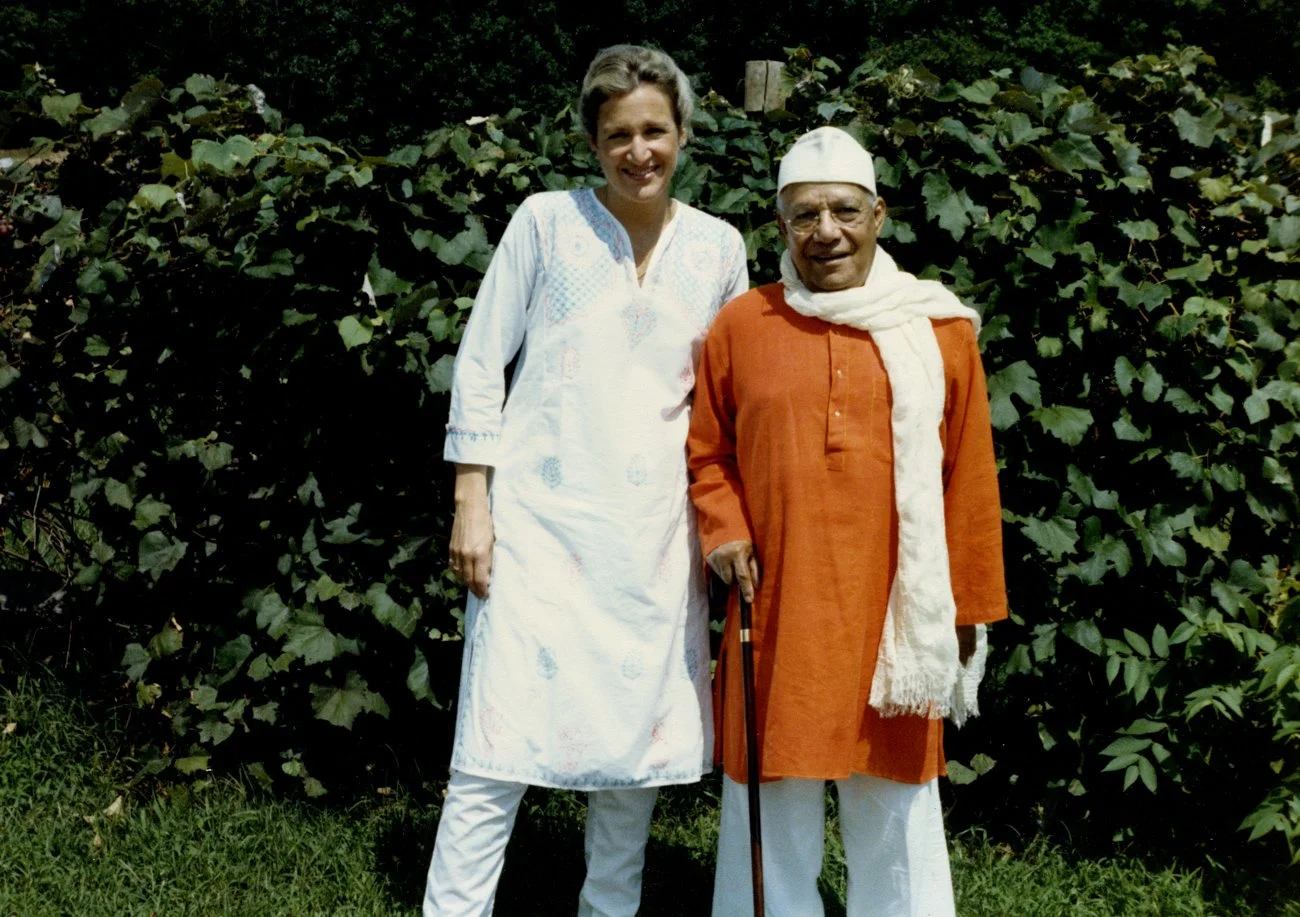
In my life I have been blessed to learn from, live and work with great masters, the foremost, of course, being my spiritual guru, Swami Premananda. In addition, I have been drawn to respected mentors in other fields. Your interests will draw you to mentors. Be high-minded and focused to find the best, and then put yourself into their chosen realm with trust and faith in them and in yourself to learn from them. There is no gain without trust and practice.
Swami Kamalananda, The Breath of God and Pranayam
The Breath of God and Pranayam
“To live is to breathe” is to assert the obvious. We do not need medical science to tell us that the whole marvelous mechanism of the human body stops when breath departs. Otherwise stated, however perfect the physical body is, with the absence of breath it is but a corpse. Yet there is more to know about breathing than the obvious, and from the spiritual heritage of Yoga comes the invitation to learn to expand what it is “to live.”
To that God we dedicate our life,
Who is the giver of life’s breath, power and vigor;
Whose command all the divine powers obey;
Who rules whatever breathes, moves or is still;
Who is the God of all created beings.Atharva Veda
“To live is to breathe” is to assert the obvious. We do not need medical science to tell us that the whole marvelous mechanism of the human body stops when breath departs. Otherwise stated, however perfect the physical body is, with the absence of breath it is but a corpse. Yet there is more to know about breathing than the obvious, and from the spiritual heritage of Yoga comes the invitation to learn to expand what it is “to live.”
Isn’t it enough, you might think, just to breathe and to be grateful to be alive, whatever one’s circumstances or age? Well, if to “breathe and let breathe” is enough for you, then the subject of this book is not going to hold your interest.
Admittedly, for many people, “to breathe” simply designates that process of air going into the lungs expanding to receive oxygen and then contracting to expel carbon dioxide. Yet the process of breathing, as we will see, involves our entire body, its energies and more, circulating throughout our entire being as various simultaneous waves, arising and falling. Also, breathing is more than what happens physically as you inhale and exhale, and it does not even originate from your lungs.
Most people will duly appreciate that breathing keeps the lungs, brain and organs functioning while maintaining all the attendant functions of digestion, circulation and movement. They know that improving breathing improves health. Although fitness watches remind their wearers regularly to mindfully take deep breaths, such attentions are still comparatively superficial, ignoring more sublime meaningful potential! Unfortunately, theologians do not develop the importance of breath as essential to one’s spiritual life. Some say that scriptural knowledge is important, some that prayer is, others that faith is, and others that ritual is, but that the knowledge of breath is of essential importance is likely to be disregarded or deemed unnecessary.
You have been breathing from your first day on earth. You are breathing now as you read this, and you will breathe for as long as you live as human. Most of the time you will not think about breathing, and yet, when methodically and meditatively breathing you will find yourself attuned to, inspired by and empowered by the most sublime wisdom ever known to human minds! Your own mental powers of Contentment and Peace, Power and Universality will grow.
Although many creatures breathe, we humans, in relation to our breath, are unique. The Old Testament’s Book of Genesis asserts that there is a special and purposeful link with God through the breath, as “God breathed the breath of life in the nostrils of man.” Note that the pronouncement in Genesis occurs only after the creation of heaven and hell, after the creation of earth and skies, after creation of days and nights — in fact after all living components of nature are created. A profound point derives from that single statement.
That God breathes at all is something we might further wonder about since God’s breath would certainly not involve lungs ... nor inhaling and exhaling. In what, then, does God’s breath consist? God’s breath must and can only be the breath of life itself, as Breath and Life are inexorably linked together. Why, then, the specific mention of “the nostrils of man”? Ah, we shall see ... The knowledge will be both practicable as well as illuminating.
Srimati Kamala “Swami Kamalananda,” The Breath of God and Pranayam
The Power of Ahimsa
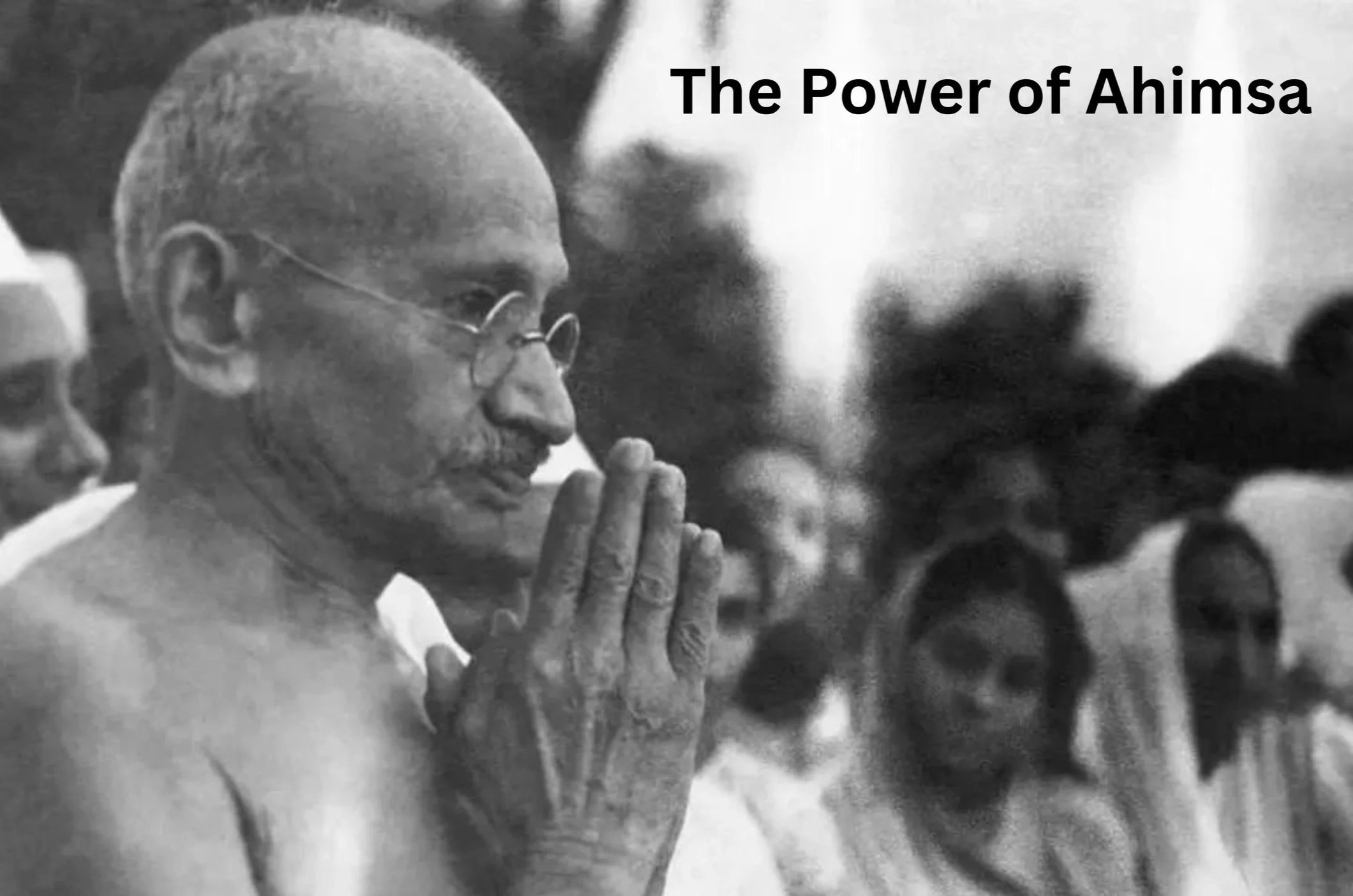
Ahimsa, in its subtle power, depends on a cosmic principle — that of the oneness of life. Ahimsa, in its positive form, means the largest love, the greatest charity. When ahimsa becomes all-embracing it transforms everything it touches. There is no limit to its power. Gandhiji understood that power. He made a conscious and constant effort to apply the power of ahimsa in his daily life. Ahimsa is living so as to realize the oneness of life.
For Mahatma Gandhi, the pursuit of Truth, dedication to the law of love, practice of selfless service, and aspiration for self-liberation, pave the way to unify the human experience. He wanted to awaken minds and unite hearts to a higher ideal—an ideal that unites Truth, love and service into living practice.
All the religions of the world, while they may differ in other respects, unitedly proclaim that nothing lives in this world but Truth.
Consider Gandhiji’s ashram prayer meetings. Through these prayer meetings, an ideal of devotion was practiced on a daily basis. The prayers, hymns, slokas and bhajans offered inspiration to nourish the mind, heart and soul each and every day. The time given to the thought of that Reality which pervades the whole universe, built a foundation of respect and reverence within each and every participant, and perhaps in hearts beyond.
If, therefore, we achieve that purity of the heart, when it is emptied of all but love, if we keep all the chords in proper tune, they ‘trembling pass in music out of sight.’ … Our prayer is a heart-search.
Love is the essence of life. It generates in us a continuous source of power which is indestructible, ever-productive and transforming. In our love, we awaken ourselves to the higher principles of life. Our ideal is to manifest this love in its perfection. The idea of the oneness of life—that you and I are one, that we are one with the stars and the planets. That if I harm you or another, I harm myself.
To slight a human being is to slight those divine powers and thus to harm not only that being but with him the whole world.
One cannot separate one’s love for God or Truth from an all-encompassing love of creation. They are inseparable. This is what Gandhiji tried to express. This is the law of love, of life. Love is more than feeling. It is all-consuming thought and fullness of action. It is absolute oneness.
I believe in the absolute oneness of God and therefore also of humanity. What though we have many bodies, we have but one soul. The rays of the sun are many through refraction. But they have the same source. I cannot, therefore, detach myself from the wickedest soul nor may I be denied the identity with the most virtuous.
Ahimsa, in its subtle power, depends on a cosmic principle — that of the oneness of life.
Ahimsa, in its positive form, means the largest love, the greatest charity. When ahimsa becomes all-embracing it transforms everything it touches. There is no limit to its power.
Gandhiji understood that power. He made a conscious and constant effort to apply the power of ahimsa in his daily life. Ahimsa is living so as to realize the oneness of life.
By Srimati Karuna

Children of Immortality
The source of man’s divine qualities is the infinite perfection of God. But man cuts himself off, though not completely, from this cosmic spiritual reservoir by his own thought of self-separateness and consequently of self-limitation. “Man thinking himself separated from Brahman, revolves on the wheel of birth and death.”
Within this ever changing body resides the eternal Brahman, God, Consciousness-Existence-Bliss Absolute. Realization of the indwelling nearness of, in truth, the inseparable oneness with Brahman awakens man to the conscious cognition of the illimitable power of his wisdom, will and love. He gains the illumination that he is above all conditions of duality, and secures that transcendental self-assurance of moral and spiritual strength which inspires and enables him to live by righteousness and truth amidst all the adversities and perplexities of life.
The source of man’s divine qualities is the infinite perfection of God. But man cuts himself off, though not completely, from this cosmic spiritual reservoir by his own thought of self-separateness and consequently of self-limitation.
“Man thinking himself separated from Brahman, revolves on the wheel of birth and death.”
Man, in his soul, is omnipotent. By divine benediction he possesses the power to liberate himself from the thralldom of bondage by realizing his identity with God.
“In the realization of Brahman is the severance of all bondage of self-limitation.”
The Rishi Svetasvatara, a sage of self-realization and the author of this (Svetasvatara) Upanishad, reveals the wisdom and the way to divine identity and self-liberation:
“Ye sons of immortality, listen!”
—Swami Premananda, Introduction to his translation of the Svetasvatara Upanishad in Eight Upanishads
Meditate on the Light of AUM
“By meditating on AUM, the Word, within the effulgence of each of the seven lotuses, the mystic centers of spiritual revelation, is gained the inner illumination of the self which consumes the causes of all finiteness and self-limitation.”— Kaivalya Upanishad “The Self is symbolized by the word AUM. AUM is composed of three mystic sound vibrations. These also signify the first three states of consciousness in the self." — Mandukya Upanishad

Hong Swa & Pranayam: The Breath of Life
“Rise above the consciousness of separation and realize thyself in all and all in thee.” -Adi Shankarachariya “The flame of pure-consciousness is eternally ignited within this body. By the meditation of Hong-Swa, all delusion having been dispelled, the Self is revealed in its effulgent glory. The supreme Self is Hong Swa, which leads to the realization of Sohong in wisdom and bliss.” -Svetasvatara Upanishad
