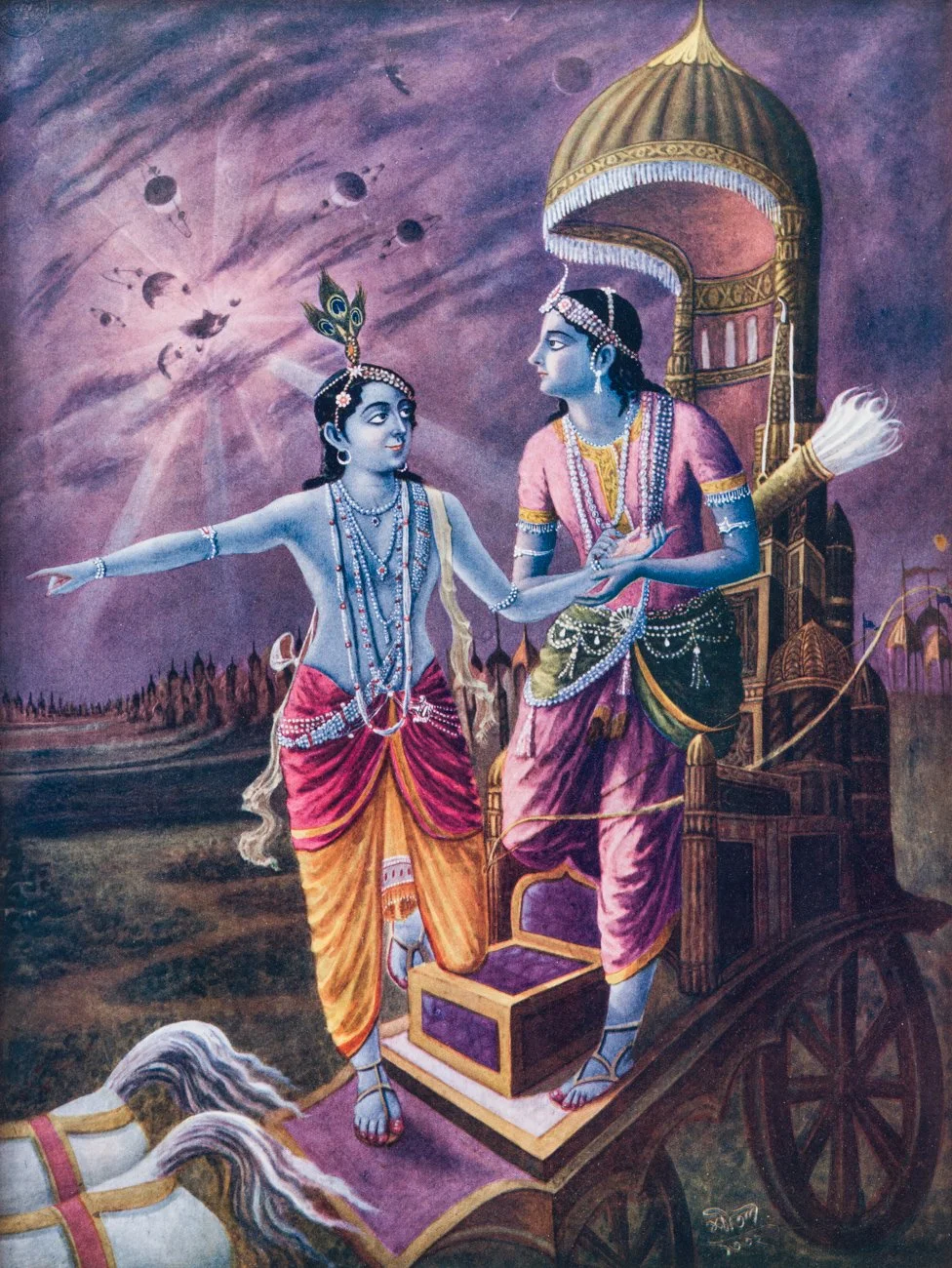
Guru
Krishna as the guide of Arjuna reveals the truth and ideal of guru—that is, our own divine, ever pure and perfect soul, Self-conscious and ever one with God. Embodying the ideal of human guru, Krishna leads Arjuna to discover the life of his own soul.
“The word ‘guru’ comes to us from the Hindu heritage, yet the ideal of divine guidance is found throughout all spiritual traditions. It is so because the ideal and relationship of guru authority are integral to religious experience. Who was the guru of Plato? Did not Socrates lead Plato to the path of self-realization as his disciple? The guru of Shankaracharya, Govinda, initiated him into the light of meditation and inner revelation. John the Baptist protested that he could not initiate Jesus because Jesus was more spiritually advanced than he. He saw the divine unfoldment of Jesus. Yet, Jesus reminded John that every soul at one time is formally introduced and consciously makes a vow to God. ‘Suffer it to be so now, for thus it becometh us to fulfill all righteousness.’
Humanly speaking, guru is to be honored because he embodies the ideal we are seeking. Humanly imperfect, divinely perfect, guru is the image of our ideal. If we cannot recognize divinity in the human form we will not recognize it in formlessness. In reality, guru is our own self. Guru is the one who reveals to us our own soul. Guru is the self-revealing one. It is God whom we see in guru. God is the Supreme Guru, in reality the only Guru. God reveals Himself to us in our human guru.
The most profound meaning of guru is presented to us as Krishna, our Supreme Self, in the Bhagavad-Gita. It is the most sublime because it most clearly reveals the law, ideal and reality of Guru as well as the identical divinity of disciple, the self as individual (Arjuna). In Krishna we understand who is guru; in Arjuna we see how to fulfill perfect discipleship.
Who is this Guru, Krishna? ‘The one who draws the whole universe unto himself,’ or ‘the one to whom the whole universe is attracted,’ as the name ‘Krishna’ in its Sanskrit derivative ‘Akarshan’ denotes. This is not a personal god, but the ever abiding Self. Krishna is in each one of us as our soul. He speaks in the Gita as Atman, the closest indwelling self who reveals the Paramatman, or Supreme Self.
Krishna as the guide of Arjuna reveals the truth and ideal of guru—that is, our own divine, ever pure and perfect soul, Self-conscious and ever one with God. Embodying the ideal of human guru, Krishna leads Arjuna to discover the life of his own soul.”
Frontiers of the Spirit
Swami Kamalananda

Liberation Through Work
What is Karma Yoga? It is Self-Realization in action; liberation through work; freedom by service. It is commonly called the path of action. In whatever state of self-expression we engage, that is action. We think, we love, we work. These are all actions. Karma Yoga is the regulation of all our actions in order that we may realize our innate spiritual perfection.
What is Karma Yoga? It is Self-Realization in action; liberation through work; freedom by service. It is commonly called the path of action. In whatever state of self-expression we engage, that is action. We think, we love, we work. These are all actions. Karma Yoga is the regulation of all our actions in order that we may realize our innate spiritual perfection. The philosophy of Karma Yoga is the science of work. It teaches us how to perform all our activities that we may find peace and happiness in our daily life. Besides it opens our vision in wisdom whereby we may regain the full consciousness of our ever abiding state of subjective freedom, or salvation.
The beauty of the philosophy and science of yoga is this: That it does not require anything more from its follower than that which he already possesses. Starting on this foundation it helps him to utilize that to regain his absolute freedom.
Karma Yoga propounds this truth. It recognizes that we are constantly working; then why should we not use that activity for the highest purpose of life? Every action can be so directed as to bring us oneness with God.
But there is a secret key to this science of self-emancipation. Karma Yoga gives us that secret key. Therefore, Karma Yoga may be called the secret of work. The same work can enslave us to sense-identification, or reveal our innate freedom. It can drown us in misery, or bring us to the heights of peace. It can make us either restless, nervous, physical wrecks, or calm, dynamic, and strong. It can hide or reveal the Self. It can steep us in ignorance, or free us in wisdom. Karma Yoga tells us the secret of it all. It tell us how to become free from action not through abstention from, but by the performance of action.
The Law of Self-Manifestation (Karma Yoga)
Swami Premananda
Beginningless and Endless
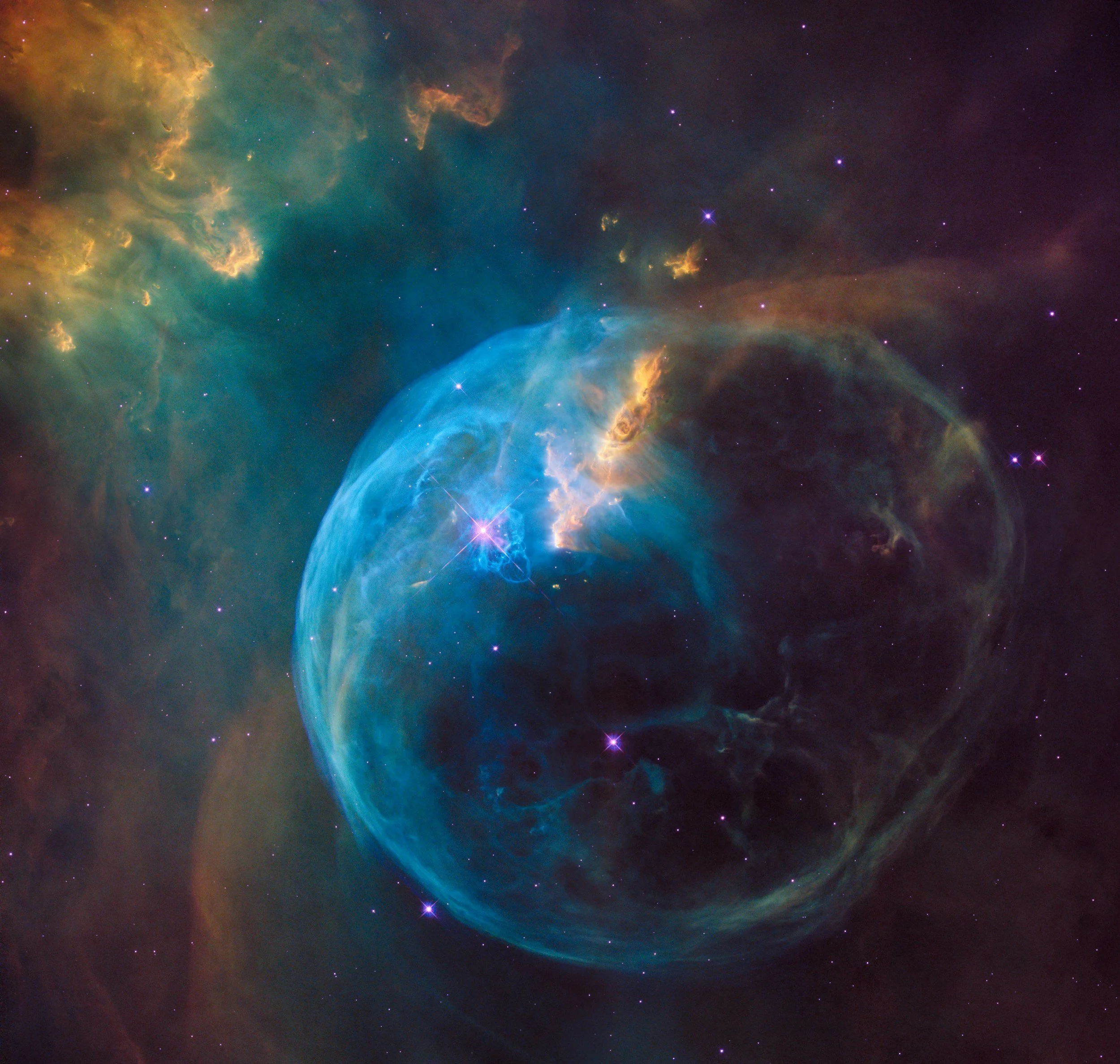
O precious cycle of time, I witness your changing attire, your wardrobe of expression. Traversing celestial realms, this budding universe appears before me in all its grandeur.
O precious cycle of time, I witness your changing attire, your wardrobe of expression.
Traversing celestial realms, this budding universe appears before me in all its grandeur.
The motion of time is a wheel of birth and rebirth. The progression and rhythm of life tells me an unfolding story. What it reveals, illumines my mind.
O wheel of time, grant me the vision of timelessness. Let me know that which is Real and unreal.
Grant me understanding of the eternal and infinite. Tell me the secret of the beginningless and endless.
Prayer Beads
Srimati Karuna
Meditation on AUM
AUM represents the physical, mental and spiritual states of consciousness of the Self. For the final Wednesday evening of our Kriya Yoga Meditation series we will explore the powerful suggestion of the silent utterance of this sacred mantram, contemplating its meaning and significance, as we meditate on AUM.
Kriya Yoga Meditation Series
Wednesday, May 15, 2024
7:30 p.m.
Conducted by Srimati Karuna
All are welcome.
AUM represents the physical, mental and spiritual states of consciousness of the Self. For the final Wednesday evening of our Kriya Yoga Meditation series we will explore the powerful suggestion of the silent utterance of this sacred mantram, contemplating its meaning and significance, as we meditate on AUM.
"AUM is the symbol of the cosmic universe, the phenomenal as well as the noumenal. The past, the present, and the future, the origin, existence, and unfoldment in perfection, are all explained by the word AUM. And that which is beyond the category of time is also revealed by AUM. Verily, all is the manifestation of the Reality of AUM."
Mandukva Upanishad

Light of Inner Illumination
All messengers of light have identified the path of inner illumination. It is accessible to anyone who makes sincere effort. Even when darkness surrounds us from all sides, still there is a light on the altar of our consciousness that burns bright. For this evening’s Kriya Meditation, let us meditate on the glory of that effulgent reality. All are welcome.
Kriya Yoga Meditation Series
Wednesday, May 8, 2024
7:30 p.m.
Conducted by Srimati Karuna
All are welcome.
All messengers of light have identified the path of inner illumination. It is accessible to anyone who makes sincere effort. Even when darkness surrounds us from all sides, still there is a light on the altar of our consciousness that burns bright. For this evening’s Kriya Meditation, let us meditate on the glory of that effulgent reality. All are welcome.
“The innermost radiant light within the spiritual eye is the mystic door of God-revelation. When the mind remains firmly established on that radiant light, it is gradually absorbed by the ever expanding effulgence pervaded with pure self-consciousness that finally leads to the realization of the absolute Self, Brahman. if, however, the mind fails to remain fixed at the spiritual eye, it returns to the senses, but continues to retain its peace and serenity. By virtue of its subjective meditation and enlightenment the mind attains greater patience, devotion, inspiration, determination, power, faith, wisdom, self-illumination, and other lofty qualities. In the light of the spiritual eye mind receives the illumination of the Self.”
Kaushitaki Upanishad
Translated by Swami Premananda
Light on Kriya Yoga

Hong Swa
"O Thou self-manifested cause and substance of creation, O Thou indwelling Self of all, Thou source of illumination, guide me beyond Thy rays of creation, transport me beyond Thy objective form that, by Thy grace, I may behold Thy glorious Self: That absolute Self abiding in the transcendental effulgence, verily, I am That."
Kriya Yoga Meditation Series
Wednesday, May 1, 2024
7:30 p.m.
Conducted by Srimati Karuna
All are welcome.
The hamsa, or the swan, is often identified with the Supreme Spirit, Ultimate Reality or Brahman. The flight of the hamsa symbolizes moksha or freedom of self-liberation in release from the cycle of samsara.
"O Thou self-manifested cause and substance of creation, O Thou indwelling Self of all, Thou source of illumination, guide me beyond Thy rays of creation, transport me beyond Thy objective form that, by Thy grace, I may behold Thy glorious Self: That absolute Self abiding in the transcendental effulgence, verily, I am That."
Isha Upanishad
Prana and Kundalini
In meditation, the mind has to become more subtle. To get to that subtle perception we have to begin with that which sets the whole engine in motion. That is Prana. Prana determines the quality of our consciousness. This cosmic Prana is not realized by the light of intellect, the brilliance of mind, or the power of the senses.
Kriya Yoga Meditation Series
Wednesday, April 24, 2024
7:30 p.m.
Conducted by Srimati Karuna
All are welcome.
In meditation, the mind has to become more subtle. To get to that subtle perception we have to begin with that which sets the whole engine in motion. That is Prana. Prana determines the quality of our consciousness. This cosmic Prana is not realized by the light of intellect, the brilliance of mind, or the power of the senses.
Our minds draw power from the cosmic prana, illuminating the centers of consciousness so that it connects a person’s inner being with cosmic life energy. When universal consciousness is perceived, the result is an awareness of ourselves as well as life around us. In this fourth evening of our Kriya series we will explore the depth of Prana.
“Absolute calmness cannot be attained without the practice of Pranayam; nor is the Self realized without meditation. Existence in the world of duality, even for an instant, is impossible without Prana, the cosmic energy, because the phenomenal universe is the differentiation of the undifferentiated Prana. Illumination does not come from merely attaining complete mastery over the sense-organs. But when mind transcends the influence of sense-impressions, the Self is realized.”
Swami Premananda
From His Spiritual Interpretation of the Gita
Chapter 3: The Law of Unfoldment

Breath of Life
The mystic studies the breath of life in subtle and beautiful ways. In this third evening of our Kriya series, we enter that current which reaches the innermost and extends outward.
The mystic studies the breath of life in subtle and beautiful ways. In this third evening of our Kriya series, we enter that current which reaches the innermost and extends outward.
"One does not live by the air one breathes in inhalation and exhalation. The source of life is another. It is the Self."
Katha Upanishad

Serenity and Subjectivity
To free the mind from the strong grip of mental attachment requires a steadfast pursuit of the study of silence. Not just silence of the senses but a sense of calm can be attained by an inward journey. In this second evening of our Kriya Yoga series we will dive into the ocean of self-subjectivity and the depth of calm.
To free the mind from the strong grip of mental attachment requires a steadfast pursuit of the study of silence. Not just silence of the senses but a sense of calm can be attained by an inward journey. In this second evening of our Kriya Yoga series we will dive into the ocean of self-subjectivity and the depth of calm.
"With sense organs wondrously infused with Thy cosmic powers, unto Thee I surrender all my thoughts and deeds. Blessed by Thy divine effulgence enshrined in my soul, I become pure, strong and calm, facing all vicissitudes of life with peace and confidence."
Rig Veda

Awakening
What are the dimensions of our meditation? In our daily life and activity we live in dimensions of length, height and depth and we experience the effects of time. Scientists theorize about additional dimensions in which other worlds arise and other histories and futures are possible. In our meditation we explore universes of experience that go beyond space and time, to the infinite and eternal. In the first evening of our Kriya Series we will begin to explore awakening to the light and life of meditation.
What are the dimensions of our meditation? In our daily life and activity we live in dimensions of length, height and depth and we experience the effects of time. Scientists theorize about additional dimensions in which other worlds arise and other histories and futures are possible. In our meditation we explore universes of experience that go beyond space and time, to the infinite and eternal. In the first evening of our Kriya Series we will begin to explore awakening to the light and life of meditation.
“When the self is awakened in the Supreme Self, when consciousness is liberated in Pure-Consciousness, then Brahman, the Absolute, is realized in boundless Bliss.”
Kena Upanishad

Symbol of the Palm
In the light of mysticism, the entry into Jerusalem symbolizes the journey of life, the pilgrimage of self-unfoldment which each of us must follow on the path of life. The life of Jesus sets forth a spiritual pattern which each of us must follow to walk on the path of God.
Excerpt from Seven Mystic Holydays
Swami Premananda
And a very great multitude spread their garments in the way! others cut down branches from the trees, and strewed them in the way. And the multitudes that went before and that followed, cried, “Hosanna! Hosanna in the highest”
—Matthew 21:8-9
Each year in the spring, when human hearts rejoice in the glory of new life resurrecting through all nature, certain religious rites are observed throughout the entire world. With only slight variations of time, all great religions enjoin upon the observance of Lent. Under different names it is celebrated as a period of fasting and purification. Its purpose is to lift the consciousness out of the domain of the sensory world into greater awareness of God and of divinity.
During this holy season, millions draw a little closer to God in consciousness. In that sense we say that it is an especially sacred time. Every moment is sacred because the all-permeating presence of God is ever with us. In reality each day is holy because all time is God’s time. Can there be a moment or second apart from God? But during special holydays, when millions of souls are awakened to the love of God, there is a spiritual radiation, like a cosmic broadcast, through the entire universe.
The Lenten period precedes Palm Sunday which commemorates an occasion of deep spiritual significance in the life of Jesus of Nazareth. After eighteen years of meditation and realization, Jesus began to preach the truths he had found within himself. The people of his home town and country heard of the spiritual glory which had come to their native son. So when word came that he was returning to Jerusalem, throngs came forth to meet him. They gave him a gala welcome, waving palms and shouting hosannas of praise.
In this homecoming, I believe, there was a deep human touch. Jesus had wanted to come back to the place where he had spent most of his early days. He knew that his earthly life was coming to an end. He could have observed the Passover anywhere for he had transcended the idea that there is virtue in mere external forms of rituals.
In the light of mysticism, the entry into Jerusalem symbolizes the journey of life, the pilgrimage of self-unfoldment which each of us must follow on the path of life. The life of Jesus sets forth a spiritual pattern to walk on the path of God. When he comes and enters into the center of the city, the people welcomed him by strewing their garments before him. It signifies the inner subjective discardance of false concepts and ideals, eradicating and dispersing the clouds which hide the light of purity and holiness.
The multitude, as they spread their garments, cried out “Hosanna! Hosanna in the highest!” This chanting implies the consciousness of joy. Inner happiness is a prerequisite to spiritual realization. The reality of God is revealed only in subjective joy. One who is awakened to the love of God has an inner current of contentment in the heart. God alone is the source of all true joy and the palm is the symbol of joy and faith.
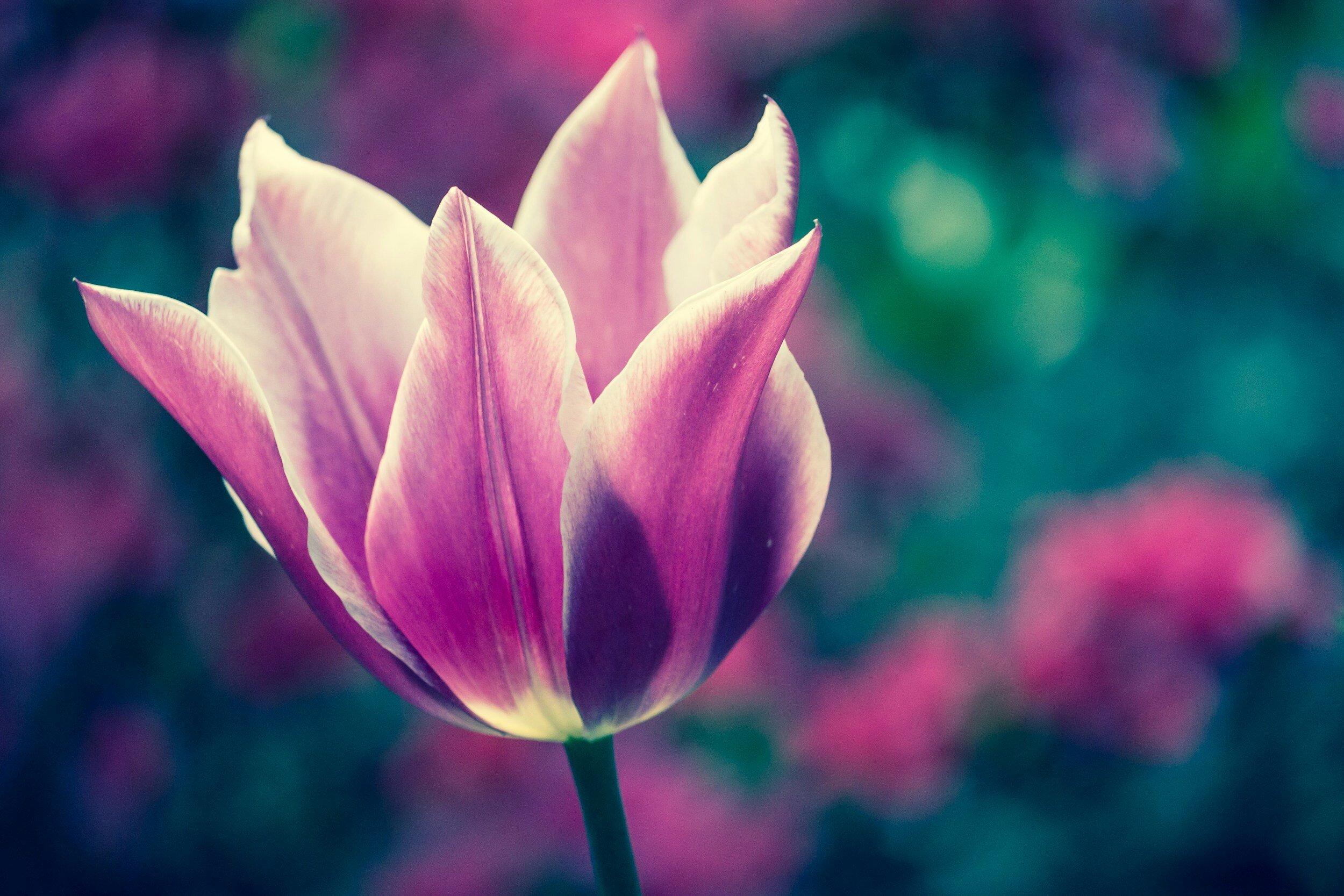
Life is Guided by Consciousness
All life is guided by consciousness. Consciousness is responsible for all our happiness or unhappiness, peace or sorrow in life. Right now we are our consciousness. Our consciousness reveals the authority over our daily experience.
All life is guided by consciousness. Consciousness is responsible for all our happiness or unhappiness, peace or sorrow in life. Right now we are our consciousness. Our consciousness reveals the authority over our daily experience. Therefore, it is wise to evaluate the course of our own consciousness to see what authority we are obeying most of the time. What is our perspective, vision, awareness, ideal that guides our learning and growth? As Jesus wisely said, “Where your treasure is, there your heart will be also.” Our treasure or predominant identification of consciousness determines our happiness.
The quality of our life improves when we live more in the understanding of our pure consciousness. Our pure consciousness is the light of soul. It is ever one with the pure light of the universe. Wise individuals heed the guidance and authority of their souls giving them intrepid strength to face the most awesome struggles of life.
Happiness is found in following one's own path perfectly, and the ideal path is progressive. Fulfillment of even limited ideals leads us on to greater and nobler ideals. The ideal life improves with experience and by the growth of ideal. My ideal has evolved with my life. What I seek; what I am aware of; what I work towards; what I love; what is of utmost importance to me—the composite consciousness of these as my ideal has guided my life and determined my happiness at each stage, leading to fulfillment that carried me on to enlarged ideals and comprehension. I have found that God has directed my path to ever new frontiers and as I enter them I feel increasingly the blessedness of this treasured wealth of life.
From Frontiers of the Spirit
Swami Kamalananda

A Word for Nature
Books and words comprise scriptures, but they are not the only revelations of life. All creation is “word,” God's cosmic scripture for us to read and understand. The method of study is glorification, communion, and feeling that the stream of life that flows through our and Nature's veins is One.
Books and words comprise scriptures, but they are not the only revelations of life. All creation is “word,” God's cosmic scripture for us to read and understand. The method of study is glorification, communion, and feeling that the stream of life that flows through our and Nature's veins is One.
The gospels relate how Jesus taught his disciples “many tongues.” I doubt that we are intended to believe from that that he instructed them in foreign languages. Rather, that he helped them to learn how God speaks Law and Life through self-manifestation; that the trees, flowers, and all creatures are, too, the language of the Infinite. As Shakespeare said in As You Like It, “And this our life, exempt from public haunt, finds tongues in trees, books in the running brooks, sermons in stones, and good in everything.”
There are countless religions, sects and theologies. Life is not long enough to study them all. But all derive from one expression: Cosmic Nature. Religion comes not from East or West, but from the heart of Nature. Study Nature. Nature does not exist in a single instance without expressing the most profound meaning of life.
It was Nature that awakened man to religion: Beauty, wonder and admiration are the beginning of all worship and prayer. If there were no love or beauty, religion would never have existed. Nature is the only scripture written directly and entirely by God—as such the most perfect source of self-revelation.
The religion of Nature is not based on a personal experience of someone else in another time. According to Nature's religion, no one can be religious until he has the direct revelation for himself. Nature is the first scripture of Yoga.
As you find yourself in Nature you will evolve morally. You will expand in your spiritual consciousness. There will be an integrated harmonious development felt and revealed in every aspect of your life as you find it in Nature. All obstacles will drop away because Nature has an exclusively spiritual purpose. The whole activity of Nature exists so that the soul may emerge through successive and progressive experiences to realize that it is free in the Absolute. When the soul knows that it is free from the differentiation and form of the external Nature, then it has learned its lesson well! When it perceives its oneness with the soul of Nature, it is whole.
The companionship of Nature is not imagined. It is real. The universe of Nature in which we live is filled with the spirit akin to our own. Nature is alive with God. What that spirit awakens in the heart is a blessing. Some people consider a certain plant sacred; others bow to a stone; many worship the sun. It is always the desire to love and to feel union with God through this wonderful world that is satisfied in such reverences.
Come out into Nature—not the nature of maps and marked paths, not even the nature of America or of any particular country—but the Nature of God…and of yourself. That Nature is filled with whispers of ruling powers which inhabit trees and flowers, streams and mountains. They will feed your inspiration and speak to you in your own immortal language.
Frontiers of the Spirit
Swami Kamalananda

Nine Stages of Self-Unfoldment
Self-realization is the highest goal of our life. We are irresistibly progressing towards that ultimate objective of our existence. In truth, through science, art, philosophy and religion we are drawing ever nearer to the realization of the full perfection and glory of God, our supreme Self. In the realization of our divine self we reach that state of self-perfection wherein we realize our identity with God and attain the realization that we are the absolute self.
The first is spiritual vision. Spiritual vision is that super-sensory perception wherein the transcendental truths are revealed. Infinity and eternity are innate qualities of our life. Immortality is the very substance of our soul. Universality is the essence of our spiritual being. The reality of our true self is beyond all finite categories. God is the absolute spirit. He is all pervading yet illimitable, revealed only in pure consciousness though known through the cognitive power of intelligence and discrimination. We are impelled by our spiritual nature to attain the knowledge of God and our true self. Our whole being demands it.
We are from spirit. Therefore, we reach out for the perfection of God. We intuitively know our ultimate spiritual destiny. We are convincingly aware within our consciousness that the perfection of God is the divine destiny of our soul, of all souls. We feel that God is the source, the substance and the sustenance of all. Desire to know God, soul and truths which are infinite, eternal and absolute, is the strongest of all urges within our innermost self. Nothing can obliterate this inner longing of the human spirit. Impelled by an irresistible force that is already within us, our mind, heart and soul ascend in continuous aspiration, transcending all concepts of time, space and duality, to gain the vision of the reality, perfection and glory of God.
The second is spiritual aspiration. Spiritual aspiration is soul’s yearning for God and his perfection. It is the desire of the soul to unfold and manifest its divine qualities until they are perfected to the state of the attributes of God, wherein soul realizes its identity with the supreme Spirit. Spiritual ambition is the elevating force of the human spirit. In the innermost depth of our heart we all long to make our life beautiful, complete and joyous.
Every one of us yearns for the grace of virtue and righteousness. Because it carries within itself all the attributes of God, our soul is unceasing in the endeavour to bring into full manifestation its divine potentialities. We not only desire the unfolding of our godly qualities but we also long to share their beneficence with our loved ones. We spiritually enrich ourselves as well as others by sharing our divine treasures of virtue and righteousness with all souls.
The third is intuition. Intuition is soul's power of direct apprehension of truth. We possess the faculties of the senses and mind wherewith to gain knowledge. We are also endowed with a spiritual power which gives us the ability to know the truth immediately and directly without the aid of the senses and the mind.
The power is intuition. We all possess the power of intuition because none of us is denied the reality of soul. All knowledge is gained within consciousness. Knowledge is revelation within consciousness. The purer the consciousness the more developed is the intuition. Truth is the ever-existing reality. It reveals itself within us when we have made our consciousness pure in its self-effulgence.
The fourth is contemplation. Contemplation is the total application of mind and consciousness to attain complete knowledge of truth and reality. It is the definite focusing of thought upon the subject of revelation. Meditation is profound contemplation upon God, soul and all other spiritual truths and realities. Meditation lifts our vision and consciousness into the realm of effulgent infinity wherein we become immersed in all-absorbing blissfulness.
The fifth is constancy. Constancy is the tenacity of the soul. It is the resolution of a devotional heart and the steadfastness of an unwavering mind. It is the courage of the inner self to pursue the course of a noble ideal amidst all obstacles. It is the firmness of the spirit that seeks the highest good.
The sixth is constructive attitude. A constructive attitude is the positive power of mind and heart. It has its origin in the soul. When the mind and heart are inspired and guided by the divine qualities of the soul that constructive attitude is attained. Spiritual idealism is the foundation of the constructive attitude. The closer we identify our life, thought, desire and feeling with spiritual qualities the more abiding becomes our constructive attitude. It not only keeps our own consciousness established on all that is beautiful and sublime within ourselves, but also guides our perceptive vision to cognize that which is good and elevating in all experiences of life.
A constructive attitude is indicative of inner spiritual unfoldment. Spirituality invariably awakens the consciousness of a positive approach within us. The constructive attitude, therefore, is an integral part of the inner thinking of a man of spiritual illumination.
The seventh is universality. Universality is the divine glory of our soul. It is as natural to our soul as freedom is to space. Our soul is universal, infinite and all-encompassing. It is limitless in all its divine qualities. The righteousness of our soul cannot be confined within the limitations of time, space and form.
The godly virtues of our soul grant us the realization that all are parts of our greater self and that we are one with all. God has endowed our soul with the attributes of universality in order that we may realize that in spirit we are one with all objects and beings of his infinite creation as well as with him.
The eighth is self-transcendence. Man is a transcendental soul. We are transcendental spirit. Nothing of this sensory world can confine our soul. Birth and death, pleasure and pain, and all other conditions of this plane of evanescent existence are merely the passing shadows of the divine reality of our soul.
There are other planes of existence and different worlds of manifestation in God's cosmic creation. Our soul journeys through them all, but none of these can hold our soul within its limitations. God has made our soul of the substance of his transcendent divinity that we may dwell in our spiritual glory forever.
The ninth is self-realization. Self-realization is the realization of our true self. It is the revelation of our godly self within our pure consciousness. It is the direct knowledge of what we are in our spiritual self. The realization of the self alone gives us the right understanding of every aspect of our life and its expressions. The knowledge of our true self accords us with the spiritual direction to our life, thought, will and emotion. Desire for self-realization is the supreme motive force of our life. Let a man know his real self and he shall conduct his life in conformity with ethical principles and spiritual idealism.
The light of the self is the true light in man. Self-realization is the highest goal of our life. We are irresistibly progressing towards that ultimate objective of our existence. In truth, through science, art, philosophy and religion we are drawing ever nearer to the realization of the full perfection and glory of God, our supreme Self. In the realization of our divine self we reach that state of self-perfection wherein we realize our identity with God and attain the realization that we are the absolute self.
From: Meditation and Self-Unfoldment: The Divine Way of the Soul, 1979
Swami Premananda

Peace of Subjectivity
Let us examine our mental life to see how well established in the peace of our own subjectivity we are: For too many people the day is so crowded with one activity after another that there is little time given to realize pure self-reflection. Instead, they habitually establish themselves solely in their objective life, allowing their mind to be dominated by the sense-world.
Let us examine our mental life to see how well established in the peace of our own subjectivity we are: For too many people the day is so crowded with one activity after another that there is little time given to realize pure self-reflection. Instead, they habitually establish themselves solely in their objective life, allowing their mind to be dominated by the sense-world. They fill weekly engagement calendars with minutiae of their social activities but do precious little to organize and direct their mental duties. During the day, when confronted with free time their unbridled mind instantly demands distraction: Call someone. Turn on television. Go to a game. Go eat. Get away.
Is this continuous distraction not an addiction? Or is it not virtual mental slavery—refusing the mind its own freedom or repose between morning and evening!
By nightfall one is so mentally enervated he just wants to escape in sleep. Yet when he wakes up the next morning he starts anew in the same old worldly habits. How sad! So much of life is destroyed, lost, missed, in the endless habit of sense-bound self-consciousness.
Do you know what happens to the mind that is unprepared, untrained, ignorant of its divine powers of pure self-reflection? It becomes afraid. Afraid to be alone. Afraid to be silent. Afraid to be calm. It is the greatest tragedy of life, because every person desires peace of mind. Every person craves self-composure and strength of calmness, yet few people know where they exist or how to find them. Few people are willing to devote even a few minutes of their day to find themselves in silence and solitude.
Yet we can free ourselves from the habits of worldliness and get into the peace of self-subjectivity in many beautiful, meditative, ways: For instance, some people enjoy absorbing themselves in the thought of being part of the all-pervasive beauty and peace of God. They walk alone, “losing themselves” in the company of God in nature, communing with the vastness of the heavens above them or answering the hypnotic invitation whispered from a woodland stream at their feet. Who wouldn't be blessed by the subjective adoration? A love of the “inner life” includes finding in the quietness and loveliness of the world surrounding us a self-revealing subjective calm. This comprehensive mood of inspiration is a prerequisite for meditation. The habits of quietness, reverie and reverence for nature are of themselves important components of meditation.
Meditation is the only way to self-enlightenment and peace, but unless one truly understands his subjective life he will encounter great difficulties when he attempts meditating. Promised the bliss and spiritual attainments of meditation the novice initially elects it with enthusiasm. But what happens if he is subjectively unprepared is sadly predictable: he either becomes bored with meditation or restless. The reason? So long has his consciousness been dominated by and engrossed in the outer, sensory world that his uncultivated inner realm seems empty to him. Or worse, left unattended it has become cluttered. It is just as if one has been outside all day and returned home to find everything inside his home in disarray. How discouraging! Entering our subjective abode that has been neglected and unattended day after day from morning till night, our mind would surely turn inward and feel, “I want out of this!” The novice, having initially chosen meditation with enthusiasm now rejects it summarily. His unexplored power of introspection is weak, too burdened by worldliness, and also too weak to withstand the demands of the world.
Without a subjective life the true self remains veiled, unknown.
Swami Kamalananda
The Mystic Cross

Initiation into Subjective Meditation is Like a Bridge
“Initiation into subjective meditation is like a bridge to those who are earnest and determined to transcend all inner finiteness. Realization of the imperishable Brahman, the absolute Self, is the goal of self-liberation.”
“The perfection of the Self is revealed in the divinity of the Self. He whose mind remains constantly identified with the senses, who is restless of body, who is lacking in subjective serenity, and whose consciousness is engrossed with relative concepts and finite thought impressions, even with much learning, cannot attain the realization of the Self.
“Beyond the reach of the phenomenal power, where mind is sanctified in the wisdom of Pure-Consciousness; beyond the domain of ego, where the individualized self-consciousness is illumined by the effulgence of the Absolute; beyond the grasp of death, where immortality abides in Bliss; there is the transcendental Self. Who can ever express in words the nature and the reality of the Self?
“Hidden within this body there are two states of consciousness; one is the state of supreme Brahman, and the other is that of self-acquired concepts. Men of Self-realization, who have attained their identity with the absolute Self at Sahasraram, call these two the states of ‘light and shade’. And those whose practice of triune subjective meditation, Sahaja Sadhana, comprising Maha-Mudra, Kriya and Jyoti-Mudra, is polarized within the Five-Pranic Effulgence between Muladhar and Prajna-Ajna, are also cognizant of this truth.
“Initiation into subjective meditation is like a bridge to those who are earnest and determined to transcend all inner finiteness. Realization of the imperishable Brahman, the absolute Self, is the goal of self-liberation.”
Katha Upanishad
Translation by Swami Premananda
From Eight Upanishads

Love is Soul
All possess love. We not only possess love, but we also have the spiritual strength to express it. To possess love is to manifest it. One whose heart is imbued with love can never hide it, for his whole being radiates it. Can a full-blown rose hide its fragrance? Then how can anyone ever conceal the sweetness of love? For love is sweeter than the rose
Love is the inherent quality of the human heart. We, as yet, may not have developed the perfect intellect to understand metaphysical truths; our physical strength may not be adequate to allow us to work and serve; we may be mentally deficient, or physically weak, but the unending flow of the fountain of love is in every one of us. We are not truly alive until we have drunk from the fountain of love. Then alone we know the fullness of life when we have given ourselves to love. In love we truly live. Life unfolds itself in love, for love is life.
All possess love. We not only possess love, but we also have the spiritual strength to express it. To possess love is to manifest it. One whose heart is imbued with love can never hide it, for his whole being radiates it. Can a full-blown rose hide its fragrance? Then how can anyone ever conceal the sweetness of love? For love is sweeter than the rose.
We tend spontaneously to manifest love. Even from the day we are born, we try to express our love. None can ever fully express the love that fills his heart. Word and gesture are too finite to express the sublimity of infinite love that dwells in the human heart. Complete realization of love comes in the union of souls, for love is a quality of soul. Love is soul.
Swami Premananda
The Magnetic Power of Love (Bhakti Yoga)

Ascending Consciousness
With ascending consciousness soul offers itself in sacrifice throughout its human pilgrimage to God, and sacrifice can be perceived and understood in the manifestation of the human personality at four levels.
Soul comes to God through ever-expanding consciousness of its true being. Sacrifice, the “making sacred” of life, is the most natural offering of the beauty, love, goodness and wisdom of heart and soul, body and mind. The greater the consciousness of sacrifice, the greater the realization of freedom, oneness and selflessness. Spiritual sacrifice is a positive power, because it is in accordance with all spiritual progress everywhere.
With ascending consciousness soul offers itself in sacrifice throughout its human pilgrimage to God, and sacrifice can be perceived and understood in the manifestation of the human personality at four levels:
At the first level, consciousness is limited to selfish and worldly identification. One behaves in ignorance of the beneficent oneness enfolding and sustaining all life. Hence, he perceives his existence as temporal, separate and finite. He is subject to the discomfort of unhappiness as his desires and pleasures are limited to that which comes and goes. Imprisoned within his own limitations he is not capable of deep concern for others and often acts harshly.
At the second stage, consciousness recognizes that one must compromise and adjust to relative circumstances to achieve happiness on earth. One may reciprocate kindness and offer deeds of obligation, yet, if still dominated by personal awareness, he will rebel if his own way is not followed or if his own well-being is not secured first. He sees the necessity for good as motivated by personal gain.
A truly good and noble human being is one who possesses the third consciousness—that of sacrifice. At this level the heart rules. One is fulfilled in happiness through the serving of the joy and contentment of others. The bond of oneness of life in its mutual unfoldment is felt and served through harmony, balance, joy and beauty.
A person of the fourth level of consciousness is humanly divine in the attainment of sacrifice, adoring and realizing the love of God everywhere and in all beings. Without relying on human knowledge or judgment, confirmation or approval, he willingly and constantly lives and works in harmony with cosmic good. His human kindness, love and service are offered in adoration of God with no ulterior motive of personal gain. His gentleness, compassion, inner contentment and charity inspire and guide other hearts. He is a blessing to himself and to the world.
Frontiers of the Spirit
Swami Kamalananda

Why Do We Meditate?
We meditate to live in the consciousness of God, to enlighten our life with the spirit of God. That is our goal. This soul within us is God. Therefore, it is through our own soul that we will come to know God. All meditation begins with the soul, not with the senses.
Why do we meditate?
We meditate to live in the consciousness of God, to enlighten our life with the spirit of God. That is our goal. This soul within us is God. Therefore, it is through our own soul that we will come to know God. All meditation begins with the soul, not with the senses.
A person without the awareness of his soul is like an empty mansion. The structure seems cold—without character or charm—without that vitality by which it is companionable. Buddha felt that without self-knowledge a man is only a corpse, a shell of his existence: “The only dead are the ignorant,” he said.
Mere thinking that this embodied soul of ours will somehow go on forever in time does not make us immortal. The consciousness of immortality is the attainment of a realization of power, of being, of love and of will that is beyond the senses and beyond the mind. To be conscious of the soul’s pure existence free of birth and death, pain and pleasure and ignorance, is to realize immortality.
Such self-awareness is rare, but it has been achieved by human beings who lived on this earth with normal responsibilities. Their master gave them such indomitable strength and fearlessness that others around them were astonished and held them in awe.
How does the mind become self-enlightened? How does this faculty of mind become pure? How does it become serene and balanced?
Aspiring for loftiness and calmness of mind, some people propose to leave the world of mundane distractions and human obligations. They believe that forswearing responsibilities in the material world will help to free their minds from attachments and finite desires. They seek a solitary life or retreat hoping to thereby enlighten their minds. One doesn’t necessarily advance spiritually that way. Merely to distance the body from the rush and push of worldly responsibilities isn’t going to calm or illumine the mind.
How would the mind be able to concentrate any better in seclusion? The old thoughts and habits that we created in the mind would follow us even to the most glorious mountaintop. When most people try to separate themselves from worldly habits and duties they dwell mainly on the memories of people and on desires and thoughts from worldly pastimes, even though their body may be in solitude.
We must learn to master the mind with strength and skill the way an archer does his bow: The archer (our soul) possesses all the necessary power, but in order to send the arrow (ascending pure consciousness) soaring, he must practice skillfully holding the bow (i.e., the mind) steady, at a distance. He can then withdraw the string (the mind’s subjective power) in close to himself, and launch the arrow to its target.
Swami Kamalananda
The Mystic Cross
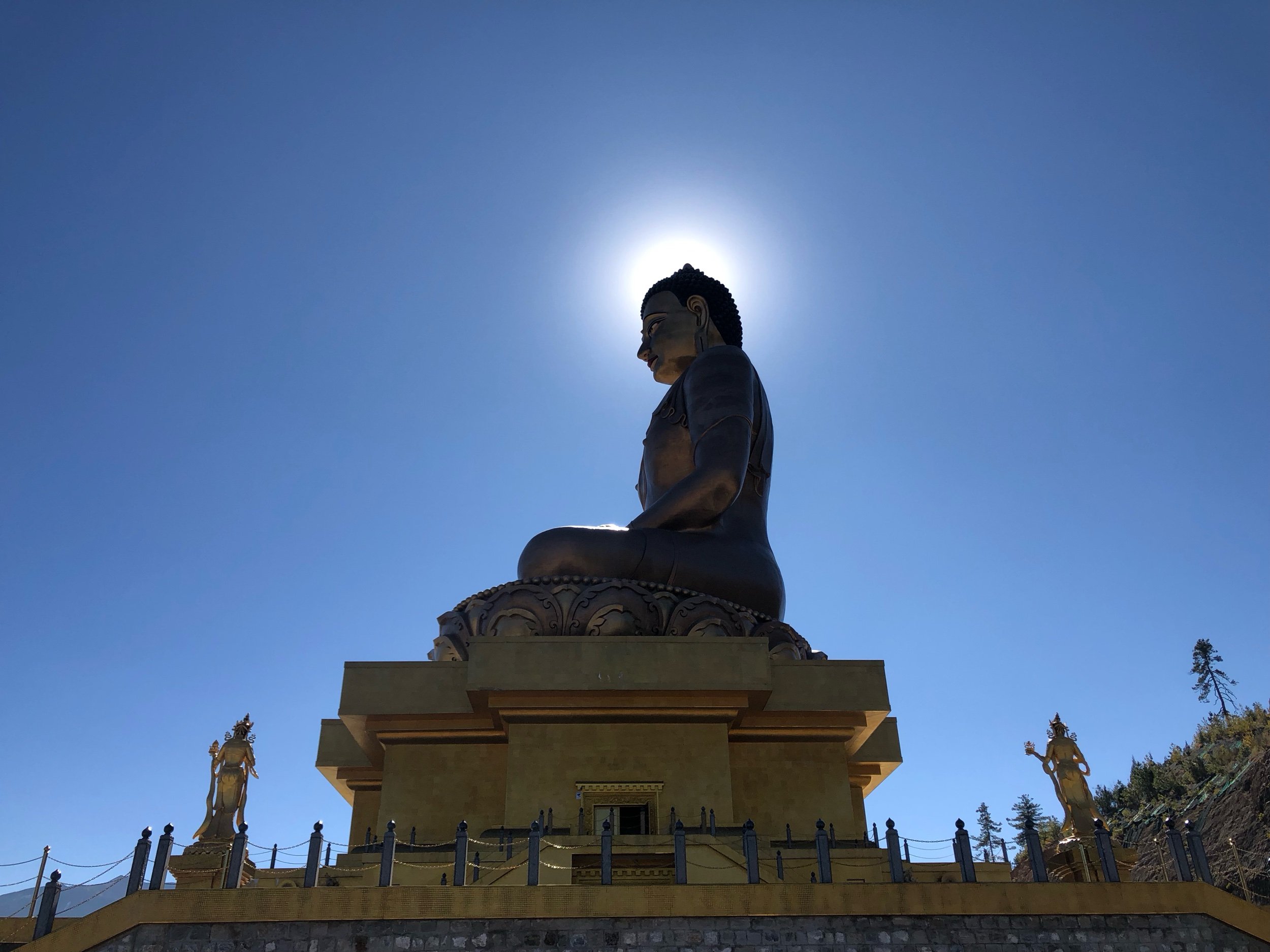
Path of Self-Enlightenment
Speak ill of no one, hurt no one, steadfastly follow the path which leads to self-liberation, be moderate in the enjoyment of life, from time to time seek solitude, but always keep your mind firmly established on the highest Self: These are the conditions of the path of self-enlightenment.
“Spiritually man is not segregated from his fellow beings, human or otherwise. The self of man is universally one and identical in perfection with every being and object. At one pole man is one with the grain of sand and the blade of grass, and at the other he is the transcendental and absolute God. When a man lives and acts in accordance with this divine nature of his true Self, he practices noninjury.”
—Swami Premananda, Introduction to The Path of the Eternal Law, Dhammapada
“Speak ill of no one, hurt no one, steadfastly follow the path which leads to self-liberation, be moderate in the enjoyment of life, from time to time seek solitude, but always keep your mind firmly established on the highest Self: These are the conditions of the path of self-enlightenment.”
—The Dhammapada, translated by Swami Premananda